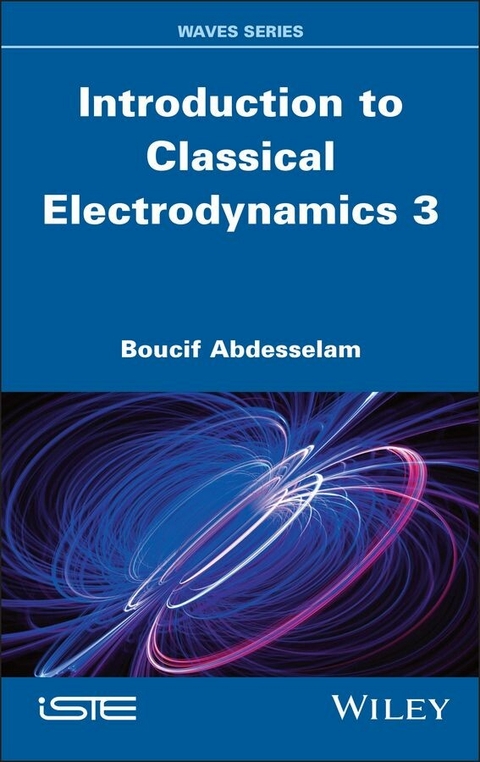
Introduction to Classical Electrodynamics 3 (eBook)
471 Seiten
Wiley-Iste (Verlag)
978-1-394-42769-7 (ISBN)
Introduction to Classical Electrodynamics 3 presents the applications of electromagnetic theory in modern physics.
This book covers waveguides, resonant cavities and transmission lines. It also analyzes electromagnetic radiation from localized and extended oscillating sources, as well as radiation from (non-)relativistic point charges. The book examines particles in circular motion, Thomson scattering, Cherenkov radiation, and Kirchhoff scattering, and presents in detail the problems of diffraction by circular apertures and conducting spheres. Finally, it deals with the principles of special relativity, the covariant formulation of electromagnetism, as well as the concepts of electromagnetic mass, radiation reaction force and the Abraham-Lorentz model.
This book is intended for physics and mathematics students, as well as engineering students interested in the challenges of electromagnetic theory. The discussion is supplemented with numerous applications derived from the theoretical concepts presented.
Boucif Abdesselam is a professor in the Physics Department of the Faculty of Science and Technology at the Université Ain Temouchent Belhadj Bouchai, Algeria. He is also a member of the Theoretical Physics Laboratory at the University of Oran 1, Algeria.
Preface
There is no place in this new kind of physics both for the field and matter, for the field is the only reality.
Albert Einstein
An electric charge is an abstract concept, comparable to the concept of mass, introduced to explain certain behaviors in physics. However, unlike mass, an electric charge can take two experimental forms that are arbitrarily called positive and negative. Two charges of the same nature, both positive or both negative, for instance, repel each other, while two opposite charges attract each other. This phenomenon is called electrostatic interaction.
The history of electric charges goes back to the ancient Greeks who observed that rubbing certain objects against fur produced an imbalance in the total electric charge. These “electrified” objects would also attract other light objects, like hair. What is more, if the objects are rubbed against each other for long enough, it is even possible to create a spark.
Electric charges can be experimentally measured. Particles observed in nature have charges that are integer multiples of an elementary charge, which is a fundamental physical constant. An elementary charge is the electric charge on a proton or, equivalently, the opposite of the electric charge on an electron. It is expressed in Coulombs (C), or in A × s in the international system of units. The value of an electric charge, considered to be invisible, and its discrete nature were first discovered in 1909 by Robert Andrews Millikan.
The elementary charge, denoted by e, has an approximate value e = 1.602176634 × 10⁻¹⁹C. The exact value of the elementary charge is currently defined by: , where h is Planck’s constant, with h = 6.626070040 × 10⁻³⁴Js; α is the fine structure constant, with α = 7.2973525664 × 10⁻³; μ0 is the vacuum magnetic permeability, with μ0 = 4π × 10−7Hm−1; and c is the speed of light in a vacuum, with c = 299, 792, 458 m/s. The existence of quarks was postulated in the beginning of 1960 and they are believed to possess a fractional electric charge or , but they are confined within hadrons, whose charge and may be zero, and may be equal to the elementary charge, or may be an integer multiple of the elementary charge. Quarks have not yet been separately detected, but they are assumed to have existed in a free state in the very first instants of the Universe (the quark epoch). Charge is an invariant in the theory of special relativity. A particle of charge q, whatever its velocity, will always retain the same charge q.
There are two branches of study:
- Electrostatics is the branch of physics that studies the phenomena created by static electric charges for the observer. In physics, an electrically charged particle creates a vector field that is called an electric field. In the presence of a charged particle, the local properties of a space are therefore modified. This is therefore an accurate translation of the concept of a field. If there is another charge in this same field, it will be subject to the action of the electric force (one of the four forces of nature) exerted at a distance by the particle: the electric field is in a way the mediator of this distant action. If there is a movement of electric charges, generally electrons, within a conductive material under the effect of a potential difference at the ends of the material, an electric current is produced. The concept of electric current was first introduced by Benjamin Franklin. He was the first to imagine electricity as a type of invisible fluid present in all matter. He postulated that friction of an insulating surface causes the fluid to move and that a flow of this fluid constitutes an electric current. A material is made up of a large number of electric charges, but these charges balance out among themselves, that is, there is the same number of electrons (negative) as protons (positive). At normal temperatures, the material is electrically neutral. When a static electricity effect is produced, this means that there has been a displacement of charges from material A to material B. This is the electrification phenomenon. Excess or missing charges, that is, uncompensated charges, are responsible for electrical effects on a body (the example of the rubbed stick). There are two kinds of materials:
- A material is said to be a perfect conductor if, when electrified, the uncompensated charges move freely through the material.
- If the uncompensated charges do not move freely and remain fixed in the place where they were deposited, we say that it is a perfect insulator (or dielectric).
In reality, a real material is obviously lies between these two limit states:
- Magnetism represents all physical phenomena in which objects exert attractive or repulsive forces on other materials. The electric currents and magnetic moments of the fundamental elementary particles are at the origin of the magnetic field generated by these forces. The magnetic field is therefore a vector quantity (characterized by an intensity and a direction) defined for each point in space. It is determined by the position and orientation of magnets, electromagnets and the displacement of electric charges. The presence of this field is seen in the existence of a force acting upon the moving electric charges (called the Lorentz force), and various effects that affect certain materials (paramagnetism, diamagnetism, or ferromagnetism, depending on the case). Magnetic susceptibility is the quantity that determines how much a magnetic field interacts with a material.
Electricity and magnetism are intimately related. In 1820, Ørsted discovered the relationship between electricity and magnetism: a wire carrying an electric current is capable of deflecting the magnetized needle of a compass. Subsequently, Ampère, based on Ørsted’s work, discovered and formulated a number of laws governing the relationship between magnetism and electrodynamics. In 1831, Faraday discovered that if an electric current produces a magnetic field, the reverse is also true. An electric current can be produced by setting a magnetic field in motion, according to Lenz’s law.
This marked the birth of electromagnetism. It is therefore the field of physics that studies the interactions between electrically charged particles, whether at rest or in motion, using the concept of the electromagnetic field. Electromagnetism can be defined as the branch that studies the electromagnetic field and its interactions with charged particles. The electric field and the magnetic field are the two components of the electromagnetic field described by electromagnetism. The equations that describe the evolution of the electromagnetic field are called Maxwell equations. Electric and magnetic fields waves can propagate freely in space and in most materials. These are called electromagnetic waves and correspond to all manifestations of light across wavelengths (radio waves, microwaves, infrared, visible domain, ultraviolet rays, X-rays and gamma rays). Maxwell wrote: The agreement of the results seems to show that light and magnetism are affections of the same substance, and that light is an electromagnetic disturbance propagated through the field according to electromagnetic laws. From this point of view, optics can be seen as an application of electromagnetism. The electromagnetic interaction is also one of the four fundamental interactions. Together with quantum mechanics, it enables us to understand the existence, cohesion and stability of atoms and molecules.
From the point of view of fundamental physics, the theoretical development of classical electromagnetism led to the theory of special relativity at the beginning of the 20th century. The need to reconcile electromagnetic theory and quantum mechanics led to the construction of quantum electrodynamics, in which electromagnetic interaction is interpreted as an exchange of particles called photons. In particle physics, electromagnetic interaction and weak interaction are unified within the electroweak theory.
Note to readers
Electromagnetic field theory is often poorly or insufficiently taught in university physics programs. The heavy dependence on mathematics, especially vector calculus, integral calculus, complex functions and special functions, etc., add to the difficulty in teaching this subject and may obscure certain phenomena such that students get mired in mathematical difficulties and lose sight of practical applications and vice versa. This modest contribution aims to lay out the essential ideas of the theory in the most logical order. Special importance is given to the mathematical developments of this theory. The experimental side of the theory is only lightly approached. We will not insist on units of measurement. These three volumes will contain many examples (the most classic). I have tried to give as much detail as possible in the calculations. Across the three volumes, the discussion is essentially divided into three main topics: (1) charges and/or dipoles, as the source of the electrostatic field; (2) currents and/or magnetization as sources of the magnetic field; (3) electrodynamics, where the electric field and magnetic field are of equal importance. This book...
| Erscheint lt. Verlag | 11.12.2025 |
|---|---|
| Reihe/Serie | ISTE Invoiced |
| Sprache | englisch |
| Themenwelt | Naturwissenschaften ► Physik / Astronomie |
| Technik ► Elektrotechnik / Energietechnik | |
| Schlagworte | Abraham-Lorentz model • Cherenkov radiation • circular apertures • Classical electrodynamics • conducting spheres • diffraction • Electromagnetic mass • Electromagnetic radiation • Electromagnetic theory • Kirchhoff scattering • Physics • radiation reaction force • Resonant Cavities • Special relativity • Thomson Scattering • Transmission Lines • Waveguides |
| ISBN-10 | 1-394-42769-7 / 1394427697 |
| ISBN-13 | 978-1-394-42769-7 / 9781394427697 |
| Informationen gemäß Produktsicherheitsverordnung (GPSR) | |
| Haben Sie eine Frage zum Produkt? |
 EPUB (Adobe DRM)
Kopierschutz: Adobe-DRM
Adobe-DRM ist ein Kopierschutz, der das eBook vor Mißbrauch schützen soll. Dabei wird das eBook bereits beim Download auf Ihre persönliche Adobe-ID autorisiert. Lesen können Sie das eBook dann nur auf den Geräten, welche ebenfalls auf Ihre Adobe-ID registriert sind.
Details zum Adobe-DRM
Dateiformat: EPUB (Electronic Publication)
EPUB ist ein offener Standard für eBooks und eignet sich besonders zur Darstellung von Belletristik und Sachbüchern. Der Fließtext wird dynamisch an die Display- und Schriftgröße angepasst. Auch für mobile Lesegeräte ist EPUB daher gut geeignet.
Systemvoraussetzungen:
PC/Mac: Mit einem PC oder Mac können Sie dieses eBook lesen. Sie benötigen eine
eReader: Dieses eBook kann mit (fast) allen eBook-Readern gelesen werden. Mit dem amazon-Kindle ist es aber nicht kompatibel.
Smartphone/Tablet: Egal ob Apple oder Android, dieses eBook können Sie lesen. Sie benötigen eine
Geräteliste und zusätzliche Hinweise
Buying eBooks from abroad
For tax law reasons we can sell eBooks just within Germany and Switzerland. Regrettably we cannot fulfill eBook-orders from other countries.
aus dem Bereich