The Potential of Agroecosystems to Reduce Climate Change
Routledge (Verlag)
978-1-041-03671-5 (ISBN)
- Noch nicht erschienen (ca. Juni 2026)
- Versandkostenfrei
- Auch auf Rechnung
- Artikel merken
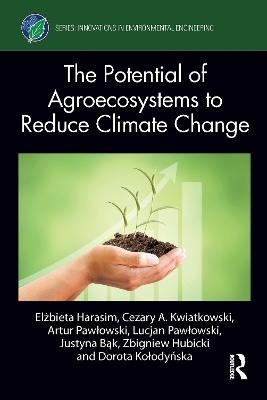
As agricultural systems bear the brunt of global population growth, the world faces an unprecedented challenge: meeting rising food demands while mitigating environmental degradation and climate change. The agricultural intensification methods pioneered since the 1960s have exacted a significant environmental toll in the form of diminishing biodiversity, reducing carbon storage capacity, depleting water resources, degrading soil quality, and increasing greenhouse gas emissions.
This comprehensive monograph presents innovative solutions for transforming agroecosystems from environmental liabilities into powerful climate mitigation tools. The authors examine cutting-edge agrotechnical treatments, environmental engineering technologies, and circular economy principles that enable agricultural waste to serve as effective soil improvers and fertilizers. Particular emphasis is placed on the physicochemical properties of biochar and its critical role in carbon sequestration, offering readers both theoretical foundations and practical applications.
This is a valuable resource for agricultural scientists, environmental engineers, sustainability professionals, policymakers, graduate students in environmental sciences, and anyone committed to understanding and addressing the intersection of food security and climate change.
Elżbieta Harasim, PhD., Sc. D, is a researcher and lecturer at the Department of Herbology and Plant Cultivation Techniques, University of Life Sciences, Lublin, Poland. Her research interests include improving agrotechnics of cereal, herbal and vegetable plants, the impact of the cultivation system (ecological and conventional) on biodiversity, quality of soil and agricultural crops, the effect of bio-stimulants and foliar fertilizers on crop yield and its quality, the use of alternative sources of fertilization (biochar, zeolite, digestate, fertilizer whey, mushroom substrate) in plant cultivation, methods of weed control, profitability and economic efficiency in plant production, as well as the role of agriculture in mitigating climate change and multifunctionality of rural areas. Cezary A. Kwiatkowski, Ph.D., Sc. D, is a researcher and lecturer at the Faculty of Agrobioengineering, University of Life Sciences, Lublin, Poland. His research interests include optimization of agronomic practices, agricultural systems, improving agrotechnics of herbal plants and vegetables, the effect of biostimulators and other foliar sprays on crop yield and quality, evaluation of the suitability of spent mushroom substrate (SMS) for crop fertilization, aspects of organic farming in agroecosystems, agrotechnical factors influencing soil quality, the role of agriculture in climate change mitigation and multifunctionality of rural areas. Artur Pawłowski, Ph.D., Sc. D., is a researcher and lecturer at the Faculty of Environmental Engineering, Lublin University of Technology, Poland. His research interests include multidimensional nature of sustainable development, factors connected with climate change and energy sector, especially in the context of renewable sources of energy. Lucjan Pawłowski, Ph.D., Sc. D., is a professor at the Lublin University of Technology, Faculty of Environmental Engineering, Poland. His research interests include climate change, mitigation of carbon dioxide by terrestrial ecosystem, energy, environmental engineering and application of ion exchange for water and wastewater treatment. Justyna Bąk, Ph.D., Sc. D., is a researcher at the Department of Inorganic Chemistry, Faculty of Chemistry, Maria Curie-Skłodowska University, Lublin, Poland. His research interests include adsorption processes of inorganic pollutants on carbon and biochar materials and modifications of these materials. Zbigniew Hubicki, Ph.D., Sc. D., is a professor at the Faculty of Mathematics, Physics and Chemistry, University of Maria Curie-Skłodowska, Lublin, Poland. His research interests include chemistry and technology of rare elements, sorption and extraction methods for separation and separation of metal ions and organic compounds, waste and wastewater treatment technologies and agricultural and environmental chemistry. Dorota Kołodyńska, Ph.D., Sc. D., is a professor at the Faculty of Chemistry of the Marie Curie- Skłodowska University, Lublin, Poland. His research interests include ion exchange chromatography of d- and f-electron elements, methods for separation of inorganic compounds, removal of metal ions from waters and wastewaters, extraction of rare earth elements with special emphasis on biodegradable complexing agents and modified biochar and hybrid sorbents.
1. Introduction: The Role of Agroecosystems in the Environment and Economy 2. Agroecosystems, Climate Change, and Environmental Engineering 3. Application of Waste and By-Products for Carbon Sequestration in Soil 4. Biochar as a Promising Material for Improving Soil Fertility and Climate Change Mitigation 5. The Impact of Crop Production on Boosting CO2 Sequestration with Particular Emphasis on Catch Crop Cultivation 6. Role of cereals in carbon dioxide sequestration – A Polish example 7. Final Conclusions
| Erscheint lt. Verlag | 12.6.2026 |
|---|---|
| Reihe/Serie | Innovations in Environmental Engineering |
| Zusatzinfo | 23 Tables, black and white; 6 Line drawings, black and white; 2 Halftones, black and white; 8 Illustrations, black and white |
| Verlagsort | London |
| Sprache | englisch |
| Maße | 174 x 246 mm |
| Gewicht | 453 g |
| Themenwelt | Technik ► Umwelttechnik / Biotechnologie |
| Weitere Fachgebiete ► Land- / Forstwirtschaft / Fischerei | |
| ISBN-10 | 1-041-03671-X / 104103671X |
| ISBN-13 | 978-1-041-03671-5 / 9781041036715 |
| Zustand | Neuware |
| Informationen gemäß Produktsicherheitsverordnung (GPSR) | |
| Haben Sie eine Frage zum Produkt? |
aus dem Bereich