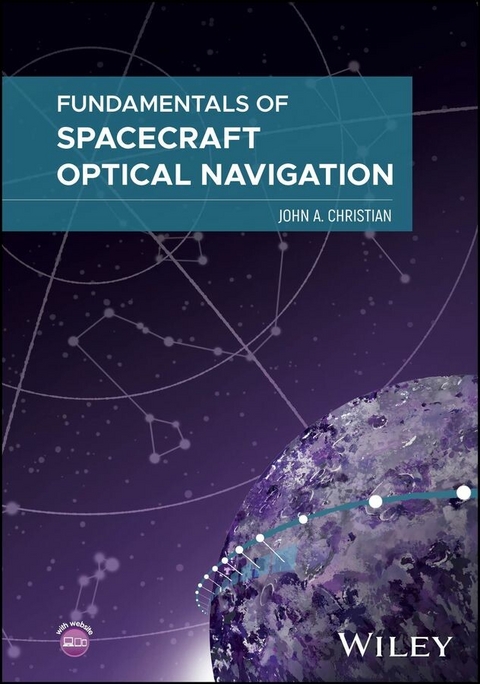
Fundamentals of Spacecraft Optical Navigation (eBook)
1191 Seiten
Wiley (Verlag)
978-1-394-26773-6 (ISBN)
An authoritative and comprehensive foundation for professionals, educators, and students working in optical navigation
In Fundamentals of Spacecraft Optical Navigation, aerospace engineer John Christian delivers a rigorous and up-to-date discussion of optical navigation-the art of navigating spacecraft with camera images. The author combines the rich history of the fields of aerospace engineering, geometry, astronomy, planetary science, and computer vision with a robust treatment of the mathematics needed to solve contemporary problems.
Organized into ten chapters, the book provides the first comprehensive treatment of optical navigation. Readers will find:
- A detailed account of the history of optical navigation, with plentiful excerpts and figures from original sources
- A rigorous introduction to the mathematics of projective geometry
- Thorough introductions to spacecraft dynamics, kinematics, and reference frames
- Comprehensive explorations of star catalogs, astrometry, and planetary photometry
- Overview of optical instrument hardware design
- Practical discussion of celestial navigation and terrain relative navigation (TRN)
Perfect for graduate students interested in spacecraft guidance, navigation, and control, Fundamentals of Spacecraft Optical Navigation will also benefit aerospace faculty and aerospace professionals with a responsibility for designing, reviewing, operating, or working with optical navigation systems.
John A. Christian, PhD, is an Associate Professor in the Guggenheim School of Aerospace Engineering at the Georgia Institute of Technology. He directs the Space Exploration and Analysis Laboratory (SEAL). Dr. Christian develops algorithms for extracting information from space sensor data.
Chapter 1
Introduction
There is nothing new in the world except the history you do not know.
—Harry S. Truman, 33rd President of the United States of America
Navigation is a critical function for any practical spacecraft. The term navigation has taken on a variety of different meanings in popular culture, casual conversation, and nontechnical writing. To the spacecraft engineer, however, the task of navigation is to infer the dynamical state (e.g., position, velocity, attitude, attitude rate) of a vehicle using observations of the surrounding environment, natural phenomena, or human-made signals/beacons. Inferring the dynamical state often involves simultaneously estimating other parameters about the environment (e.g., gravity, terrain models, atmospheric density) or the vehicle itself (e.g., sensor calibration/bias parameters). Navigation information comes from navigation sensors (e.g., cameras, radio transceivers, altimeters, and inertial measurement units), which do not generally produce direct observations of the state itself—but instead produce an output related to the state. We call these sensor outputs navigation observables. Since individual navigation observables do not (usually) provide full insight into the vehicle’s dynamical state at any instant in time, we must combine sensor data to estimate the desired states. It is important that this combination (sometimes called sensor fusion) be performed in a statistically optimal way—something we usually achieve with a navigation filter (e.g., Kalman filter) [131].
There are many different ways to navigate a spacecraft, and this book is about one of them: optical navigation (OpNav). In this work, we define OpNav as the art of spacecraft navigation with optical observations. These optical observations are usually collected in the visual or infrared wavelengths. Although early OpNav systems relied on manual observations of objects by an astronaut, essentially all OpNav observables since the mid-1970s have been extracted from digital images collected by cameras (or telescopes) onboard the spacecraft. Thus, for all practical purposes, modern OpNav is the art of navigating with images.
Optical observations (e.g., images) of celestial bodies carry different types of navigation information under different viewing geometries. This book discusses all the major classes of OpNav in practical use today (c. 2025), as well as a few emerging OpNav techniques. Stars are among the most distant celestial bodies visible with small onboard cameras. Their great distance means that stars are usually only helpful for determining the orientation of a spacecraft, as the apparent inter-star angles are only weakly dependent on the position of the observer (assuming the observer is confined to our Solar System and its immediate neighborhood). Indeed, perturbations to the apparent inter-star angle are often more dependent on the velocity of the observer due to the relativistic effect of stellar aberration. The various ways in which we may use stars for navigation is the topic of Chapter 8.
Recognizing that stars are very far away, it follows that optical sightings of celestial bodies within our Solar System (e.g., planets, moons, asteroids, and so on) are more appropriate targets for position estimation. When a planet is far away (but not as far as the stars!), its apparent direction defines a line-of-position on which the spacecraft must lie. The absolute orientation of this line in space may be determined by (nearly) concurrent star observations. Multiple such planet sightings produce multiple lines-of-position that intersect at the spacecraft’s location. When closer to the planet, the body’s apparent size provides a coarse estimate of the distance, and a complete position fix may be derived from a single image. This is often achieved with horizon-based OpNav methods. These types of planet-based (or moon-based, asteroid-based) OpNav are the topic of Chapter 9.
As the spacecraft moves even closer to a celestial body, we eventually encounter the situation where the terrain fills the entire image. In this case, we navigate using observations of surface features—a particular type of OpNav referred to as terrain relative navigation (TRN). In some cases these features correspond to a particular type of landform (e.g., craters), while in other cases they are simply “interesting” regions (of varying spatial extent) on the surface. These features may be matched to a map to obtain an absolute estimate of the spacecraft location. Alternatively, when no map is available, we may match features from image to image to understand the terrain-relative motion. TRN is the topic of Chapter 10.
As we will see in Section 1.1, all of the above was plainly obvious before the first spacecraft was ever launched into space. The technologies necessary to make these obvious ideas actionable, however, did not exist until the 1960s for ground-based operation or until the 2000s for onboard operation. Truly, autonomous OpNav was not possible until the early 2020s. We find, therefore, that the “simple” ideas behind OpNav actually require a rather broad foundation to put into practice. The OpNav engineer must understand a diverse range of foundational topics such as applied mathematics (Chapter 2), projective geometry (Chapter 3), time and coordinate frame conventions (Chapter 4), star catalogs (Chapter 5), radiometry (Chapter 6), and camera hardware (Chapter 7). Only then do we have the understanding required to speak meaningfully about the OpNav tasks briefly outlined earlier (and discussed in detail in Chapters 8–10).
1.1 OpNav Pre-history
Navigation is one of the oldest fields of applied science. Early humans who wished to travel great distances were forced to develop navigation techniques, lest they become lost and never reach their destination. Recognizing that the development of superior navigation technologies provided substantial economic, cultural, and military advantages, many early (and modern!) civilizations devoted considerable resources to navigation research. Indeed, as we will discover throughout this book, some of the most foundational discoveries in the fields of astronomy and mathematics (from classical antiquity to the modern era) were uncovered in the pursuit of navigation.
1.1.1 Maritime Celestial Navigation
Especially challenging—and especially relevant as a precursor to space navigation—is the navigation of ships on the open sea. Without fixed landmarks, it was easy for early voyagers to lose their way. Rather than being a historical curiosity, the study of classical maritime celestial navigation is essential for the modern OpNav engineer. Indeed, it is not much of a stretch to say that spacecraft OpNav is a direct descendant of the celestial navigation techniques pioneered by mariners and terrestrial explorers. The paragraphs that follow provide a high-level overview of this subject, along with many references to later parts of this book. The reader may find it useful to read this section more than once—first for context and then again after mastering the concepts from later chapters.
The Polynesians were among the earliest civilizations to develop a practical means of long-distance navigation at sea. Early Polynesians colonized islands throughout the South Pacific in multiple waves.1 The islands of West Polynesia (e.g., Tongan, Samoan, and Fijian archipelagos)—all thousands of miles from mainland Asia—are thought to have been settled around 1000 bce [766]. Following a nearly 1,500- to 2,000-year pause, a second large-scale migration into the more distant East Polynesian Islands (e.g., Hawaiian Islands, Society Islands) happened in two distinct waves during the 500–1,000 ce period [766, 813]. Navigation during these voyages relied on observations of stars, birds, clouds, ocean swells/currents, and other natural phenomena. Regarding the specific use of stars, one of the most detailed surviving accounts is from the journal of Captain José de Andı́a y Varela, written during the Spanish conquest of Tahiti (1774–1775):
There are many sailing masters among the people, the term for whom is in their language fatere. […] They have no mariner’s compass, but divide the horizon into sixteen parts, taking for the cardinal points those at which the sun rises and sets. […] When the night is a clear one they steer by the stars; and this is the easiest navigation for them because, these being many [in number], not only do they note by them the bearings on which the several islands with which they are in touch lie, but also the harbours in them, so that they make straight for the entrance by following the rhumb of the particular star that rises or sets over it. […] They distinguish the planets from the fixed stars, by their movements; and give them separate names. To the stars they make use of in going from one island to another they attach the name of the island, so that the one which serves for sailing from Otahiti to Oriayatea has those same names, and the same occurs with those that serve them for making the harbours in those islands. [306, p. 284–287]
Unfortunately, despite the Polynesians’ navigational successes, many of the details of their methods have been lost (attempts have been made to reconstruct these techniques [259]). Instead, the methods of maritime navigation that motivated early spacecraft OpNav systems were primarily of western...
| Erscheint lt. Verlag | 9.12.2025 |
|---|---|
| Sprache | englisch |
| Themenwelt | Technik ► Maschinenbau |
| Schlagworte | Aerospace Navigation • astrodynamics • Astrometry • attitude determination • computer vision • Image Processing • Optical Navigation • Optics • planetary photometry • space exploration • Space Navigation • star catalogs • star trackers |
| ISBN-10 | 1-394-26773-8 / 1394267738 |
| ISBN-13 | 978-1-394-26773-6 / 9781394267736 |
| Informationen gemäß Produktsicherheitsverordnung (GPSR) | |
| Haben Sie eine Frage zum Produkt? |
 EPUB (Adobe DRM)
Kopierschutz: Adobe-DRM
Adobe-DRM ist ein Kopierschutz, der das eBook vor Mißbrauch schützen soll. Dabei wird das eBook bereits beim Download auf Ihre persönliche Adobe-ID autorisiert. Lesen können Sie das eBook dann nur auf den Geräten, welche ebenfalls auf Ihre Adobe-ID registriert sind.
Details zum Adobe-DRM
Dateiformat: EPUB (Electronic Publication)
EPUB ist ein offener Standard für eBooks und eignet sich besonders zur Darstellung von Belletristik und Sachbüchern. Der Fließtext wird dynamisch an die Display- und Schriftgröße angepasst. Auch für mobile Lesegeräte ist EPUB daher gut geeignet.
Systemvoraussetzungen:
PC/Mac: Mit einem PC oder Mac können Sie dieses eBook lesen. Sie benötigen eine
eReader: Dieses eBook kann mit (fast) allen eBook-Readern gelesen werden. Mit dem amazon-Kindle ist es aber nicht kompatibel.
Smartphone/Tablet: Egal ob Apple oder Android, dieses eBook können Sie lesen. Sie benötigen eine
Geräteliste und zusätzliche Hinweise
Buying eBooks from abroad
For tax law reasons we can sell eBooks just within Germany and Switzerland. Regrettably we cannot fulfill eBook-orders from other countries.
aus dem Bereich