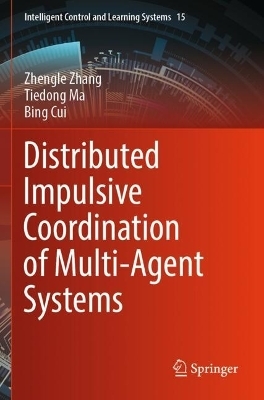
Distributed Impulsive Coordination of Multi-Agent Systems
Springer Verlag, Singapore
978-981-97-6264-4 (ISBN)
- Titel nicht im Sortiment
- Artikel merken
This book investigates the distributed impulsive coordination control of multi-agent systems (MASs), including consensus problem and formation problem. Compared with continuous control, impulsive control as a discontinuous control method only needs information interaction at impulsive instants, which can greatly reduce the transmission cost in the communication process. In practice, MASs are often affected by environmental and hardware conditions, resulting in the application of impulsive control is limited. For example, it is difficult to exert the impulsive control signal accurately at a fixed instant, and it is difficult to control all agents at the same impulsive instant. Moreover, the actual models of MASs often contain some constraints such as unknown parameters, stochastic perturbation, and time delays. In addition, stochastic switching topologies and cyberattacks will limit the communication between agents in MASs, which will greatly affect the coordination control performance. Based on the existing research results, this book considers the above constraints of MASs in practice and studies the key problems of distributed impulsive coordination control for MASs. The book is intended for undergraduate and graduate students who are interested in control system theory, as well as engineers studying MASs.
Dr. Zhengle Zhang received his B.E. degree in Automation from Chongqing University, Chongqing, China, in 2017, and the Ph.D. degree in Control Theory and Control Engineering from Chongqing University, Chongqing, China, in 2023. Since Aug. 2023, he has been in School of Electrical Engineering, Henan University of Technology as a lecturer. He focuses on the research of impulsive control in multi-agent systems. His recent research interests include coordination of multi-agent systems, impulsive control, adaptive control, cyberattacks, etc. Since 2017, he has published 17 papers in international journals and conferences. Dr. Tiedong Ma received his B.E. degree in Electrical Engineering and Automation from Changchun University of Technology, Changchun, China, in 2001, M.E. and Ph.D. degrees in Control Theory and Control Engineering from Northeastern University, Shenyang, China, in 2005 and 2009, respectively. Since Sep. 2011, he has been in School of Automation, Chongqing University, as an associate professor. He focuses on the research of discontinuous control and its applications. His recent research interests include fractional-order system control, impulsive control, intermittent control, coordination control of multi-agent system, cluster control of unmanned system, etc. Since 2007, he has published 91 papers in international journals and conferences. In addition, he has published one monograph ("Impulsive Control Theory", Science Press, 2016) and obtained second prize in Chongqing Natural Science Award (ranked second). Dr. Bing Cui received the Ph.D. degree in Information and Communication Engineering from the Harbin Engineering University, Harbin, China, in 2016. He was a visiting scholar with the Automation and Robotics Research Institute, University of Texas at Arlington, Arlington, TX, USA, from 2013 to 2015, and a visiting researcher with the School of Aerospace, Transport and Manufacturing, Cranfield University, Cranfield, UK, in 2019. From 2017 to 2019, he was a postdoctoral researcher with the School of Automation, Beijing Institute of Technology, Beijing, China, where he has been an associate professor, since 2019. He focuses on the research of distributed control, spacecraft attitude control, and finite-time control, etc. Since 2013, he has published 46 papers in international journals and conferences.
1. Introduction.- 2. Distributed Variable Impulsive Consensus of Multi-Agent Systems.- 3. Distributed Asynchronous Impulsive Consensus of Multi-Agent Systems.- 4. Distributed Impulsive Consensus of Delayed Multi-Agent Systems.- 5. Distributed Discontinuous Adaptive Impulsive Consensus of Uncertain Multi-agent Systems.
The book is structured on 9 chapters . Simulation results as illustrations are also given in all chapters. a book which can be useful to all those working in the field of multi-agent systems a quite important area of research and development. (Vladimir Rasvan, zbMATH 1566.93012, 2025)
| Erscheinungsdatum | 06.12.2025 |
|---|---|
| Reihe/Serie | Intelligent Control and Learning Systems |
| Zusatzinfo | 102 Illustrations, color; 1 Illustrations, black and white |
| Verlagsort | Singapore |
| Sprache | englisch |
| Maße | 155 x 235 mm |
| Themenwelt | Technik ► Elektrotechnik / Energietechnik |
| Schlagworte | Adaptive Control • coordination problem • cyber attacks • Delay Systems • Distributed Control • Formation Problem • Fractional-order systems • Impulsive control • Multi-agent Systems • Nonlinear Systems |
| ISBN-10 | 981-97-6264-2 / 9819762642 |
| ISBN-13 | 978-981-97-6264-4 / 9789819762644 |
| Zustand | Neuware |
| Informationen gemäß Produktsicherheitsverordnung (GPSR) | |
| Haben Sie eine Frage zum Produkt? |
aus dem Bereich