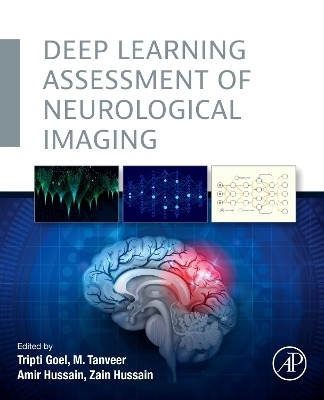
Deep Learning Assessment of Neurological Imaging
Academic Press Inc (Verlag)
978-0-443-30291-6 (ISBN)
- Noch nicht erschienen (ca. Juni 2026)
- Versandkostenfrei
- Auch auf Rechnung
- Artikel merken
Tripti Goel is an accomplished professional with a strong academic background and a diverse research portfolio. She earned her Bachelor of Engineering (Hons) from Maharishi Dayanand University in 2004, followed by an MTech in 2008 from Chhotu Ram State College of Engineering and a Ph.D. in 2017 from BPS Mahila Vishwavidyalaya, both in Haryana. Her career journey includes roles as a lecturer at Bhagwan Mahaveer Institute of Engineering and Technology and Guru Premsukh Memorial College of Engineering in Haryana. Later, she joined NIT Delhi as an Assistant Professor in July 2015 before becoming a Scientist at the National Brain Research Center, Gurugram, in February 2018. Subsequently, she joined NIT Silchar as an Assistant Professor in June 2018. Dr. Goel's research contributions span deep learning, artificial intelligence, medical imaging, pattern recognition, optimization, and feature extraction. Over the last decade, she has authored 26 conference proceedings, 42 journal publications, 2 patents, and 6 book chapters. Her notable work involves biomarker identification for Alzheimer's diagnosis using MRI and fMRI images. Currently, as the Principal Investigator of a project funded by the Government of India Science & Engineering Research Board (SERB)- Core Research Grant, she is focused on predicting biomarkers for Alzheimer's diagnosis using MRI, susceptibility-weighted imaging (SWI), and FDG-PET images. Dr. Goel's multidisciplinary expertise showcases her significant contributions to the fields of medical imaging and neuroscientific research. M. Tanveer is an accomplished Associate Professor and Ramanujan Fellow at the Discipline of Mathematics at the Indian Institute of Technology Indore. He earned his Ph.D. in Computer Science from Jawaharlal Nehru University, New Delhi, and his M.Phil degree in Mathematics from Aligarh Muslim University. Before joining IIT Indore, he served as a Postdoctoral Research Fellow at the Rolls-Royce@NTU Corporate Lab, Singapore, and as an Assistant Professor at the LNM Institute of Information Technology, Jaipur. His extensive research focuses on support vector machines, optimization, machine learning, and deep learning, with applications in Alzheimer's disease and dementias. Tanveer has an impressive publication record, with over 100 referred journal papers and more than 3950 citations, earning him a high h-index of 33 (Google Scholar, June 2023). Stanford University recognized him as one of the world's top 2% scientists. Tanveer has received numerous accolades, including the 2023 IIT Indore Best Research Paper Award and the 2022 Asia Pacific Neural Network Society Young Researcher Award. He holds editorial roles in several prestigious journals and serves on review boards for over 100 scientific journals. Additionally, he has organized and chaired numerous international conferences, including serving as the General Chair for the 29th International Conference on Neural Information Processing (ICONIP2022). Currently, he leads 12 major research projects funded by the Government of India from various esteemed organizations, showcasing his significant contributions to the field of computational intelligence and mathematics. Amir Hussain is a highly accomplished academic and researcher with a distinguished career in artificial intelligence (AI) and data science. He earned his B.Eng and Ph.D. degrees from the University of Strathclyde, Glasgow, U.K., in 1992 and 1997, respectively. His academic journey includes positions at various prestigious institutions, culminating in his role as a Professor at Edinburgh Napier University (ENU) since 2018. At ENU, he serves as the founding Director of the Centre for AI and Robotics (CAIR) and leads the Data Science and Cyber Analytics (DSCA) Research Group, managing over 20 academics and research staff. Additionally, he is the founding Head of the Cognitive Big Data Analytics (CogBiD) Research Lab and co-Lead of the Centre for Cardio-Vascular Health. Amir Hussain is actively engaged in leadership roles, serving as the Chair of the IEEE UK and Ireland Industry Applications Society Chapter. His advisory roles extend to national and global industries, as well as international government organizations. Notably, he played a crucial role as an international advisor for the Kuwait Government’s Institute for Scientific Research, contributing to the development of the country's National AI Strategy and the National AI Centre of Excellence. With a prolific publication record, Hussain has authored three international patents, over 500 publications, including international journal papers, books, monographs, and book chapters. His innovative work on functionally expanded neural networks (FENN methodology) resulted in a key patent acquisition by a U.S. company. As a Principal Investigator, he has led major cross-disciplinary research projects with grants totaling over GBP 5 Million. Hussain has supervised over 35 Ph.D. students, including notable graduates such as Prof Erik Cambria and Dr Soujanya Poria, both recognized for their contributions to AI research. His impactful research, leadership, and advisory roles underscore Amir Hussain's significant contributions to the fields of AI and data science. Dr. Hussain is a medical professional with a diverse academic and research background. He earned his BSc (Hons) in Medicine from the University of St Andrews, UK, and MBChB Medicine from the University of Edinburgh in 2017 and 2020, respectively. Currently serving as an Academic Core Psychiatry Trainee at Inverclyde Royal Hospital, he is also an Honorary Clinical Lecturer at the University of Glasgow and an Executive Committee Member of the Royal College of Psychiatrists Digital Psychiatry Special Interest Group. Dr. Hussain actively contributes to medical education as an Associate Faculty Member of the Clinical Educator Programme and undertakes teaching and research activities at Edinburgh Medical School. His involvement includes roles as an SSC1 Tutor, Early Year Guide, and founding Co-ordinator of the FY Clinical Skills Tutor Scheme. Additionally, he participates in medical education research projects and sits on the steering group of the Undergraduate Certificate in Medical Education. Recognized for his academic achievements, Dr. Hussain was a 2020-22 Foundation Fellow at the Royal College of Psychiatrists, receiving CPD funding. He has held appointments as a Visiting Researcher at institutions such as Boston University School of Public Health, Nanyang Technological University, and the University of Oxford. Dr. Hussain's research interests center around leveraging artificial intelligence and data science in various healthcare applications, including primary care, public health, neuroscience, psychiatry, ophthalmology, and medical education. He has presented his work at national and international conferences and published in leading academic journals. His commitment extends to leadership roles as the founding President of the Edinburgh Coexistence Initiative, a Board Member for the Edinburgh Interfaith Association, and the Student Activities Liaison Officer for the IEEE UK and Ireland Industry Applications Chapter.
1. Graph convolutional networks for diagnosis of Alzheimer’s disease: A review
2. Introduction to Deep Learning Algorithms
3. Application of Deep Learning for Brain Tumors.
4. Application of Deep Learning for Parkinson’s Disease.
5. Predicting Biological Age of the Brain using Magnetic Resonance Imaging and Deep Learning Methods
6. Artificial Intelligence in Schizophrenia Detection: A Comparative Review of Machine Learning and Deep Learning Approaches
7. Ensemble of deep learning Algorithms for neurological disorders
8. A Framework for Characterizing Brain Iron Concentration in Neurodegenerative disease using Quantitative Susceptibility Mapping
9. Application of Deep Learning for Brain Stroke Diagnosis
10. Advanced Entropy Feature Engineering Using EMD and VMD for Schizophrenia Classification
11. Issues and Challenges of Neurological Disorders Diagnosis Research
12. Opportunities and Future Directions of Neurological Disorders Diagnosis Research
13. Neurology beyond Deep Learning
| Erscheint lt. Verlag | 1.6.2026 |
|---|---|
| Verlagsort | San Diego |
| Sprache | englisch |
| Maße | 191 x 235 mm |
| Themenwelt | Informatik ► Theorie / Studium ► Künstliche Intelligenz / Robotik |
| Medizin / Pharmazie ► Physiotherapie / Ergotherapie ► Orthopädie | |
| Technik ► Medizintechnik | |
| ISBN-10 | 0-443-30291-X / 044330291X |
| ISBN-13 | 978-0-443-30291-6 / 9780443302916 |
| Zustand | Neuware |
| Informationen gemäß Produktsicherheitsverordnung (GPSR) | |
| Haben Sie eine Frage zum Produkt? |
aus dem Bereich