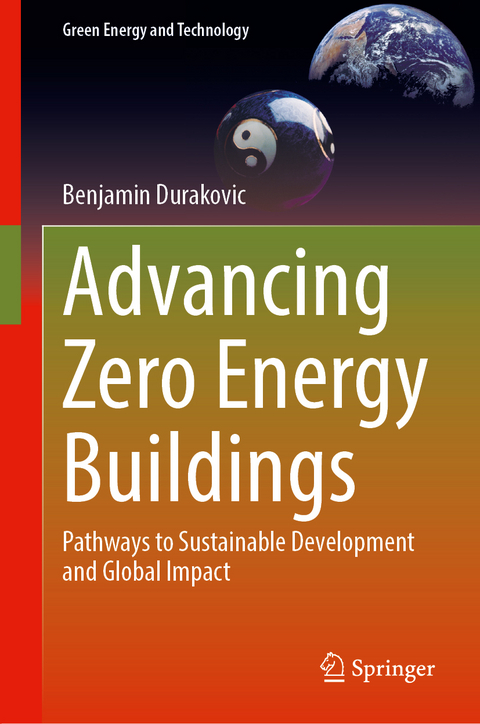
Advancing Zero Energy Buildings
Springer International Publishing (Verlag)
978-3-032-16600-5 (ISBN)
- Noch nicht erschienen - erscheint am 02.03.2026
- Versandkostenfrei
- Auch auf Rechnung
- Artikel merken
This book provides a comprehensive exploration of the advancement of Zero Energy Buildings (ZEBs) as a key strategy for achieving sustainable development and global energy goals. It delivers actionable insights into performance metrics, smart management systems, policy frameworks, and global innovations that drive the transition to renewable energy.
This book highlights the growing need for energy-efficient buildings and net-zero strategies, In light of current environmental challenges. ZEBs have become essential tools for reducing operational energy use while enhancing occupant comfort and overall building performance. This book begins by examining the strategic role of ZEBs in supporting the UN Sustainable Development Goals and national climate commitments. It then explores the evolution of energy codes and standards, offering a comparative perspective across regions and jurisdictions.
Readers are introduced to advancements in energy-efficient building strategies, including passive design, smart materials, and renewable integration. A key focus is the integration of Building Management Systems (BMS), which serve as critical enablers for ZEBs by providing real-time monitoring, adaptive control, and enhanced energy optimization. These systems enable performance transparency, predictive maintenance, and user-centered design.
Additionally, this book presents case studies of ZEB projects from around the world, showcasing technical achievements and the significance of supportive governance and financing models. Importantly, the discussion extends beyond individual buildings to Zero Energy Communities (ZECs), recognizing the potential for integrated systems across neighborhoods and urban developments. This broader perspective aligns ZEB efforts with district energy planning, smart grid deployment, and community engagement, positioning ZEBs within a larger ecosystem of sustainable urban infrastructure.
Concluding with a forward-looking perspective, the book identifies emerging trends and challenges in the global ZEB movement, including digitalization, life-cycle assessment, and resilience to climate extremes.
Dr. Benjamin Durakovic is an associate professor at the International University of Sarajevo, in Bosnia, specializing in sustainable building technologies, with a particular focus on energy efficiency in buildings. He has authored/edited number of academic books, book chapters, and published a substantial number of research articles and reviews in leading journals specializing in energy efficiency and sustainable building technologies. His research has been featured in high-impact journals addressing topics like thermal energy storage, PCM-enhanced envelope systems, and low-energy building strategies. He is the author of a monograph titled PCM-Based Building Envelope Systems: Innovative Energy Solutions for Passive Design, and among the others, a contributing author to several volumes on building energy demand management, where he among the others examined strategies for reducing peak demand and enhancing building energy responsiveness.
Importance of zero energy buildings in sustainable development.- Building codes and energy standards: Pathways toward zero energy buildings.- Advances in energy-efficient building strategies.- Building management systems.- Evolving zero energy building practices and their role in global sustainability.- Lesson learned from ZEB projects worldwide.- From zero-energy buildings to zero energy communities.- Shaping the future of zero energy buildings.
| Erscheint lt. Verlag | 2.3.2026 |
|---|---|
| Reihe/Serie | Green Energy and Technology |
| Zusatzinfo | IV, 180 p. 12 illus., 11 illus. in color. |
| Verlagsort | Cham |
| Sprache | englisch |
| Maße | 155 x 235 mm |
| Themenwelt | Technik ► Architektur |
| Schlagworte | Building management system • Energy-efficient Building Technologies • renewable energy • Sustainable construction practices • zero Energy Buildings |
| ISBN-10 | 3-032-16600-4 / 3032166004 |
| ISBN-13 | 978-3-032-16600-5 / 9783032166005 |
| Zustand | Neuware |
| Informationen gemäß Produktsicherheitsverordnung (GPSR) | |
| Haben Sie eine Frage zum Produkt? |
aus dem Bereich