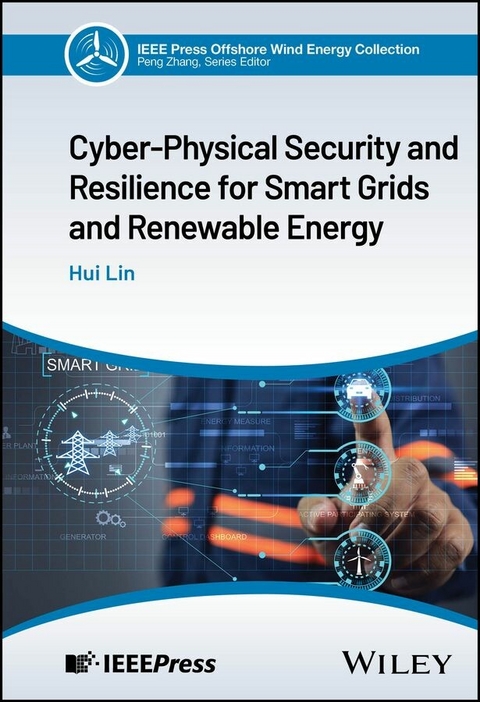
Cyber-Physical Security and Resilience for Smart Grids and Renewable Energy (eBook)
228 Seiten
Wiley-IEEE Press (Verlag)
978-1-394-29836-5 (ISBN)
Guidance for security-oriented management of operational technology and insights on new cyber-physical security solutions for smart grids and renewable energy
Cyber-Physical Security and Resilience for Smart Grids and Renewable Energy describes state-of-the-art technologies of cyber security approaches to increase the resilience of cyber-physical infrastructures used by power grids. It begins by presenting fundamental knowledge of cyber security, computer networks, and current physical processes of power systems with the integration of distributed energy resources. By studying the forensic analysis of representative security incidents in power grids, the author explains the fundamental construction and emerging challenges unique to today's power grids.
Cyber-Physical Security and Resilience for Smart Grids and Renewable Energy
includes information on:
- Security methods retrofitted according to domain-specific knowledge of power systems and distributed energy resources
- Possible solutions from the perspectives of systems specification, system modeling, network programming, and formal verification
- Real attack incidents and outage accidents caused by cyber-physical attacks and disruption against smart grids
Cyber-Physical Security and Resilience for Smart Grids and Renewable Energy is an excellent resource for students and engineers seeking guidance for security-oriented management of operational technology. It also serves as a starting point for academic researchers exploring new cyber-physical security solutions.
Hui Lin, PhD, is an Associate Professor in the Electrical, Computer, and Biomedical Engineering Department at the University of Rhode Island. His research interests include system/network security, intrusion detection, cyber-physical systems, Internet of Things, software-defined networking, and cloud computing.
Guidance for security-oriented management of operational technology and insights on new cyber-physical security solutions for smart grids and renewable energy Cyber-Physical Security and Resilience for Smart Grids and Renewable Energy describes state-of-the-art technologies of cyber security approaches to increase the resilience of cyber-physical infrastructures used by power grids. It begins by presenting fundamental knowledge of cyber security, computer networks, and current physical processes of power systems with the integration of distributed energy resources. By studying the forensic analysis of representative security incidents in power grids, the author explains the fundamental construction and emerging challenges unique to today s power grids. Cyber-Physical Security and Resilience for Smart Grids and Renewable Energy includes information on: Security methods retrofitted according to domain-specific knowledge of power systems and distributed energy resourcesPossible solutions from the perspectives of systems specification, system modeling, network programming, and formal verificationReal attack incidents and outage accidents caused by cyber-physical attacks and disruption against smart grids Cyber-Physical Security and Resilience for Smart Grids and Renewable Energy is an excellent resource for students and engineers seeking guidance for security-oriented management of operational technology. It also serves as a starting point for academic researchers exploring new cyber-physical security solutions.
Chapter 1
Introduction
1.1 Cyber-Physical Perspectives of Smart Grids
Electrical power grids are interconnected critical infrastructures that serve a single critical objective: continuously providing energy supplies to meet the demands. Achieving this objective requires each power grid to include three main components: power generation, power consumption, and power delivery. Power generation produces electricity at power plants using various energy sources, including fossil fuels, nuclear power, and renewable energy sources (RESs) such as wind, solar, and hydro. Power consumption, also known as load demands, refers to various physical processes that require a certain amount of electrical energy to achieve their predefined functionality, e.g., lighting, motor movement, etc. Power delivery refers to the transmission or distribution systems that provide reliable and sufficient physical connectivity between power generation and consumption units, often located in different geographical locations.
Modern power grids are gradually evolving into a smart grid. These changes are often observed in three main aspects. First, off-the-shelf computing technologies transform traditional legacy metering devices into an embedded computer system. For example, many intelligent relays are equipped with general-purpose CPUs and run customized operating systems, allowing for the automation of complex decision-making at remote field sites without requiring a centralized control center. Second, off-the-shelf communications network technologies connect physical devices in wide geographical locations to collect increasing amounts of data at a high frequency. This wide-area monitoring capability enables the detection of power grid anomalies with greater accuracy and timeliness. Third, distributed energy resources’ (DERs) involvement blurs the boundary between power generation and consumption. For example, a residential site, regarded as a power consumption site in a traditional power grid, can now generate its electricity using a rooftop solar panel. Consequently, the traditional one-way flow of electricity becomes a two-way or an interconnected electricity network, introducing opportunities to satisfy various load demand situations and challenges to efficiently and effectively allocate heterogeneous energy sources.
These understandings lead to the following definitions of smart grids from certain established sources:
- “A Smart Grid is a modern electricity system. It uses sensors, monitoring, communications, automation, and computers to improve the flexibility, security, reliability, efficiency, and safety of the electricity system.” [1]
- “Smart Grid generally refers to a class of technology people are using to bring utility electricity delivery systems into the 21st century, using computer-based remote control and automation. These systems are made possible by two-way communication technology and computer processing that has been used for decades in other industries. They are beginning to be used on electricity networks, from the power plants and wind farms all the way to the consumer of electricity in homes and businesses. They offer many benefits to utilities and consumers – mostly seen in big improvements in energy efficiency on the electricity grid and in the energy users’ homes and offices.”
All these technological advancements inspire us to provide a cyber-physical perspective of smart power grids, based on which we can further understand the security properties. But exactly, what are cyber-physical systems (CPSs)? We can begin with the traditional control systems to gain a better understanding of their concepts. As shown in Figure 1.1, even though control systems can have various appearances, e.g., automobiles, medical devices, power grids, and agriculture, they operate on top of a typical feedback loop, involving two interactions performed interchangeably. On the one hand, sensors collect measurements from physical processes, and a control center uses them as input to control algorithms, continuously obtaining the updated models of the physical processes. When the physical processes require adjustment to ensure its long-term stability, the control center leverages actuators to deliver commands generated by the control algorithms according to physical states.
Figure 1.1 Various control systems following a typical feedback loop. A control algorithm leverages various sensors to collect measurements from a physical process, to monitor the system’s run-time states accurately. If a control command is needed, the control algorithm uses actuators to deliver them and maintain continuous and stable operations in the physical process.
Traditional control systems relied on legacy sensors and actuators to perform sensing and actuation tasks. To enhance operational efficiency and reduce administrative costs, engineers have increasingly adopted off-the-shelf computing components and network infrastructure as replacements. This shift has driven the evolution of control systems into CPSs.
The core concept rooted in CPS is closely related to “cybernetics,” which was initially proposed by Norbert Wiener in 1948 [2]. Around 2006, Dr. Helen Gill of the US National Science Foundation (NSF) formally introduced the term CPSs to describe the evolutionary shift observed in industrial control systems and traditional embedded systems. Currently, there is no standard definition of CPS. However, the National Institute of Standards and Technology (NIST) provides the following reference definition [3]. “Cyber-Physical Systems (CPSs) comprise interacting digital, analog, physical, and human components engineered for function through integrated physics and logic. These systems will provide the foundation of our critical infrastructure, form the basis of emerging and future smart services, and improve our quality of life in many areas. CPSs will bring advances in personalized health care, emergency response, and traffic flow management.”
1.2 Grid Integrated with Renewable Energy
The International Energy Agency (IEA) published a prediction for renewable energy growth until the middle of this century, shown in Figure 1.2. According to its model, we anticipate that power generation based on solar photovoltaic (PV) systems (including both utility and distributed sources) will increase by more than 80 times during the 2023–2028 period compared to the generation between 2005 and 2010. Similarly, the global grid-connected wind power generation is expected to increase sixfold.
Figure 1.2 The forecast of renewable energy growth by technology, main, and accelerated cases for 2005–2028 from the IEA [4] ([5]/CC BY 4.0).
While solar PV still dominates the share of renewable energy generation, wind electricity has become a surging source. However, unlike solar PV, wind power farms utilize various technologies, necessitating further in-depth research and development. Among them, onshore wind is expected to dominate the market for the foreseeable future, primarily because it is not restricted by the coastline near a sea or an ocean; it can be deployed in various geographic areas and under different climatic conditions. However, for the area near the shore, offshore wind, whether floating or fixed, is a great attraction, as it experiences fewer intermittent features compared to onshore wind due to the flat sea, fewer obstacles, and more predictable air flows. Onshore wind power remains one of the most mature RESs. Offshore wind technology is derived mainly from its onshore counterpart, which has undergone rapid technological advancements in recent years. Because of these reasons, an offshore wind turbine can produce up to twice as much electricity as an onshore wind turbine. Furthermore, it poses fewer problems in terms of social acceptability, as they are often not visible and are located in rural residential areas.
1.3 Emergence of Cyber-Physical Attacks
The newly emerging cyber-physical attacks pose a significant threat to today’s power grid infrastructure and present substantial challenges to existing security measures. Employing a sophisticated interplay between cyber and physical devices, adversaries can coordinate the compromise of computing devices and the disruption of physical processes to maximize impact and conceal the consequences of the disruption [6]. For example, Russian hackers coordinated cyberattacks with missile strikes targeting Ukraine’s energy infrastructure in October 2023, causing an outage affecting hundreds of thousands of Ukrainian civilians [7]. This attack, which can combine various attack strategies, presents the following unique features:
- Physical disruption: the ultimate objective of physical disruption is to introduce irreversible consequences, e.g., economic losses and human casualties. Making things worse, existing security solutions focus on detecting, preventing, and mitigating cyber components, with little domain knowledge of physical infrastructure.
- Stealthiness: the adversaries can rely on operations encoded in legitimate formats but with a different parameter to launch attacks. A benign operation for one physical state may become malicious for a different physical state, making it difficult to build a whitelist or blacklist to detect the attacks preemptively.
- Complication: adversaries can leverage the complicated and proprietary interactions between cyber and physical components to launch the...
| Erscheint lt. Verlag | 2.12.2025 |
|---|---|
| Reihe/Serie | IEEE Press Collection on Offshore Wind Energy |
| Sprache | englisch |
| Themenwelt | Naturwissenschaften ► Physik / Astronomie |
| Technik ► Elektrotechnik / Energietechnik | |
| Schlagworte | Cyber Physical Attacks • cyber-physical infrastructures • distributed energy resources • energy cybersecurity • formal verification cybersecurity • network programming cybersecurity • power grid security • system modeling cybersecurity |
| ISBN-10 | 1-394-29836-6 / 1394298366 |
| ISBN-13 | 978-1-394-29836-5 / 9781394298365 |
| Informationen gemäß Produktsicherheitsverordnung (GPSR) | |
| Haben Sie eine Frage zum Produkt? |
 EPUB (Adobe DRM)
Kopierschutz: Adobe-DRM
Adobe-DRM ist ein Kopierschutz, der das eBook vor Mißbrauch schützen soll. Dabei wird das eBook bereits beim Download auf Ihre persönliche Adobe-ID autorisiert. Lesen können Sie das eBook dann nur auf den Geräten, welche ebenfalls auf Ihre Adobe-ID registriert sind.
Details zum Adobe-DRM
Dateiformat: EPUB (Electronic Publication)
EPUB ist ein offener Standard für eBooks und eignet sich besonders zur Darstellung von Belletristik und Sachbüchern. Der Fließtext wird dynamisch an die Display- und Schriftgröße angepasst. Auch für mobile Lesegeräte ist EPUB daher gut geeignet.
Systemvoraussetzungen:
PC/Mac: Mit einem PC oder Mac können Sie dieses eBook lesen. Sie benötigen eine
eReader: Dieses eBook kann mit (fast) allen eBook-Readern gelesen werden. Mit dem amazon-Kindle ist es aber nicht kompatibel.
Smartphone/Tablet: Egal ob Apple oder Android, dieses eBook können Sie lesen. Sie benötigen eine
Geräteliste und zusätzliche Hinweise
Buying eBooks from abroad
For tax law reasons we can sell eBooks just within Germany and Switzerland. Regrettably we cannot fulfill eBook-orders from other countries.
aus dem Bereich