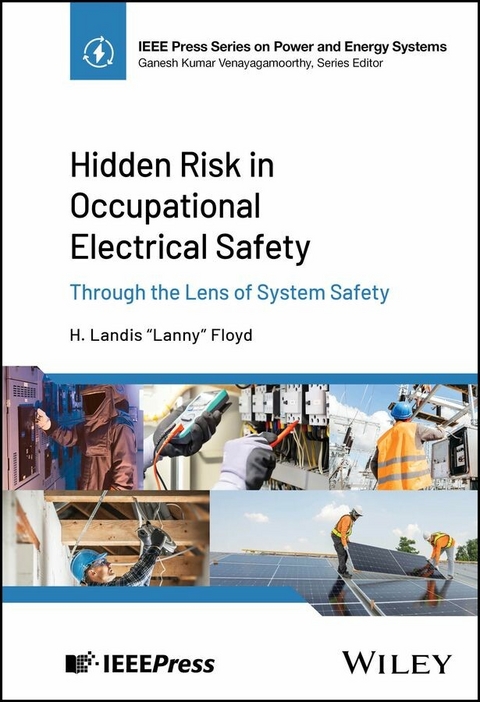
Hidden Risk in Occupational Electrical Safety (eBook)
363 Seiten
Wiley-IEEE Press (Verlag)
978-1-394-25779-9 (ISBN)
'A work that not only delves into the technical intricacies of working on and around electrical systems but also underscores the importance of fostering a foundational culture of safety across all workplace organizations. In today's dynamic landscape, where innovation and significant risks coexist, Lanny's deep insights will undoubtedly empower readers to navigate the complexities of electrical safety and indeed overall safety managed systems with confidence and competence.'
-MIKE DOHERTY, CUSP, IEEE Senior Member, past chair CSA Standard Z462, Workplace Electrical Safety
Improve electrical safety in the workplace with this essential overview
Electrical safety is vital for any workplace. Electrical hazards and workplace electrical injuries can be avoided through the rigorous implementation of safety standards and practices, such as those catalogued in Hidden Risk in Occupational Electrical Safety. Originating from the revolutionary breakthrough which began at DuPont global operations in the 1980s, and which has continued to see progress in risk reduction and the emergence of a zero-fatality electrical safety program, this book outlines concrete steps which can improve system safety in workplaces of any kind. With detailed discussions of statistical data and its role in helping organizations understand and manage risk of electrical accidents, it's a must-own for electrical safety professionals looking to capitalize on a revolution in workplace safety.
Readers will also find:
- A unique combination of research into management commitment workplace behavior and engineering experience in the area of high-risk hazards
- Detailed discussion of 'hidden' injuries such as neurological, psychological, and other lingering impacts of otherwise 'invisible' electrical injury
- Concrete tools for minimizing worker exposure to electrical hazards and the most effective measures in ensuring worker safety
Hidden Risk in Occupational Electrical Safety is ideal for electrical safety professionals and other decision-makers who take on the responsibility for occupational electrical safety within their organizations.
H. Landis 'Lanny' Floyd received his BSEE from VA Tech in 1973. His 45+ year career with DuPont focused on electrical safety in the design, construction, operation and maintenance of DuPont facilities worldwide. He is an adjunct faculty member in the graduate school of Advanced Safety Engineering and Management at The University of Alabama at Birmingham (UAB). Floyd has received awards from leading institutions recognizing his work to advance the practice of electrical safety. He is an IEEE Life Fellow, a professional member of American Society of Safety Professionals, a Certified Safety Professional, a Certified Electrical Safety Compliance Professional, a Certified Utility Safety Professional, a Certified Maintenance & Reliability Professional, a Certified Reliability Leader and a registered professional engineer in Delaware, Michigan, Pennsylvania, and Texas. He also established Electrical Safety Group, Inc. in 2001 to provide expert witness and consulting services in electrical safety matters.
Introduction
The future has already arrived. It's just not evenly distributed.
William Gibson
American futurist and science fiction author
I have a confession. There is nothing new in this book that has not already been published or presented elsewhere. The content of The Hidden Risk in Occupational Electrical Safety is a synthesis of hundreds of papers, articles, conference presentations, tutorials, and webinars that I've authored over the past 40+ years. Each chapter is centered on central themes from my previously published work. So what is the value of this book to you? The subtitle, Through the Lens of System Safety, is a label I recently applied to the mindset I've used in exploring the nooks and crannies of electrical safety-related management systems, safe work practices, and technology to identify opportunities for further reducing the risks associated with exposure to hazardous electrical energy. Many potential readers may not be aware of or have access to my past publications and presentations. After more than 40 years of championing opportunities to advance the practice of electrical safety through my papers and presentations, this book provides the tool, The Lens of System Safety, to show these opportunities in a cohesive and connected way.
Imagine driving on an isolated rural road at night, with light coming only from a full moon. The low level of lighting is sufficient to navigate the roadway. Switching on the headlights changes the details you can see, giving you more ability to see hazards and avoid risks. Similarly, the mindset of system safety can help expand how you think about simply complying with regulations, codes, and standards. Gaps and opportunities in management systems, safe work practices, and technology are illuminated, which can lead to applying additional measures or controls to further reduce acceptable risk.
The Preface describes some of the experiences and relationships from my personal and professional life that had a particular impact on shaping my view on how I could make a difference in preventing serious injuries and fatalities caused by electrical energy.
In Chapter 1, “The Lens of System Safety,” I emphasize both the importance and limitations of an electrical safety culture based on simply complying with the Occupational Safety and Health Act (OSHA) regulations, which first appeared in 1970, followed by compliance resources provided by the National Fire Protection Association (NFPA), IEEE, and other standards developers. I discuss a more comprehensive solution based on proven concepts derived from system safety. System safety has its roots in the efforts to control the risk of catastrophic accidents in nuclear weapons and advanced aviation that evolved during World War II. The lens of system safety is a mindset framed by the most rigorous safety and risk management methodology embedded in system safety. The lens of system safety is the foundation for thinking differently, enabling me to understand how to embrace a risk-based approach that complements compliance.
On March 28, 1979, an accident began unfolding at the Three Mile Island nuclear generating station in Harrisburg, PA. Chapter 2, “What We Can Learn from a Nuclear Accident,” tells a story about how a nuclear accident, having the potential of being the most catastrophic man-made disaster in human history, introduced me to the power of system safety. This chapter discusses a key learning from The Report of the President's Commission on the Accident at Three Mile Island. That key learning helped me understand that compliance with regulations and standards was essential in the journey, but was not the destination, in my work to advance electrical safety.
Electrical safety regulations, codes, and standards provide minimum requirements for preventing electrical injuries. In Chapter 3, “Limitations of a Compliance Culture,” residual risk is described as the amount of risk associated with a task or process that remains after inherent risks have been reduced by an acceptable risk control methodology, i.e., compliance. What if intrinsic risks are not completely identified? How do you determine if the residual risk has been reduced to a level acceptable to both the worker and the organization? This chapter explores these and other questions to provide insight into methods for searching and exposing opportunities for continual improvement, thereby reducing worker exposure to hazardous electrical energy. Areas of potential hidden danger discussed include management/leadership, facilities design, safe work practices, incident investigations, procurement, the included workforce, and outsourcing.
Chapter 4, “A Case History in Breakthrough Performance,” discusses the demonstrated breakthrough and sustainable results from the electrical safety improvement strategy implemented by DuPont in its global operations. DuPont was a pace-setting leader in process and occupational safety throughout the 19th and 20th centuries; however, in the mid-1980s, I was among a handful of people concerned that electrical injuries were an unrecognized outlier in the company's safety performance. We utilized data from a workforce of over 100,000 spanning nearly 20 years to help top leadership understand that accepted exposure to hazardous electrical energy was a phenomenon of very low frequency but extraordinarily high consequence. The low frequency of electrical injuries had caused a blind spot in safety management. However, our data showed that approximately 8% of the lost time injuries (LTIs) from hazardous electrical energy were fatal. Although nonfatal electrical injuries had almost no impact on calculating LTI metrics, the number of fatalities was a significant contributor to the number of deaths in DuPont's experience. Two of my published papers serve as bookends for this chapter. The first paper, published in 1993, outlined our strategy for changing the electrical safety culture in DuPont. The second paper, published in 2013, discusses 20 years of experience in continually improving the implementation of the strategy.
We live in an electrical world, and all workers are exposed to some degree of electrical hazards. For office workers, exposure may be limited to appliances, cords, outlets, and power strips. For construction laborers, exposure includes the use of extension cords, power tools, and overhead and underground power lines. Overhead lines pose a concern, as unintentional contact with mobile equipment, scaffolds, ladders, and conductive materials is a leading cause of fatalities among construction workers. Chapter 5, “Our Electrical World,” poses a key question: Is your electrical safety program applied to workers whose job expectations include working on or near energized circuits and equipment, or is it used for all workers who may be exposed to electrical hazards? The chapter discusses how the electrical safety program should encompass all workers, with the program tailored to the specific hazards and risks in various work environments.
Modern industry and commerce are nearly entirely dependent on electrical technologies for energy, control, data management, and communications. While a worker's mishap in these critical systems may result in injury to the worker, with much greater frequency, an accident or incident also has the consequence of significant disruption to the enterprise's operations. Chapter 6, “Collateral Injuries, Consequences, and Benefits: The Underlying Power of an Effective Electrical Safety Program,” discusses the broad implications of incidents in electrical systems critical to business and commerce. Ensuring that top management understands the total value of continual improvement in preventing electrical mishaps can help provide sustained value and support to justify measures and investments in electrical safety programs, thereby preventing injury to workers.
Recognizing personal vulnerability to risk is an essential step in establishing objectives for the design of electrical systems and in improving workers' safety-related behaviors to reduce injury rates. Studies in the fields of cognitive, social, and health psychology suggest that risk perception catalyzes changing behaviors, including those related to safety. Chapter 7, “The Value of Vulnerability,” combines research findings in psychology with practical engineering experience regarding high-risk hazards that have potential for fatal and disabling injury and shows how vulnerability can impact the effectiveness of safety training for engineers who design electrical systems, supervision of workers potentially exposed to electrical hazards, and workers at risk for serious electrical injury.
The scopes of OSHA electrical safety regulations and NFPA 70E Standard for Electrical Safety in the Workplace address safe work practices and personal protective equipment (PPE), which are part of a comprehensive solution for managing exposure to hazardous electrical energy. Suppose this limitation is not understood when applying these standards. In that case, an organization seeking to reduce or eliminate electrical incidents and injuries in its operations may not fully realize the potential of achieving this goal. Chapter 8, “Safety Management Systems,” discusses the benefits of implementing an electrical safety program that incorporates the requirements of electrical safety regulations and standards within the management framework of Occupational Health...
| Erscheint lt. Verlag | 2.12.2025 |
|---|---|
| Reihe/Serie | IEEE Press Series on Power and Energy Systems |
| Mitarbeit |
Herausgeber (Serie): Ganesh Kumar Vanayagamoorthy |
| Sprache | englisch |
| Themenwelt | Technik ► Elektrotechnik / Energietechnik |
| Schlagworte | Administrative Control • collateral serious injury • electrical mishap loss risk • Fatality prevention • low frequency/high consequence • prevention through design • Risk Perception • safety management system • Safety Regulation • serious injury prevention |
| ISBN-10 | 1-394-25779-1 / 1394257791 |
| ISBN-13 | 978-1-394-25779-9 / 9781394257799 |
| Informationen gemäß Produktsicherheitsverordnung (GPSR) | |
| Haben Sie eine Frage zum Produkt? |
 EPUB (Adobe DRM)
Kopierschutz: Adobe-DRM
Adobe-DRM ist ein Kopierschutz, der das eBook vor Mißbrauch schützen soll. Dabei wird das eBook bereits beim Download auf Ihre persönliche Adobe-ID autorisiert. Lesen können Sie das eBook dann nur auf den Geräten, welche ebenfalls auf Ihre Adobe-ID registriert sind.
Details zum Adobe-DRM
Dateiformat: EPUB (Electronic Publication)
EPUB ist ein offener Standard für eBooks und eignet sich besonders zur Darstellung von Belletristik und Sachbüchern. Der Fließtext wird dynamisch an die Display- und Schriftgröße angepasst. Auch für mobile Lesegeräte ist EPUB daher gut geeignet.
Systemvoraussetzungen:
PC/Mac: Mit einem PC oder Mac können Sie dieses eBook lesen. Sie benötigen eine
eReader: Dieses eBook kann mit (fast) allen eBook-Readern gelesen werden. Mit dem amazon-Kindle ist es aber nicht kompatibel.
Smartphone/Tablet: Egal ob Apple oder Android, dieses eBook können Sie lesen. Sie benötigen eine
Geräteliste und zusätzliche Hinweise
Buying eBooks from abroad
For tax law reasons we can sell eBooks just within Germany and Switzerland. Regrettably we cannot fulfill eBook-orders from other countries.
aus dem Bereich