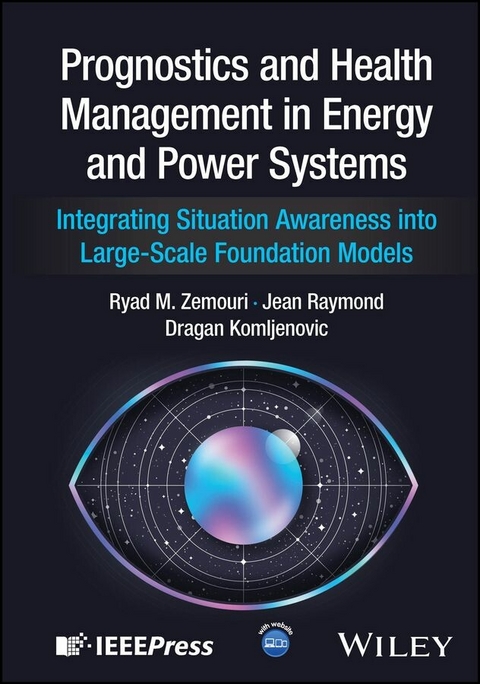
Prognostics and Health Management in Energy and Power Systems (eBook)
259 Seiten
Wiley-IEEE Press (Verlag)
978-1-394-36701-6 (ISBN)
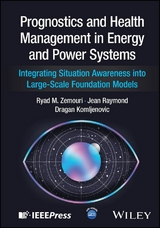
Key insights and practical guidance on transitioning to clean energy while meeting increasing energy demands, covering AI developments and more
Prognostics and Health Management in Energy and Power Systems explores two highly topical subjects, energy transition and the latest advances in Artificial Intelligence, and provides insights and practical guidance for a smooth transition to clean, low-carbon energy while simultaneously continuing to meet the ever-increasing demand for energy.
The first part of this book is completely devoted to the challenges, trends, and Asset Management requirements for the energy transition and explains why the energy system of the future must be resilient, autonomous, anticipatory, and situation-aware. The second part of the book presents key developments in recent years and shows the gradual shift from a collection of monolithic architectures for narrow, singular tasks to a set of modular, reconfigurable architectures capable of handling different types of tasks. An industrial case study is illustrated in the third part of the book, showing that Large-Scale Foundation models represent a promising technique to support the Prognostics and Health Management of the energy system.
This book includes information on:
- Key differences between reliability and resilience, covering Low-Impact, High-Probability events and High-Impact, Low-Frequency events
- Important factors in the operation of current and future power plants and substations, including software, complexity, human error, data, and maintenance
- Modularity, reliability, and explainability of Large-Scale Foundation models
- Transformer-based Deep Neural Networks, covering Attention Mechanisms, Positional Encoding, and input-output data embedding
- Graph-based approaches to prognostics of complex machinery with sparse Run-to-Failure data, covering diagnostics feature extraction and graph dataset generation
Prognostics and Health Management in Energy and Power Systems is an essential forward-thinking reference for engineers and researchers working in the energy sector with an interest in AI techniques and Machine Learning.
Ryad M. Zemouri, Ph.D, is a Data Scientist at Hydro-Québec's Research Institute (IREQ), Canada. Previously, he was an Associate Professor at the University of Cnam, Paris. His research interests include machine learning and artificial neural networks, with a particular interest in industrial applications of machine learning to prognosis and health management (PHM). He has published nearly 100 papers in various international conferences and journals.
Jean Raymond, ing., Ph.D., M.Sc.A., is a RAMS Engineer in Hydro-Québec's Expertise, Engineering and Standardization, Canada. He has over 34 years of experience as a telecom network and systems engineer. He was responsible for the long-term development of its transport and power systems. He actively contributes to international standards groups (IEC, IEEE), and leads several committees. He has authored over twenty publications. Jean is involved in modernizing university programs in RAMS and Asset Management.
Dragan Komljenovic, ing., Ph.D, is a Senior Research Scientist at Hydro-Québec's Research Institute (IREQ), specializing in reliability, resilience, asset management, and risk analysis. He previously served as a reliability and nuclear safety engineer at the Gentilly-2 nuclear power plant, also part of Hydro-Québec. Dragan actively collaborates with several universities and has authored over 120 peer-reviewed journal and conference papers. He is a Fellow of the International Society of Engineering Asset Management (ISEAM).
| Erscheint lt. Verlag | 28.11.2025 |
|---|---|
| Sprache | englisch |
| Themenwelt | Naturwissenschaften ► Physik / Astronomie |
| Technik ► Elektrotechnik / Energietechnik | |
| Schlagworte | Clean Energy • energy ai • energy architecture • Energy Challenges • energy climate change • energy machine learning • Energy Reliability • Energy Resilience • Energy Transition • energy trends • low carbon energy • neural networks energy |
| ISBN-10 | 1-394-36701-5 / 1394367015 |
| ISBN-13 | 978-1-394-36701-6 / 9781394367016 |
| Informationen gemäß Produktsicherheitsverordnung (GPSR) | |
| Haben Sie eine Frage zum Produkt? |
 PDF (Adobe DRM)
Kopierschutz: Adobe-DRM
Adobe-DRM ist ein Kopierschutz, der das eBook vor Mißbrauch schützen soll. Dabei wird das eBook bereits beim Download auf Ihre persönliche Adobe-ID autorisiert. Lesen können Sie das eBook dann nur auf den Geräten, welche ebenfalls auf Ihre Adobe-ID registriert sind.
Details zum Adobe-DRM
Dateiformat: PDF (Portable Document Format)
Mit einem festen Seitenlayout eignet sich die PDF besonders für Fachbücher mit Spalten, Tabellen und Abbildungen. Eine PDF kann auf fast allen Geräten angezeigt werden, ist aber für kleine Displays (Smartphone, eReader) nur eingeschränkt geeignet.
Systemvoraussetzungen:
PC/Mac: Mit einem PC oder Mac können Sie dieses eBook lesen. Sie benötigen eine
eReader: Dieses eBook kann mit (fast) allen eBook-Readern gelesen werden. Mit dem amazon-Kindle ist es aber nicht kompatibel.
Smartphone/Tablet: Egal ob Apple oder Android, dieses eBook können Sie lesen. Sie benötigen eine
Geräteliste und zusätzliche Hinweise
Buying eBooks from abroad
For tax law reasons we can sell eBooks just within Germany and Switzerland. Regrettably we cannot fulfill eBook-orders from other countries.
aus dem Bereich