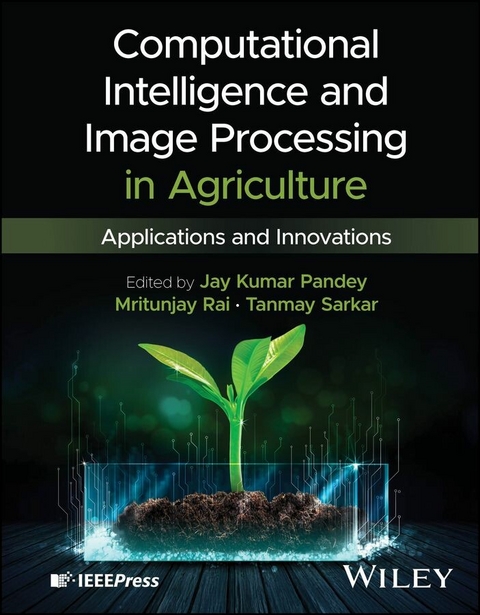
Computational Intelligence and Image Processing in Agriculture (eBook)
698 Seiten
Wiley (Verlag)
978-1-394-32088-2 (ISBN)
Revolutionizing Agricultural Quality Control with AI, Image Processing, and Computational Intelligence Techniques
As the global demand for high-quality, sustainable agricultural products increases, advanced technology becomes critical in meeting these challenges. Computational Intelligence and Image Processing in Agriculture explores how innovative technologies are transforming agricultural quality evaluation. Combining foundational concepts with practical applications, this comprehensive text delves into innovative techniques to improve accuracy, efficiency, and sustainability in quality control.
Addressing key challenges faced by researchers, practitioners, and industry professionals, contributions from leading experts in AI, agriculture, and computational intelligence provide a deep understanding of technologies such as deep learning, computer vision, and AI-driven robotics. Real-world examples, step-by-step tutorials, and code snippets make the concepts accessible and actionable, while coverage of emerging trends and future directions highlights the evolving landscape of agricultural technology. Offering interdisciplinary insights and practical tools to modernize evaluation techniques, reduce waste, enhance food safety, and meet the growing demands of sustainable farming practices, this book:
- Addresses challenges and solutions for real-time monitoring systems in agriculture
- Highlights cutting-edge applications such as AI-driven robotics and LiDAR in farming
- Emphasizes sustainability and environmental impact through technological innovation
- Offers detailed coverage of image analysis algorithms for quality control
- Discusses ethical and environmental implications of technology in agriculture
This book is ideal for advanced undergraduate and graduate courses in agricultural engineering, computer science, and AI applications. It is also an essential reference for professionals including agricultural scientists, AI practitioners, and quality control experts.
Jay Kumar Pandey is an Assistant Professor at Shri Ramswaroop Memorial University, India, and specializes in AI, machine learning, image processing, biomedical engineering, and renewable energy. Holding a Ph.D. and M.Tech. in Power Control, and an MBA in Finance & Marketing, he focuses on real-time imaging, surveillance, emotion recognition, driving AI solutions for healthcare, agriculture, disaster prediction, renewable energy, and advanced surveillance systems.
Mritunjay Rai is an Assistant Professor at Shri Ramswaroop Memorial University, India. He specializes in digital image processing, machine learning, and thermal imaging. His research, including a Ph.D. from IIT (ISM) Dhanbad, focuses on real-time thermal imaging, surveillance, and emotion recognition. With numerous publications and editorial contributions, he advances AI-driven solutions for healthcare, disaster prediction, and next-generation surveillance systems.
Tanmay Sarkar is currently working as a Lecturer in the Department of Food Processing Technology, Government of West Bengal. He is the top 2% global most cited researcher, by Stanford University, USA and Elsevier (2024). His research areas include AI, and food bioactive.
Revolutionizing Agricultural Quality Control with AI, Image Processing, and Computational Intelligence Techniques As the global demand for high-quality, sustainable agricultural products increases, advanced technology becomes critical in meeting these challenges. Computational Intelligence and Image Processing in Agriculture explores how innovative technologies are transforming agricultural quality evaluation. Combining foundational concepts with practical applications, this comprehensive text delves into innovative techniques to improve accuracy, efficiency, and sustainability in quality control. Addressing key challenges faced by researchers, practitioners, and industry professionals, contributions from leading experts in AI, agriculture, and computational intelligence provide a deep understanding of technologies such as deep learning, computer vision, and AI-driven robotics. Real-world examples, step-by-step tutorials, and code snippets make the concepts accessible and actionable, while coverage of emerging trends and future directions highlights the evolving landscape of agricultural technology. Offering interdisciplinary insights and practical tools to modernize evaluation techniques, reduce waste, enhance food safety, and meet the growing demands of sustainable farming practices, this book: Addresses challenges and solutions for real-time monitoring systems in agriculture Highlights cutting-edge applications such as AI-driven robotics and LiDAR in farming Emphasizes sustainability and environmental impact through technological innovation Offers detailed coverage of image analysis algorithms for quality control Discusses ethical and environmental implications of technology in agriculture This book is ideal for advanced undergraduate and graduate courses in agricultural engineering, computer science, and AI applications. It is also an essential reference for professionals including agricultural scientists, AI practitioners, and quality control experts.
Chapter 1
Grain Quality Assessment: Image-based Techniques for Grain Analysis, Detecting Contaminants and Impurities and Real-world Applications
Kanakaprabha Selvakumari
Department of Artificial Intelligence and Machine Learning, Malla Reddy College of Engineering, Hyderabad, Telangana, India
1.1 Introduction
The quality of grain directly impacts food security, safety, and value to consumers as it is an essential component of the food supply chain. For thousands of people around the world, grains including rice, wheat, maize, and barley are staple foods; therefore, evaluating their quality is essential for steady supply and consumption. The grain quality assessment has been carried out traditionally using hands and by the specialists evaluating the physical characteristics such as color, size, shape, and texture. Yet, the results of these traditional techniques can be uneven as they are frequently costly, time-consuming, and prone to human errors. In addition, manual methods are unable to fulfill the demand for rapid, precise assessments and can be harmful to the grain, hindering the expansion of agricultural crops and exports. Image processing, artificial intelligence (AI), and computer vision techniques can be applied to automate the testing of grain properties and quality, providing an advanced solution for grain assessment.
The large-scale grain analysis is made possible using these techniques, which provide higher yields of accurate and impartial results compared to other results of the human involvement. Additionally, a variety of impurities and contaminants, such as foreign particles, fungal infections, insect damage, and mycotoxins, may not be readily apparent to the naked eye, but can be detected using image-based methods. For the food and agricultural industries, the grain quality control is very essential, and the ability to quickly evaluate grain quality and identify contaminants in real time presents significant challenges. In recent years, the grain quality assessments are changed with the introduction of machine learning and AI into image-based methodologies. The convolutional neural networks (CNNs) and deep learning examples of advanced models are classifying grains, identifying flaws, and predicting possible contamination. These AI-powered systems are continually picking new grains, which helps in performing better over time and adjusting to the different grain types and environmental factors. The image-based grain quality monitoring techniques have grown in popularity within the industry. This chapter identifies the most recent image-based methods for evaluating grain quality and assessing pollutants and other imperfections. It also identifies methods that are being used in the real world to enhance food safety, improve supply chain, and reduce waste treatment. This chapter provides main overview of the image-based grain quality analysis, exploring the most recent research. The primary objectives are to identify machine learning and image processing techniques for grain quality analysis. The grain quality can be improved by grading, contaminant identification, and impurity analysis of grains, which benefits agriculture and food safety. These techniques can be used in real-world business situations.
1.1.1 Importance of Grain Quality in Global Food Security
The quality of grain is an essential part of the world’s food security, as grains like wheat, rice, maize, and barley are staples in diets worldwide. These grains contribute significantly to daily caloric intake and are vital for meal preparation. The nutrient content, sales, and safety of these grains are all affected by their quality, which influences the general welfare and availability of the food. The grain quality needs to be ensured for a variety of reasons. Superior grains offer higher nutritional content, which includes essential proteins, vitamins, and carbohydrates, supporting human health. Food infections and malnutrition can be caused by poor-quality grains, which are often contaminated by pests, pollutants, or spoilage. This can be due to lax food safety regulations. The stability of both domestic and global food markets heavily depends on grain quality. Grain production is a multibillion-dollar global industry, and the economic health of many countries is influenced by both imports and exports. Food scarcity in areas of risk can be made worse by inconsistent or low-quality grains, which can result in rejection in deliveries, trade disputes, and economic losses for providers. In addition, sustainable agriculture mainly depends on grain quality. Grain degradation is largely caused by inadequate storage and poor post-harvest handling, which can result in significant food loss and waste. Based on the estimate from the Food and Agriculture Organization (FAO), grains account for a significant portion of the annual loss or waste of around 30% of food production. Improving grain quality can help reduce waste, ensuring more food reaches consumers and enhancing food security (Figure 1.1).
Figure 1.1 Importance of food security.
The grain quality is vital for improving food safety and preventing the spread of illnesses brought by pollutants, including chemical residues, fungi, and mycotoxins. These chemicals have the potential to seriously harm health and threaten food security. These risks can be reduced using cutting-edge grain evaluation technologies; by improving food quality, these technologies help diminish threats to public health. The grain quality plays an essential role in preserving food security worldwide, encouraging sustainable farming methods and the probability of food systems. These image-based technologies for assessing grain quality offer better solutions to the challenges, ensuring grain quality preservation and protection on a global level.
1.1.2 Challenges in Traditional Grain Quality Assessment
In today’s agricultural and food industries, using standard methods for evaluating grain quality is no longer sufficient. The physical examination used in these traditional methods depends on the assessment of grains. Based on the size, shape, and surface texture, this method is very subjective and prone to human error, and it mainly depends on the knowledge and level of the evaluator giving a general sense of quality. The trade, processing, and storage of crops can be affected by inaccurate evaluations. The time-consuming and laborious nature of conventional treatments presents another challenge. The substantial human resources are frequently required for physical inspections, particularly for large companies or during crop seasons when the time is crucial. The physical filtering of the grain samples to detect the impurities or pollutants can be an expensive process, which causes a delay in the supply chain. Furthermore, only small portions of the grain lot are typically evaluated, which may not accurately represent the entire batch. This can lead to significant issues, such as contamination by fungi or pest infestations, which may go unnoticed. Additionally, the capacity of conventional techniques to find internal defects is frequently restricted. For example, internal problems like the growth of mold and accumulation of mycotoxins are difficult to identify by simple visual assessment, but they can be harmful if left undetected. The risk of contaminated grains reaching the food supply presents serious health dangers to consumers and landowners alike. Therefore, the standard methods for evaluating grain quality are becoming less appropriate to meet the demands of modern agriculture and food safety. The development of modern automated techniques such as image-based analysis offers more reliable and scalable solutions to the limitations of accuracy, scope, and efficiency found in conventional methods of grain analysis.
1.1.3 Role of Image-based Techniques in Addressing Grain Quality Issues
Due to the limitations of traditional grain quality assessment methods, image-based approaches have become revolutionary tools in the industry. These methods offer a more effective, accurate, and non-destructive way of evaluating grain quality on a broad scale using developments in Artificial Intelligence, Computer Vision, and Machine Learning. One of the main advantages of image-based methods is their ability to automate the evaluation process, eliminating the need for unnecessary manual inspections while providing dependable and accurate results. The image-based algorithms can analyze a variety of grain features based on their size, shape, color, and texture, which is one of the most notable advantages. These methods can assess grain quality in real time by scanning large volumes of grain quickly using high-resolution cameras and image processing algorithms. This not only expedites the quality control procedure but also improves accuracy by reducing human error (Figure 1.2).
Figure 1.2 Image-based techniques in addressing grain quality.
In addition, image-based methods excel at identifying pollutants and imperfections that might not be obvious to the naked eye. Advanced imaging techniques, such as infrared imaging can detect foreign particles, insect damage, fungal diseases, and contamination. This ensures the early identification of other problems that might seriously impact public health and food quality. Artificial Intelligence and convolutional neural networks further enhance the capabilities of image-based grain quality assessments. Large datasets of grain images can be used to train models, giving them the ability to identify minute patterns that may be signs of contamination or flaws. As new grain types, environmental factors, and other...
| Erscheint lt. Verlag | 27.11.2025 |
|---|---|
| Sprache | englisch |
| Themenwelt | Technik ► Elektrotechnik / Energietechnik |
| Schlagworte | Agricultural Technology • AI in agriculture • AI quality evaluation agriculture • AI sustainable farming • computational intelligence agriculture • image processing quality evaluation agriculture • machine learning quality control agriculture |
| ISBN-10 | 1-394-32088-4 / 1394320884 |
| ISBN-13 | 978-1-394-32088-2 / 9781394320882 |
| Informationen gemäß Produktsicherheitsverordnung (GPSR) | |
| Haben Sie eine Frage zum Produkt? |
 EPUB (Adobe DRM)
Kopierschutz: Adobe-DRM
Adobe-DRM ist ein Kopierschutz, der das eBook vor Mißbrauch schützen soll. Dabei wird das eBook bereits beim Download auf Ihre persönliche Adobe-ID autorisiert. Lesen können Sie das eBook dann nur auf den Geräten, welche ebenfalls auf Ihre Adobe-ID registriert sind.
Details zum Adobe-DRM
Dateiformat: EPUB (Electronic Publication)
EPUB ist ein offener Standard für eBooks und eignet sich besonders zur Darstellung von Belletristik und Sachbüchern. Der Fließtext wird dynamisch an die Display- und Schriftgröße angepasst. Auch für mobile Lesegeräte ist EPUB daher gut geeignet.
Systemvoraussetzungen:
PC/Mac: Mit einem PC oder Mac können Sie dieses eBook lesen. Sie benötigen eine
eReader: Dieses eBook kann mit (fast) allen eBook-Readern gelesen werden. Mit dem amazon-Kindle ist es aber nicht kompatibel.
Smartphone/Tablet: Egal ob Apple oder Android, dieses eBook können Sie lesen. Sie benötigen eine
Geräteliste und zusätzliche Hinweise
Buying eBooks from abroad
For tax law reasons we can sell eBooks just within Germany and Switzerland. Regrettably we cannot fulfill eBook-orders from other countries.
aus dem Bereich