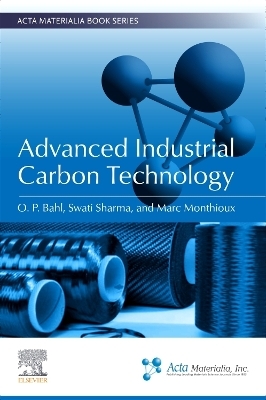
Advanced Industrial Carbon Technology
Elsevier - Health Sciences Division (Verlag)
978-0-443-44901-7 (ISBN)
- Noch nicht erschienen (ca. September 2026)
- Versandkostenfrei
- Auch auf Rechnung
- Artikel merken
Dr. Om P. Bahl is currently the President of the Indian Carbon Society and an Emeritus Scientist in the Carbon Technology Unit at the Council Of Scientific and Industrial Research–National Physical Laboratory (CSIR–NPL), New Delhi. He has served on the Board of Directors of HEG Ltd and has been an R&D advisor to major scientific institutions and industries. Dr. Bahl served the United Nations as Chief Technical Advisor in Brazil in 1981 and as a UN Expert in Bulgaria, Romania, and Poland in 1988 and 1989. He has edited several books, published numerous research articles, and successfully developed and transferred various carbon-related technologies to reputable carbon industries in India. He holds eleven patents for various carbon-related technologies. Dr. Swati Sharma is an Assistant Professor in the School of Mechanical and Materials Engineering at the Indian Institute of Technology (IIT) Mandi. Before joining IIT Mandi in 2019, she spent over five years as a Scientist and Group Leader at Karlsruhe Institute of Technology and the University of Freiburg in Germany. She earned her M.S. and Ph.D. from the University of California, Irvine, USA, in 2013. Prior to that, she worked as a Researcher at UNIST, South Korea, for one year. She completed her B.E. (Hons.) in Chemical Engineering at Birla Institute of Technology and Science, Pilani, India, in 2004, and subsequently worked as a Research Scientist for over four years at Ranbaxy Research Laboratories, Gurgaon. Her current research focuses on carbon materials and manufacturing, including the development of a new microstructural model for non-graphitizing carbons and the confirmation of fullerenes within this class of carbon materials. Dr. Marc Monthioux is Research Director Emeritus at CNRS and currently works at the Center for the Preparation of Materials and Structural Studies (CEMES) in Toulouse, France. He has decades of experience in the synthesis, characterization, and applications of various carbon materials, including natural sources like kerogens and coals, as well as technological materials such as fibers, composites, fullerenes, nanotubes, graphene, and diamane. Dr. Monthioux has collaborated with numerous international companies and is Honorary Editor of Carbon and Advisory Editor of Carbon Trends (Elsevier). He is a former chairman of the French Carbon Society and the European Carbon Association. He hosted the World Conference on Carbon in 2009 and received the European Carbon Association Award in 2022.
Part 1: Introduction to carbon materials
1. Carbon in the 21st century
2. Introduction to carbon materials: from bulk crystalline solids to nanomaterials
3. Allotropes of carbon
4. Hybridisation
5. Precursors for carbon preparation
6. Heat-treatment of organic materials
7 Effect of heat-treatment on properties of carbon
8 Nomenclature
9 General characterisation techniques
10 Overview of industrial applications of carbon
11 Conclusions and prospects References
Part 2: Pitches
1. History of tar and pitch evolution
2. Production of coal tar pitch
3. Development of impregnating coal-tar pitch
4. Development of impregnating petroleum pitches
5. Mesophase development
6. Pitch shelf-life, storage and transportation
7. Testing of pitches
8. Toxic effects of pitch
9. Conclusions and prospects References
Part 3: Extruded polycrystalline graphite
1. Background
2. Fabrication of graphite electrodes
3. Future trends
4. Testing/characterisation of graphite electrodes (astm standards)
5 Conclusions and prospects References
Part 4: Carbon fibres
1. Introduction
2. Pan-based carbon fibres
3. Cellulose-based carbon fibres
4. Pitch-based carbon fibres
5. Vapour-grown carbon fibres (vgcfs)
6. Current trends and prospects
7. Conclusions References
Part 5: Carbon fibre-based composites
1. Introduction
2. Manufacturing of carbon fibre-based composites
3. Mechanical properties of cfrps
4. Carbon/carbon composites
5. Applications and state-of-the-art
6. Recent advancements and challenges
7. Conclusions References
Part 6: Isotropic graphites
1. Introduction
2. Preparation of isotropic graphites
3. Classification of isotropic graphites
4. Manufacturing of isotropic graphite (flow diagram)
5. Structure of isotropic graphite (datasheets from leading manufacturers)
6. Conclusion and prospects References
Part 7: Non-graphitisable carbons
1. Introduction
2. Microstructure of non-graphitisable carbons
3 Characterisation of non-graphitisable carbons
4. Glass-like carbons (glassy carbons)
5. Porous and activated carbons
6. Carbon coatings
7. Conclusions and prospects References
Part 8: Carbon nanoforms
1. Introduction
2. Three nanosized dimensions (0d nanoforms)
3. Two nanosized dimensions (1d nanoforms)
4. One nanosized dimension (2d nanoforms)
5. Conclusions References
| Erscheint lt. Verlag | 1.9.2026 |
|---|---|
| Reihe/Serie | Acta Materialia Book Series |
| Verlagsort | Philadelphia |
| Sprache | englisch |
| Maße | 152 x 229 mm |
| Gewicht | 450 g |
| Themenwelt | Technik ► Maschinenbau |
| ISBN-10 | 0-443-44901-5 / 0443449015 |
| ISBN-13 | 978-0-443-44901-7 / 9780443449017 |
| Zustand | Neuware |
| Informationen gemäß Produktsicherheitsverordnung (GPSR) | |
| Haben Sie eine Frage zum Produkt? |
aus dem Bereich