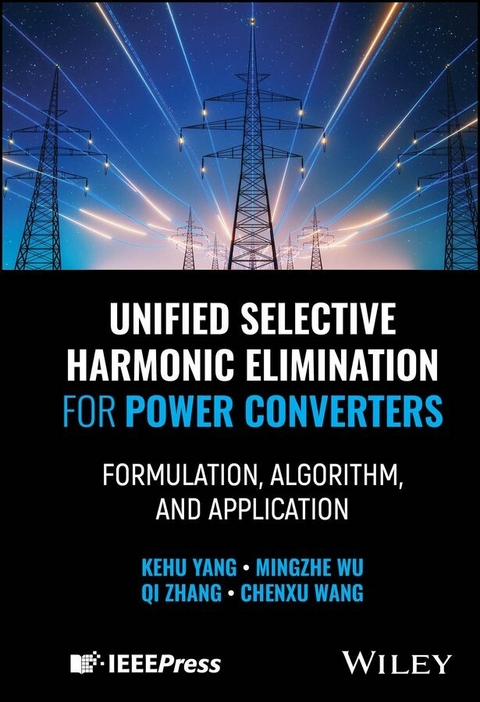
Unified Selective Harmonic Elimination for Power Converters (eBook)
484 Seiten
Wiley (Verlag)
978-1-394-31433-1 (ISBN)
Comprehensive reference detailing key aspects of SHE, enabling readers to formulate different kinds of SHE equations, effectively solve the nonlinear SHE equations, and grasp key aspects of SHE applications.
Unified Selective Harmonic Elimination for Power Converters focuses on the three main challenges of selective harmonic elimination (SHE)-the mathematical modeling of fundamental and harmonic components using the pre-defined waveform, accurately solving SHE equations and obtaining the complete switching angle solution trajectory, and implementing SHE on multilevel converters and industrial drives-with information on how to fully leverage the strength of SHE techniques in power converters. The book covers the basics of the SHE method and reviews state-of-the-art research towards SHE, such as unified SHE formulations for multilevel converters, algebraic switching angle solving algorithms for SHE equations, and optimal implementations of SHE in multilevel converters and electric drives.
The book delves into model predictive SHE control for PMSM with simulation and experimental results and explains how to achieve common mode voltage reduction and capacitor voltage balance in multilevel converters. Concepts are supported by original MATLAB/Mathematica/ Maple codes.
This book includes information on:
- Detailed derivation steps on Fourier series of square waveform and traditional SHE equations
- Unified SHE formulations for symmetric and asymmetric multilevel converters, and different SHE equations for various scenarios
- Advanced SHE solving algorithms including the resultant elimination method, the Groebner Bases-based method, symmetric polynomials, and Newton identities
- Online implementations of SHE based on both algebraic algorithms and intelligent algorithms
- Advanced capacitor voltage balancing methods under SHE for multilevel converters
- Basic and advanced closed-loop controller and model-predictive control under SHE for industrial drives
This book is a good reference for engineers and researchers in the area of power electronics, with particular interest to those involved in renewable power generation, high-power energy storage, and high-power drives.
Kehu Yang is a Professor with the School of Artificial Intelligence, China University of Mining and Technology-Beijing, Beijing, China, and a member of the IEEE.
Mingzhe Wu is a Lecturer with the School of Mechanical and Electrical Engineering, China University of Mining and Technology-Beijing, Beijing, China.
Qi Zhang is a Lecturer with the School of Artificial Intelligence, China University of Mining and Technology-Beijing, Beijing, China.
Chenxu Wang is a Ph.D. with the School of Artificial Intelligence, China University of Mining and Technology-Beijing, Beijing, China.
Comprehensive reference detailing key aspects of SHE, enabling readers to formulate different kinds of SHE equations, effectively solve the nonlinear SHE equations, and grasp key aspects of SHE applications. Unified Selective Harmonic Elimination for Power Converters focuses on the three main challenges of selective harmonic elimination (SHE) the mathematical modeling of fundamental and harmonic components using the pre-defined waveform, accurately solving SHE equations and obtaining the complete switching angle solution trajectory, and implementing SHE on multilevel converters and industrial drives with information on how to fully leverage the strength of SHE techniques in power converters. The book covers the basics of the SHE method and reviews state-of-the-art research towards SHE, such as unified SHE formulations for multilevel converters, algebraic switching angle solving algorithms for SHE equations, and optimal implementations of SHE in multilevel converters and electric drives. The book delves into model predictive SHE control for PMSM with simulation and experimental results and explains how to achieve common mode voltage reduction and capacitor voltage balance in multilevel converters. Concepts are supported by original MATLAB/Mathematica/ Maple codes. This book includes information on: Detailed derivation steps on Fourier series of square waveform and traditional SHE equationsUnified SHE formulations for symmetric and asymmetric multilevel converters, and different SHE equations for various scenariosAdvanced SHE solving algorithms including the resultant elimination method, the Groebner Bases-based method, symmetric polynomials, and Newton identitiesOnline implementations of SHE based on both algebraic algorithms and intelligent algorithmsAdvanced capacitor voltage balancing methods under SHE for multilevel convertersBasic and advanced closed-loop controller and model-predictive control under SHE for industrial drives This book is a good reference for engineers and researchers in the area of power electronics, with particular interest to those involved in renewable power generation, high-power energy storage, and high-power drives.
1
Power Converters and Selective Harmonic Elimination
1.1 Introduction to Power Converters
A power converter is an electrical device that changes the form of electrical energy to suit different applications. It can convert voltage levels, current types, and frequency, allowing for the efficient and flexible delivery of power to various systems and devices. Power converters are crucial in numerous applications, including renewable energy systems, electric vehicles, and consumer electronics, where they ensure the appropriate power levels are provided, improving performance and energy efficiency [1].
The classification of existing power converter topologies is summarized as in Figure 1.1 (excluding DC–DC converter, which is not included in this book). Based on the type of power conversion from the AC source to load, they can be generally divided into direct AC–AC conversion, e.g., matrix converters and cycloconverters, and indirect AC–DC–AC conversion, which is the most widely used solution in industry due to its higher control flexibility. Then, the power converters with indirect conversions can be further classified into voltage–source converters (VSCs) and current–source converters (CSCs) [2], where the VSCs include two‐level and multilevel VSCs (denoted as multilevel converters in the following content of this book) [3].
Figure 1.1 Classifications of power converter topologies.
1.1.1 Topologies of Voltage–Source Converters
For low‐voltage scenarios, the two‐level VSCs are usually adopted. The single‐phase configuration of two‐level converters is shown in Figure 1.2(a), where each phase only consists of two semiconductor switching devices. Due to their low device count and simple control design, they are still one of the most popular VSCs in low‐voltage industrial applications.
Figure 1.2 Single‐phase topology of a (a) two‐level converter, (b) 3L‐NPC converter, (c) 3L‐FC converter, and (d) 5L‐ANPC converter.
However, in higher voltage ratings, i.e., over the medium voltage range from 2.3 to 13.8 kV, the two‐level converters are not preferred due to the high‐voltage stress on switching devices and significant electromagnetic interference (EMI) issue generated from their output voltage waveforms with high dv/dt. Facing this issue, the concept of multilevel converters was developed in the early 1980s and gained more and more research and industrial attention over the following decades. Multilevel converters, as their name suggests, refer to the power converters that are capable of outputting voltage levels higher than two. The most obvious advantages of multilevel output waveforms are their better waveform qualities, lower total harmonic distortion (THD), and reduced EMI issues, i.e., lower dv/dt, due to their lower output voltage steps [4]. Besides, the multilevel topologies can also increase the converter's operating voltage without devices connected in series compared with the two‐level converters.
Over decades of evolution, there have been numerous multilevel converters proposed by researchers, while many of them have already been commercially applied in industry [5, 6]. The comprehensive classification of the state‐of‐the‐art multilevel converters is summarized in Figure 1.3, where there are three main types of multilevel converters, i.e., the neutral‐point‐clamped (NPC), flying‐capacitor‐clamped (FCC), and cascaded configurations [7]. Specifically, the NPC‐type can be further classified into neutral‐point‐pilot (NPP), diode‐clamped, and active NPC (ANPC) converters; the FCC‐type can be further classified into conventional FCC and stacked multicell (SMC) converters; the cascaded‐type includes cascaded H‐bridge (CHB) converters with equal or unequal DC sources, and modular multilevel converters (MMCs). Besides, the hybrid‐clamped (HC) converters can be regarded as the combination of NPC and FCC converters, while the symmetric HC (SHC) converters can be regarded as the combination of FCC and cascaded converters.
Figure 1.3 Classification of multilevel converters.
The single‐phase topologies of three commercialized converters are also presented in Figure 1.2 as examples, i.e., three‐level NPC (3L‐NPC) in Figure 1.2(b), three‐level FCC (3L‐FCC) in Figure 1.2(c), and five‐level ANPC (5L‐ANPC) in Figure 1.2(d). The 3L‐NPC converter designed by ABB, i.e., ACS1000 [8], and three‐level FCC (3L‐FCC) by Alstom, i.e., VDM4000 Symphony [9], are both suitable for voltage range up to 4.16 kV, while the ABB's 5L‐ANPC product, i.e., ACS2000 [10], is designed for voltage range over 4.16–6.9 kV. Other examples of commercialized multilevel converters include CHB by Rockwell Automation, i.e., Rockwell PowerFlex 6000 [11], and MMC module by Siemens, i.e., SM120 [12].
1.1.2 Topologies of Current–Source Converters
With the advent of gate‐commutated thyristor (GCT) devices in the late 1990s, the PWM current source rectifiers (CSRs) and CSCs using symmetrical GCT devices are increasingly implemented in medium‐voltage variable frequency drives (VFDs), such as pumps, fans, and compressors. A typical configuration of back‐to‐back PWM CSC‐fed drive system is shown in Figure 1.4 [13]. Compared with its VSC counterpart, the large DC‐link capacitor of VSCs is replaced with a large DC choke LDC in CSCs to achieve a stable DC‐link current for operations. As shown in Figure 1.4, the DC choke usually includes a magnetic core with two coils that are placed on different sides to suppress the common‐mode voltage (CMV) [14], i.e., one located at the top of the DC link while the other is placed at the bottom. Besides, the three‐phase input/output filter capacitors Cin and Cout are also necessary, which are used to help with the switching commutations of GCT devices, as well as to achieve better current performance.
Figure 1.4 Configuration of a back‐to‐back PWM CSC‐fed drive system.
High‐power CSCs have their unique operation principles, as well as their own advantages and disadvantages. In order to achieve a continuous DC current as well as a well‐defined PWM current, the CSCs should always have two and only two switches in the ON state, one in the top (S1, S3, S5) and one in the bottom (S2, S4, S6). Compared with VSCs, especially the multilevel converters, the topology structure of CSCs is usually much simpler. As they directly generate PWM currents in the output, they have motor‐friendly waveforms with better output current quality and voltage waveforms with lower dv/dt stress. Besides, they have reliable short‐circuit protection capability, as the large DC choke will limit the DC current when short‐circuit scenarios occur [15]. However, on the other hand, this feature brought by the large DC choke will, in turn, limit the dynamic performance of the CSCs.
1.2 Modulation Strategies for Power Converters
1.2.1 PWM of Voltage–Source Converters
PWM is important for power converter operations. For PWM rectifiers, it is used to control the DC‐link voltage/current value based on the input AC sources [16]; while for PWM inverters, it is used to control the output fundamental voltage/current value and frequency, as well as minimizing the output harmonic distortion [17].
For two‐level VSCs, the most commonly used PWM includes sinusoidal PWM (SPWM) and space vector modulation (SVM). For SPWM, the switching signals are generated by comparing the reference voltage with a high‐frequency carrier (usually triangular). The third‐harmonic injection is usually used together with SPWM to improve its maximum modulation index range [18]. For SVM, it is based on the αβ‐frame representation of the converter switching states and the reference voltage, and then determines the sequence of switching states as well as their duty cycles according to the reference voltage vector [19].
Compared with two‐level converters, the configurations of multilevel converters are generally more complex but with higher operational flexibility; thus, more PWM options are available for multilevel converters, which are summarized in Figure 1.5(a). Generally, four kinds of PWM are widely used in practice, i.e., phase‐shifted PWM (PS‐PWM), level‐shifted PWM (LS‐PWM), SVM, and programmed PWM [20]. With different carrier distributions, LS‐PWM can be further classified into in‐phase disposition (IPD), alternative‐phase opposite disposition (APOD), and phase opposite disposition (POD) operations, where the IPD has the best harmonic performance and is the most commonly adopted [21].
Figure 1.5 Classification of multilevel PWM. (a) General classification and (b) classification of programmed PWM.
Although the...
| Erscheint lt. Verlag | 25.11.2025 |
|---|---|
| Sprache | englisch |
| Themenwelt | Technik ► Elektrotechnik / Energietechnik |
| Schlagworte | capacitor voltage balance • Groebner Bases • model predictive control. • Multilevel Converters • newton identities • resultant elimination method • she equation • solving algorithm • switching angle • symmetric polynomial • unified formulation |
| ISBN-10 | 1-394-31433-7 / 1394314337 |
| ISBN-13 | 978-1-394-31433-1 / 9781394314331 |
| Informationen gemäß Produktsicherheitsverordnung (GPSR) | |
| Haben Sie eine Frage zum Produkt? |
 EPUB (Adobe DRM)
Kopierschutz: Adobe-DRM
Adobe-DRM ist ein Kopierschutz, der das eBook vor Mißbrauch schützen soll. Dabei wird das eBook bereits beim Download auf Ihre persönliche Adobe-ID autorisiert. Lesen können Sie das eBook dann nur auf den Geräten, welche ebenfalls auf Ihre Adobe-ID registriert sind.
Details zum Adobe-DRM
Dateiformat: EPUB (Electronic Publication)
EPUB ist ein offener Standard für eBooks und eignet sich besonders zur Darstellung von Belletristik und Sachbüchern. Der Fließtext wird dynamisch an die Display- und Schriftgröße angepasst. Auch für mobile Lesegeräte ist EPUB daher gut geeignet.
Systemvoraussetzungen:
PC/Mac: Mit einem PC oder Mac können Sie dieses eBook lesen. Sie benötigen eine
eReader: Dieses eBook kann mit (fast) allen eBook-Readern gelesen werden. Mit dem amazon-Kindle ist es aber nicht kompatibel.
Smartphone/Tablet: Egal ob Apple oder Android, dieses eBook können Sie lesen. Sie benötigen eine
Geräteliste und zusätzliche Hinweise
Buying eBooks from abroad
For tax law reasons we can sell eBooks just within Germany and Switzerland. Regrettably we cannot fulfill eBook-orders from other countries.
aus dem Bereich