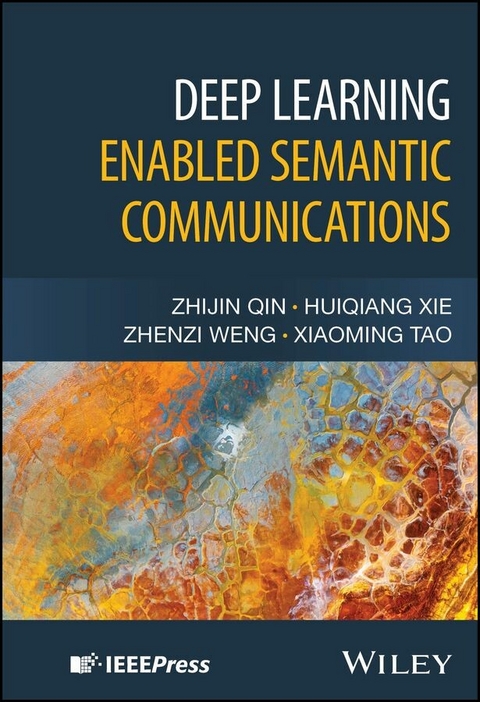
Deep Learning Enabled Semantic Communications (eBook)
175 Seiten
Wiley-IEEE Press (Verlag)
978-1-394-30625-1 (ISBN)

Comprehensive overview of the principles, theories, and techniques behind deep learning enabled semantic communications
Deep Learning Enabled Semantic Communications explores the synergy between deep learning and semantic communication, particularly in the context of advancing 6G networks. It provides a focused introduction to the subject, systematically covering deep learning enabled semantic communication systems and task-oriented semantic transmission paradigms in wireless communication.
The book reviews various aspects of semantic communications, including information theory, multimodal technologies, semantic noise, and semantic sensing. It explores cutting-edge semantic communication architectures, highlighting their advantages over traditional approaches and their potential to drive the future of intelligent information industry. The book also details applications of deep learning-based semantic communication systems across various sources, including text, speech, images, and videos, comprehensively addressing system design, performance optimization, and measurement metrics.
The book is divided into eight main parts, which cover foundational knowledge, system design, multimodal and multitask-oriented semantic communication systems, joint semantic sensing and sampling, semantic noise suppression, and generative AI enabled systems.
Written by a diverse group of experts in academia and research institutions, Deep Learning Enabled Semantic Communications includes information on:
- Fundamental knowledge about deep learning and semantic communications, including the history, neural networks, and semantic information theory
- Compression of multimodal inputs, extraction of global semantic information, and the design of neural networks to boost the capability of handling lengthy speech
- Incorporation of different sources to extract semantic features and serve diverse intelligent tasks at the receiver
- Introduction of semantic impairments in communications to uncover how to design robust systems
- Joint design of data sampling, compression, and coding schemes under the guidance of semantic information
- Framework of generative semantic communications to detail the principles of incorporating generative models into semantic communications
Deep Learning Enabled Semantic Communications is an essential learning resource and reference for graduate and undergraduate students pursuing degrees in wireless communications, signal processing, or deep learning as well as engineers in the telecommunications and IT industries focusing on wireless communication techniques.
Zhijin Qin is an Associate Professor with Tsinghua University, China. She is an Associate Editor for IEEE Transactions on Communications, IEEE Transactions on Cognitive Networking, and IEEE Communications Letters.
Huiqiang Xie, PhD, is an Associate Professor at Jinan University, Guangzhou, Guangdong, China.
Zhenzi Weng is a Postdoctoral researcher at Imperial College London, UK.
Xiaoming Tao is a Professor with the Department of Electronic Engineering at Tsinghua University. She is also a Senior Member of the IEEE.
| Erscheint lt. Verlag | 25.11.2025 |
|---|---|
| Sprache | englisch |
| Themenwelt | Technik ► Elektrotechnik / Energietechnik |
| Schlagworte | Communication Principles • Information Theory • multimodal semantic communications • semantic communication architectures • semantic communication systems • semantic noise • semantic sensing • semantic system design • Speech Input |
| ISBN-10 | 1-394-30625-3 / 1394306253 |
| ISBN-13 | 978-1-394-30625-1 / 9781394306251 |
| Informationen gemäß Produktsicherheitsverordnung (GPSR) | |
| Haben Sie eine Frage zum Produkt? |
 PDF (Adobe DRM)
Kopierschutz: Adobe-DRM
Adobe-DRM ist ein Kopierschutz, der das eBook vor Mißbrauch schützen soll. Dabei wird das eBook bereits beim Download auf Ihre persönliche Adobe-ID autorisiert. Lesen können Sie das eBook dann nur auf den Geräten, welche ebenfalls auf Ihre Adobe-ID registriert sind.
Details zum Adobe-DRM
Dateiformat: PDF (Portable Document Format)
Mit einem festen Seitenlayout eignet sich die PDF besonders für Fachbücher mit Spalten, Tabellen und Abbildungen. Eine PDF kann auf fast allen Geräten angezeigt werden, ist aber für kleine Displays (Smartphone, eReader) nur eingeschränkt geeignet.
Systemvoraussetzungen:
PC/Mac: Mit einem PC oder Mac können Sie dieses eBook lesen. Sie benötigen eine
eReader: Dieses eBook kann mit (fast) allen eBook-Readern gelesen werden. Mit dem amazon-Kindle ist es aber nicht kompatibel.
Smartphone/Tablet: Egal ob Apple oder Android, dieses eBook können Sie lesen. Sie benötigen eine
Geräteliste und zusätzliche Hinweise
Buying eBooks from abroad
For tax law reasons we can sell eBooks just within Germany and Switzerland. Regrettably we cannot fulfill eBook-orders from other countries.
aus dem Bereich