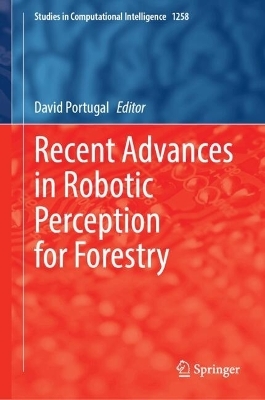
Recent Advances in Robotic Perception for Forestry
Springer International Publishing (Verlag)
978-3-032-15811-6 (ISBN)
- Noch nicht erschienen - erscheint am 04.03.2026
- Versandkostenfrei
- Auch auf Rechnung
- Artikel merken
This book addresses all aspects of artificial perception in forest environments, including localization, mapping, traversability analysis, semantic segmentation, metric-semantic mapping, scene understanding, and multi-robot architectures. Forests are among the most complex and challenging environments for robotic perception. They are dynamic, unstructured, and unpredictable, with variable weather and lighting conditions, dense canopy, rough terrain, and unreliable GNSS signals. These conditions have delayed the large-scale introduction of autonomous systems into forestry, despite the clear potential for robotics to transform tasks such as landscape maintenance, wildfire prevention, tree health monitoring, and precision harvesting.
Recent Advances in Robotic Perception for Forestry explores innovative developments that aim to bridge this gap. It addresses advances in sensing, perception, and learning and how they enable autonomous ground, aerial, and manipulator systems to operate effectively in forested landscapes.
Forestry robotics is an emerging field at the intersection of automation, AI, and sustainable land management. Tasks that are often dangerous or physically demanding for humans can, in many cases, be reliably perceived and executed by robots. This book discusses current technologies, ongoing research, and future directions in areas such as multi-sensor fusion, robust navigation, environmental monitoring, and precision forestry.
Featuring contributions from leading researchers, this book offers both foundational insights and practical solutions. It is designed for academics, engineers, and industry professionals interested in applying robotic perception to real-world forestry problems, pushing the frontier of sustainable automation in one of the most demanding domains for robotics.
David Portugal holds a M.Sc. degree (2009) in Electrical Engineering and Computers and a Ph.D. (2014) in Automation and Robotics from the University of Coimbra (UC), Portugal. His main research interests include artificial perception, localization and mapping, sensor fusion, distributed multi-robot systems, robot software architectures, and hardware integration for mobile robots. Over the course of his career, he has developed deep expertise in these areas, combining academic research with applied innovation. Currently, Dr. Portugal is an assistant professor at the University of Coimbra and a Senior Researcher at the Institute of Systems and Robotics of the University of Coimbra (ISR-UC). He has played an active role in numerous European and national research projects, including CHOPIN, TIRAMISU, Social Robot, CogniWin, GrowMeUp, STOP, CORE, SEMFIRE, WoW, 5GSmartFact, TRUSTID, Packaging of the Future, AIGreenBots, ForestSphere, and RUGGED. These projects span the areas of applied robotics, human-robot interaction, sensor fusion.
Current landscape on artificial perception for outdoor robotics for a sustainable environment.- Modular multisensing backpack for forest data acquisition and precise positioning with GNSS-RTK support.- Robust sensor integration and operation for vehicles in rough environments.- ENTFAC: A comprehensive multi-sensor dataset for perception systems in forest environments.- Deep learning for forest inventory from remotely sensed imagery: Current progress and future directions.- Color - Texture fusion - Based image classification of tree species for autonomous forest mapping.- A lightweight CNN and UAV framework for early detection of Oak wilt in forest health management.- Synthetic data augmented leaflet-level ash dieback detection.- From pixels to pathways: Assessing modern deep learning segmentation techniques in natural landscapes.- Real-time fisheye frame stabilization.- LiDAR point cloud semantic segmentation for forest applications.- Advancing diameter at breast height estimation: A trunk segmentation approach.- Lost in the woods? A survey of localization strategies for forest robotics.- A comparative field study of modern LiDAR-based odometry methods in natural environments.- Performance measures for autonomous operation in forest environments.- Impact of proprioceptive data on traversability analysis: An ablation study in forest environments.- Cooperative perception in outdoor robotics for a sustainable environment.- From concept to reality: Deploying 5G enabled robots in complex forest scenarios.- Where to perch in a tree: Vision-guidance for tree-grasping drones.- Aerial robotics for environmental dna surveys: Current developments and future opportunities for biodiversity monitoring in tree canopies.- Robotics for forest status assessments.- DigiForest: Digital analytics and robotics for sustainable forestry.
| Erscheint lt. Verlag | 4.3.2026 |
|---|---|
| Reihe/Serie | Studies in Computational Intelligence |
| Zusatzinfo | X, 602 p. 237 illus., 219 illus. in color. |
| Verlagsort | Cham |
| Sprache | englisch |
| Maße | 155 x 235 mm |
| Themenwelt | Technik ► Elektrotechnik / Energietechnik |
| Schlagworte | Artificial Perception • Computational Intelligence • Field Robotics • Forestry Robotics • Localization • mapping • Robotic Perception |
| ISBN-10 | 3-032-15811-7 / 3032158117 |
| ISBN-13 | 978-3-032-15811-6 / 9783032158116 |
| Zustand | Neuware |
| Informationen gemäß Produktsicherheitsverordnung (GPSR) | |
| Haben Sie eine Frage zum Produkt? |
aus dem Bereich