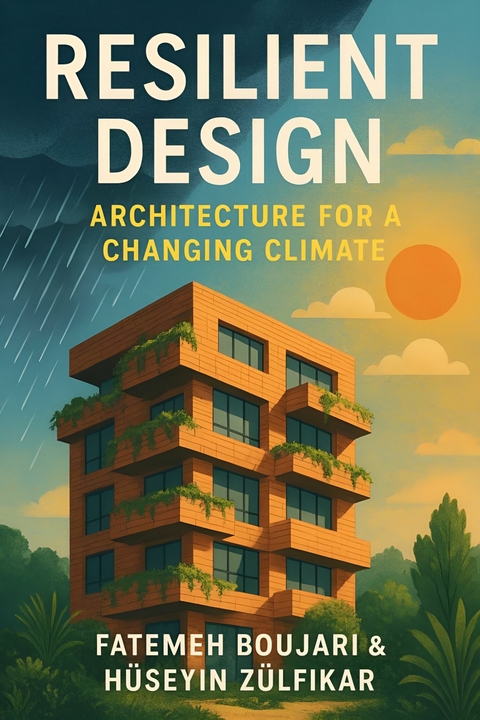
Resilient Design (eBook)
96 Seiten
Publishdrive (Verlag)
978-0-00-110565-2 (ISBN)
In an era defined by climate uncertainty, Resilient Design: Architecture for a Changing Climate presents a transformative vision for the built environment. Moving beyond traditional sustainability, this book explores resilience as a dynamic, ecological, and ethical framework, guiding architects and planners to design buildings and cities that adapt, regenerate, and thrive. From living buildings that breathe, heal, and evolve, to urban ecosystems that integrate social equity, biodiversity, and cultural continuity, it reveals how design can respond to environmental and societal disruption with intelligence and empathy. Drawing on cutting-edge material innovations, nature-based strategies, and participatory approaches, the book demonstrates that resilience is not merely technical-it is a philosophy, a moral imperative, and a creative opportunity. Rich in insight and inspiration, it challenges readers to reimagine architecture as a force that restores balance, nurtures life, and fosters hope in a changing world.
Introduction
Architecture has always stood at the intersection of human aspiration and environmental limitation. For millennia, people have shaped their surroundings not merely to shelter themselves but to express identity, culture, and power. Yet, in the twenty-first century, architecture faces a challenge more profound than any before it: the climate crisis. Rising seas, intensifying storms, prolonged droughts, and unprecedented heatwaves are redrawing the boundaries of habitability, forcing the built environment to reckon with its own fragility. The modern city, once celebrated as the pinnacle of progress, has become a primary source of carbon emissions and ecological degradation. Concrete, glass, and steel—symbols of modernity—now echo as reminders of our unsustainable trajectory. Within this crisis, however, lies an opportunity: the chance to reimagine architecture not as an agent of destruction but as an instrument of resilience and renewal.
Resilient design represents this paradigm shift. It is more than a trend or a technical response; it is a philosophy of coexistence. Where traditional architecture sought permanence, resilient design embraces adaptability. Where modernism pursued control over nature, resilience seeks harmony with it. The very notion of resilience challenges the illusion of stability that underpinned industrial civilization. Instead of resisting change, resilient architecture accepts transformation as the essence of survival. It asks architects, planners, and communities to think not in terms of static solutions but in terms of dynamic systems—structures that evolve with their environment rather than against it.
This philosophy is inseparable from the broader context of planetary transformation. Climate change is not an isolated environmental phenomenon; it is a systemic disruption that touches every aspect of society. It alters where we live, how we build, what materials we use, and even the cultural meanings we assign to space. The Anthropocene—the era in which human activity has become a geological force—has blurred the line between natural and artificial. Architecture, once seen as an art of creating order amidst nature, now finds itself constructing within a damaged ecosystem. Every building is, in some way, a negotiation between human need and planetary constraint. The resilient designer must therefore act as both creator and caretaker, innovator and ecologist, engineer and philosopher.
To understand resilience in architecture, one must first confront the limits of the modernist legacy. The twentieth century, driven by industrial optimism, celebrated efficiency, uniformity, and technological mastery. From Le Corbusier’s radiant cities to Mies van der Rohe’s glass towers, modern architecture sought universality: one language, one system, one future. Yet this vision, while revolutionary, was built upon a dangerous assumption—that human ingenuity could transcend ecological boundaries. The result was a global built environment that often ignored local climates, cultural contexts, and ecological systems. Air conditioning replaced passive cooling; concrete replaced vernacular materials; highways fragmented landscapes; and cities sprawled beyond their ecological capacity. The modernist dream of progress became, inadvertently, an architecture of vulnerability.
Resilient design emerges as a counter-narrative to this legacy. It does not reject modernism’s ambition for better living but redefines what “better” means. In place of endless growth, it proposes endurance. Instead of imposing uniformity, it values diversity—of materials, climates, species, and communities. It reclaims the wisdom embedded in vernacular traditions, where architecture evolved in dialogue with local ecosystems. The thick walls of desert dwellings, the elevated stilt houses of flood-prone regions, and the shaded courtyards of Mediterranean towns are not relics of the past but blueprints for the future. These architectures, born of necessity and refined by centuries of adaptation, embody principles of resilience long before the term entered academic discourse.
At its core, resilient design is an ethical stance. It acknowledges that the built environment is inseparable from the biosphere that sustains it. Every choice—of material, form, or site—has ecological consequences. The extraction of resources, the production of energy, and the generation of waste are all part of architecture’s hidden narrative. To design resiliently is to design with awareness: to anticipate not only the immediate needs of occupants but the long-term effects on ecosystems and generations yet to come. This ethical awareness transforms architecture from an act of consumption into an act of stewardship.
Resilience, however, is not merely about sustainability in the conventional sense. Sustainability often implies maintenance—a balance that can be preserved indefinitely. But in an era of accelerating change, balance itself may be unattainable. The climate system is not stable; it is dynamic, nonlinear, and unpredictable. Thus, resilience focuses not on preserving equilibrium but on enhancing adaptability. A resilient building does not merely withstand shock; it learns, absorbs, and transforms. It is a living system, capable of responding to new conditions without collapsing. The architectural equivalent of a forest that regenerates after fire, a resilient structure may adapt to flooding, absorb energy fluctuations, or evolve through modularity and flexibility. It embodies the capacity for renewal embedded within nature itself.
Technology plays a crucial role in this transformation, yet it is not a panacea. The temptation to rely solely on innovation—to imagine that smart systems or advanced materials will “solve” the climate crisis—is another form of denial. True resilience arises from integration, not substitution. Digital modeling, renewable energy systems, and biophilic materials must coexist with social equity, community empowerment, and cultural continuity. Architecture, after all, is a social art. A building is not resilient if it protects the wealthy while displacing the vulnerable. Urban resilience cannot exist where inequality persists. The climate crisis, like architecture, is deeply political; it reveals the fractures of our societies as much as the fragility of our infrastructure. Therefore, the resilient architect must design not only for buildings but for justice—for systems that protect all, not just some.
In this sense, resilience bridges the gap between the ecological and the ethical, between design and democracy. It redefines progress not as domination over the environment but as participation within it. The city of the future may no longer be a monument to human conquest but a landscape of coexistence—porous, green, decentralized, and regenerative. Such a city will not seek to eliminate risk but to live intelligently with it. Floodable parks, flexible public spaces, and buildings designed to breathe rather than seal themselves off are not signs of weakness but expressions of maturity. They represent an acceptance that resilience is not about invulnerability; it is about wisdom—the wisdom to endure, adapt, and flourish amid uncertainty.
Material innovation is a critical component of this movement. The rediscovery of natural materials—bamboo, rammed earth, mycelium composites, and bio-based polymers—signals a shift toward regenerative material cycles. These materials do not merely reduce carbon emissions; they participate in the life cycle of the planet. Equally, the reuse and retrofitting of existing structures redefine resilience in temporal terms. The most sustainable building, as the adage goes, is the one that already exists. Adaptive reuse transforms decay into continuity, allowing architecture to evolve organically rather than through erasure. In a world overwhelmed by waste, the act of reimagining old buildings becomes a gesture of profound ecological respect.
Yet resilience is not confined to materials or forms; it is also an emotional and cultural phenomenon. Climate change has generated not only physical destruction but also a sense of collective grief and anxiety. The loss of familiar landscapes, the uncertainty of future habitability, and the erosion of environmental identity create what psychologists call “eco-anxiety.” Architecture can play a therapeutic role here. Spaces that reconnect people with nature—through light, texture, water, and vegetation—help rebuild psychological resilience. The presence of greenery in urban environments, access to daylight, and the tactility of natural materials foster well-being. In this sense, resilient architecture heals both planet and psyche.
Moreover, resilience challenges the temporal assumptions of architectural practice. Buildings have traditionally been designed for permanence, their lifespans measured in decades or centuries. But as the climate destabilizes, permanence becomes an illusion. Rising sea levels, shifting coastlines, and new migration patterns demand architectures that are temporary, mobile, or modular. Ephemeral structures—once dismissed as secondary—may now hold the key to long-term adaptability. A shelter that can be dismantled, transported, and rebuilt is no longer a sign of impermanence but a model of resilience. Time itself becomes a design parameter, shaping not only how buildings stand but how they evolve.
Urban planning, too, must evolve. The megacity—a product of industrial concentration—is increasingly vulnerable to systemic shocks. Power outages, heatwaves, and floods expose the fragility of centralized infrastructures. Resilient urbanism advocates decentralization: distributed energy grids, localized food systems, and community-based governance. The resilient city is...
| Erscheint lt. Verlag | 17.11.2025 |
|---|---|
| Sprache | englisch |
| Themenwelt | Technik ► Architektur |
| ISBN-10 | 0-00-110565-5 / 0001105655 |
| ISBN-13 | 978-0-00-110565-2 / 9780001105652 |
| Informationen gemäß Produktsicherheitsverordnung (GPSR) | |
| Haben Sie eine Frage zum Produkt? |
 EPUB (Adobe DRM)
Größe: 2,4 MB
Kopierschutz: Adobe-DRM
Adobe-DRM ist ein Kopierschutz, der das eBook vor Mißbrauch schützen soll. Dabei wird das eBook bereits beim Download auf Ihre persönliche Adobe-ID autorisiert. Lesen können Sie das eBook dann nur auf den Geräten, welche ebenfalls auf Ihre Adobe-ID registriert sind.
Details zum Adobe-DRM
Dateiformat: EPUB (Electronic Publication)
EPUB ist ein offener Standard für eBooks und eignet sich besonders zur Darstellung von Belletristik und Sachbüchern. Der Fließtext wird dynamisch an die Display- und Schriftgröße angepasst. Auch für mobile Lesegeräte ist EPUB daher gut geeignet.
Systemvoraussetzungen:
PC/Mac: Mit einem PC oder Mac können Sie dieses eBook lesen. Sie benötigen eine
eReader: Dieses eBook kann mit (fast) allen eBook-Readern gelesen werden. Mit dem amazon-Kindle ist es aber nicht kompatibel.
Smartphone/Tablet: Egal ob Apple oder Android, dieses eBook können Sie lesen. Sie benötigen eine
Geräteliste und zusätzliche Hinweise
Buying eBooks from abroad
For tax law reasons we can sell eBooks just within Germany and Switzerland. Regrettably we cannot fulfill eBook-orders from other countries.
aus dem Bereich