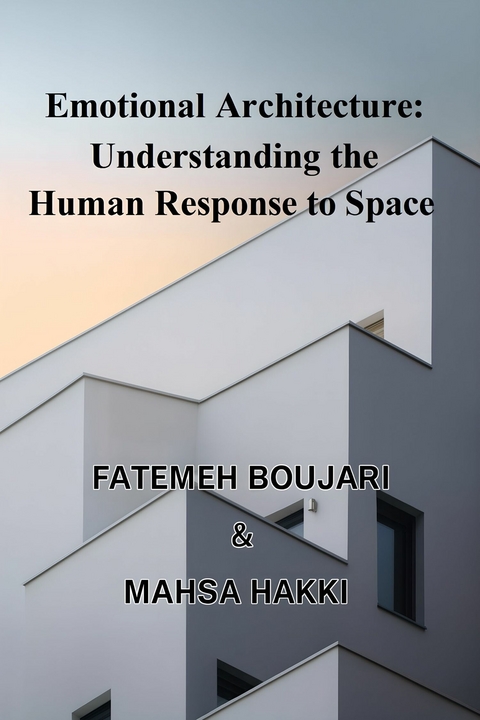
Emotional Architecture (eBook)
116 Seiten
Publishdrive (Verlag)
978-0-00-110516-4 (ISBN)
Emotional Architecture: Understanding the Human Response to Space explores the invisible yet powerful relationship between the built environment and human emotion. From the tactile resonance of materials to the rhythm of light and shadow, from personal memory to collective urban experience, this book reveals how spaces shape mood, behavior, and social connection. Combining insights from neuroscience, psychology, and design practice, it demonstrates how architects and planners can create environments that nurture well-being, empathy, and meaning. This book is a guide for anyone seeking to understand, design, or inhabit spaces that truly feel alive.
Introduction
Architecture is more than the arrangement of walls, ceilings, and voids. It is the silent composition of human experience. Every building we enter holds a conversation with us — one that rarely uses words, yet leaves deep emotional traces on our bodies and memories. The spaces we inhabit, the textures we touch, the sounds that reverberate in hallways, and the light that filters through the air all participate in a profound choreography that shapes how we feel, how we think, and ultimately, who we are. Architecture does not merely contain life; it conditions it. It is the most permanent form of emotion ever built by human hands.
To understand architecture emotionally is to shift attention from the monumental to the intimate — from the façade to the feeling, from the drawing to the dwelling. We often analyze buildings as visual or functional objects, but far less often do we explore them as emotional landscapes. Yet the true test of architecture’s success is not how it looks in photographs or blueprints, but how it feels when lived, breathed, and remembered. A corridor may compress us into anxiety; a courtyard may open us into peace. A cathedral may invoke transcendence; a hospital ward may amplify despair. These reactions are not random. They are the result of invisible relationships between proportion, light, material, and human perception. Architecture, in this sense, is a language of emotion articulated through space.
The emotional dimension of architecture emerges at the intersection of body and environment. Every sensory input — the temperature of a room, the echo of footsteps, the smell of old wood — becomes data for the brain’s continuous negotiation of comfort and meaning. Neuroscience confirms what phenomenology intuited long ago: space affects mood, cognition, and even physiology. When we enter a dimly lit corridor, the narrowing of light and the compression of space trigger instinctive caution. When we stand under a high dome, our breath slows, our gaze lifts, and we feel the ancient stirring of awe. These reactions are primal and pre-rational; they belong to the same evolutionary architecture that once guided us through forests and caves. Modern environments, despite their concrete and glass, still converse with the oldest layers of the human mind.
Yet the emotional power of architecture is not limited to instinct. It also participates in memory and culture. A childhood home, no matter how modest, becomes sacred through the accumulation of lived emotion. Its architecture is remembered not in dimensions but in sensations — the creak of a stair, the pattern of afternoon light on the wall, the smell of rain against the window. In this way, emotion turns architecture into autobiography. Every space we have ever loved or feared becomes part of our personal mythology. When architects design new environments, they are in dialogue not only with site and function but also with the invisible archive of human memory that every visitor carries inside.
Emotion in architecture is therefore both universal and particular. Light is universal; nostalgia is personal. The same courtyard that inspires calm in one culture might evoke emptiness in another. This duality reveals that emotional architecture is not a fixed formula but a living conversation between designer, inhabitant, and context. The architect provides a framework, but meaning is co-created by those who experience it. A space is never finished when construction ends; it begins to live only when it is felt. The emotional resonance of architecture evolves with time — as walls age, as uses change, as the city around it transforms. Every building gathers emotional sediment, becoming a palimpsest of human experience.
To understand emotional architecture fully, we must expand our methods of interpretation. Traditional architectural theory often privileges vision — the image of the building, its form, its geometry. But emotional architecture asks us to listen as much as to look, to feel as much as to analyze. Sound, temperature, scent, rhythm, and even silence become essential tools of comprehension. A space’s emotional identity may lie not in what it contains but in what it allows — in the pauses between walls, the gradations of light, the invitation to linger. Architecture thus becomes a temporal art: its meaning unfolds in the duration of experience, not in the instant of perception. Time is the true medium through which emotion inhabits space.
If architecture has the power to move us, it also has the power to heal or harm. Hospitals designed without daylight can deepen depression. Schools without acoustic comfort can breed distraction. Public spaces without a sense of belonging can reinforce social alienation. Conversely, architecture that honors emotional well-being can restore dignity, calm, and hope. Emotional architecture, therefore, is not an indulgence; it is an ethical responsibility. To build without considering emotional consequence is to build without empathy. The city, in this light, is a vast emotional ecosystem — a collective architecture of feeling that shapes civic identity and human connection.
Emotional design does not rely on ornament or spectacle. It arises from integrity — from the careful calibration of proportion, texture, and atmosphere. The emotional resonance of space can be found in the quiet simplicity of a monastery or the raw honesty of industrial architecture as much as in grand cathedrals or museums. What matters is authenticity: the alignment between purpose, material, and experience. When architecture speaks truthfully, it allows emotion to emerge naturally. A humble brick wall, when well-lit and well-placed, can carry more emotional weight than a gilded façade. The task of emotional architecture is not to manipulate but to reveal — to allow the inherent potential of space to engage the deepest registers of human feeling.
At its core, emotional architecture is a study of relationship — between self and environment, between the tangible and the invisible. Each space invites a particular mode of being. Some call us to gather; others call us to retreat. Some open us to wonder; others hold us in contemplation. These affective invitations are shaped by countless design decisions: the height of a ceiling, the direction of light, the rhythm of repetition, the choice of material. Yet their sum is greater than their parts. The emotion of space is not an additive property; it is emergent. It arises from the harmony or dissonance of multiple elements working together, much like music. A space can be as serene as a slow chord or as tense as unresolved dissonance. Architecture, when understood emotionally, is spatial music for the body.
To feel architecture is to acknowledge that space is never neutral. Every built environment carries an implicit ideology about how humans should move, interact, and exist. Monumental stairs command reverence; open plazas encourage gathering; glass facades suggest transparency but often conceal control. These spatial choices condition behavior subtly, shaping social and emotional life. Emotional architecture thus intersects with politics and ethics: it reveals what a society values in its collective spaces. A culture that builds with warmth and intimacy expresses a different emotional vision of humanity than one that builds with isolation and surveillance. The emotional tone of architecture is the emotional tone of civilization itself.
As cities grow denser and digital life erodes physical interaction, the emotional literacy of architecture becomes even more urgent. Screens may simulate connection, but they cannot replace the multisensory richness of place. Our bodies crave spatial intimacy — the tactile feedback of material, the rhythm of light, the acoustics of togetherness. Emotional architecture offers a path back to embodiment, reminding us that we inhabit the world not only through thought but through skin. It reclaims architecture as a medium of empathy, as a spatial practice that reawakens our sensory and emotional intelligence.
The future of architectural practice depends on rediscovering this human core. Emerging technologies like parametric design, VR modeling, and AI optimization offer extraordinary precision, yet risk alienating the emotional dimension if not guided by sensitivity. The challenge is to integrate technological innovation with emotional intelligence — to design environments that are not only efficient and sustainable but also humane and meaningful. Emotional architecture must therefore operate at multiple scales: from the intimacy of a room to the complexity of the city, from individual affect to collective mood. It is a bridge between neuroscience and poetics, between data and desire.
Ultimately, the study of emotional architecture is an act of listening — listening to what spaces do to us, to what they make us remember, to how they make us feel alive. Each person experiences space differently, but across these differences lies a shared truth: that architecture is a mirror of the soul. We project our fears and hopes into it, and it, in turn, shapes the contours of our inner life. To design or to inhabit space is to participate in a dialogue between matter and emotion, presence and memory. Architecture, then, is not only the art of building but the art of feeling — the crafting of atmospheres that speak the unspoken language of the human heart.
In tracing the emotional dimension of architecture, this book aims to expand the vocabulary through which we understand space. It is not a manual of design principles, but a meditation on how architecture moves us, heals us, and sometimes haunts us. It draws from philosophy, psychology, and art to illuminate the ways in which built environments become extensions of...
| Erscheint lt. Verlag | 17.11.2025 |
|---|---|
| Sprache | englisch |
| Themenwelt | Technik ► Architektur |
| ISBN-10 | 0-00-110516-7 / 0001105167 |
| ISBN-13 | 978-0-00-110516-4 / 9780001105164 |
| Informationen gemäß Produktsicherheitsverordnung (GPSR) | |
| Haben Sie eine Frage zum Produkt? |
 EPUB (Adobe DRM)
Größe: 1,0 MB
Kopierschutz: Adobe-DRM
Adobe-DRM ist ein Kopierschutz, der das eBook vor Mißbrauch schützen soll. Dabei wird das eBook bereits beim Download auf Ihre persönliche Adobe-ID autorisiert. Lesen können Sie das eBook dann nur auf den Geräten, welche ebenfalls auf Ihre Adobe-ID registriert sind.
Details zum Adobe-DRM
Dateiformat: EPUB (Electronic Publication)
EPUB ist ein offener Standard für eBooks und eignet sich besonders zur Darstellung von Belletristik und Sachbüchern. Der Fließtext wird dynamisch an die Display- und Schriftgröße angepasst. Auch für mobile Lesegeräte ist EPUB daher gut geeignet.
Systemvoraussetzungen:
PC/Mac: Mit einem PC oder Mac können Sie dieses eBook lesen. Sie benötigen eine
eReader: Dieses eBook kann mit (fast) allen eBook-Readern gelesen werden. Mit dem amazon-Kindle ist es aber nicht kompatibel.
Smartphone/Tablet: Egal ob Apple oder Android, dieses eBook können Sie lesen. Sie benötigen eine
Geräteliste und zusätzliche Hinweise
Buying eBooks from abroad
For tax law reasons we can sell eBooks just within Germany and Switzerland. Regrettably we cannot fulfill eBook-orders from other countries.
aus dem Bereich