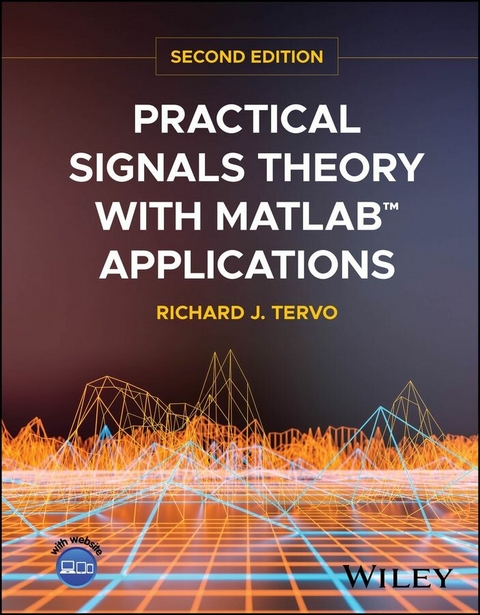
Practical Signals Theory with MATLAB Applications (eBook)
1047 Seiten
Wiley (Verlag)
978-1-394-26656-2 (ISBN)
A hands-on resource designed to teach the mathematics of signals and systems with MATLAB?
In this newly revised second edition of Practical Signals Theory with MATLAB? Applications, Richard Tervo delivers an articulate presentation of the mathematics underlying real world engineering applications and everyday electronic devices. The new edition provides extended coverage of communication systems-including digital and spread spectrum communications-as well as a new introductory chapter on using MATLAB? as a tool to visualize the mathematics of signals and systems.
The text contains numerous hands-on examples and expanded end-of-chapter exercises. It is a one-stop reference for signals and systems, explaining aspects of commonplace signal types, orthogonality and signal decomposition, transformations, and the graphical presentation of calculations and results. Readers will also find:
- A solid introduction to the mathematics of continuous and discrete signals represented in time and frequency domains
- Thorough coverage of the classic Fourier, Laplace and z-transforms, and their many applications
- New end-of-chapter worked exercises, a variety of in-line study questions with answers and easily reproducible MATLAB? code demonstrations
- Bonus material on related applications in different fields of study and a companion website designed to support additional learning
Perfect for undergraduate and graduate students of signals and systems, signals theory, and related areas of electrical engineering, Practical Signals Theory with MATLAB? Applications will also benefit researchers and professors in the field of system design and signal processing.
Richard J. Tervo, PhD, is a retired Professor of Electrical and Computer Engineering at the University of New Brunswick, Canada. For over 30 years, he taught signals and communications courses at the undergraduate and graduate levels. He is an expert in teaching the mathematical foundations of signal behavior.
Preface
The title Practical Signals Theory underscores the reality that engineers use mathematics as a tool for practical ends, often to gain a better understanding of the behavior of the world around them and just as often simply to save time and work. True to this notion, signals theory offers both a means to model complex real-world systems using consistent mathematical methods and a way to avoid tedious manipulations by leveraging the efforts of mathematicians and engineers who have already done it the hard way. Thus, signals theory includes the famous transformations named after Fourier and Laplace, designed to view real systems from advantageous new perspectives. Frequency and phase responses are easily sketched with pencil and ruler, following in the footsteps of Bode, and modern digital signal processing owes a debt to Nyquist. Moreover, in every equation or formula, there is a clue that relates to something real and that may already be very familiar.
Practical Signals Theory was written specifically to present the essential mathematics of signals and systems through an intuitive and graphical approach in which theory and principles emerge naturally from the observed behavior of familiar systems. To this end, new theorems are accompanied by real-world examples, graphical demonstrations, and encouragement to check results for consistency. From the first pages, even the most basic mathematical relationships are re-examined in a way that will lend their use to the practical application of signals theory. This approach is further supported by the powerful yet accessible mathematical and graphical tools of MATLAB, which has become a standard for electrical engineering students around the world.
Pedagogy
Any presentation of signals theory to an undergraduate audience must confront the inevitable compromise between keeping the subject material accessible to the modern student and maintaining the level of mathematical rigor that is the cornerstone of engineering studies. While the philosophical issues surrounding rigor are hardly new, it is perhaps ironic, in this course especially, that many of the distractions now available to students have come about from commercial applications of signals theory.1 The presentation of material in this text proceeds through a carefully paced progression of concepts using sketches and practical examples to motivate appreciation of the essential elements of signals theory. To that end, the ability to visualize signals and their transforms is developed as an important skill that complements a full appreciation of the underlying mathematics. Indeed, knowing why the math works and how signals interact through established principles is what distinguishes true understanding from the rote ability to memorize and to manipulate formulas and equations. Indeed, whenever a signal is seen on an instrument or in some graphical or numerical output, the important question does it make sense? can only be answered if the expected behavior can be readily reasoned and visualized. Underpinning this approach, the use of MATLAB is presented as a versatile tool to define, manipulate, display, and ultimately to better understand the theory of signals and systems. The strengths of this text include:
- The use of MATLAB is introduced as a quick and convenient way to view and manipulate signals and systems. An introductory chapter provides an overview of important MATLAB features and the mathematics that will be used throughout the text. Examples are limited to functions that are available in the MATLAB Student Version.
- The use of hand-drawn sketches is encouraged when exploring the properties of signals and their manipulation; this is extended to creating quick plots using MATLAB. This practice serves to build confidence in the theory and in the results obtained when doing homework or on the job.
- New and interesting signal properties are revealed, and the underlying theory is developed by testing different ideas on known equations. After derivations or calculations, answers are checked for consistency and to compare to expected outcomes.
- Introductory sections review fundamental mathematics and important time domain functions while laying the groundwork for the transform domain manipulations to follow. Essential mathematical skills are reexamined when first encountered. During a derivation or example calculation, care is taken to include intermediate steps to maintain focus and clarity of presentation.
- Transform domains are presented as different perspectives on the same signal whereby properties and signal behavior are linked through the underlying mathematics.
- The mathematics of orthogonal signals, the Fourier series, the Fourier transform (both continuous and discrete), the Laplace transform, and the -transform are thoroughly covered and compared. Examples and applications of different techniques, while focusing on electrical engineering, are drawn from a range of subject areas.
- Fourier analysis is defined around a notation rather than , which lends itself well to discussions of frequency and avoids awkward rescaling terms. The conventional use of is employed for Laplace and -transform expositions.
- Every chapter ends with a selection of Worked Problems that present detailed solutions and alternate approaches to solving each problem.
- MATLAB toolbox features of special interest to signals and systems are used to confirm and to illustrate example exercises. In this way, the behavior of systems modeled as a continuous or discrete transfer function or state space equation can readily be studied as a Bode diagram, pole-zero plot, impulse response, or step response.
- The appendices include useful reference tables and feature illustrated transforms that graphically present transform pairs side by side and which highlight important properties relating the time and transform domains.
Organization
This introductory text covers signals and linear systems theory, including continuous time and discrete time signals, the Fourier transform, the Laplace transform, and the -transform. The sequence follows through continuous time signals and systems, orthogonality, the Fourier series, the Fourier transform, the Laplace transform, discrete time signals including the sampling theorem, the DTFT and DFT, and the z-transform. The final chapter on communications systems provides a wealth of practical applications of signals theory and will be of special interest to students who may not otherwise take a communications systems course as part of their core curriculum.
Each chapter integrates numerous MATLAB examples and illustrations. Particular use is made of the MATLAB system definitions based on transfer function, zero-pole gain model, or state space model to study the behavior of linear systems using the impulse response, step response, Bode diagram, and pole-zero plot. The ability to model and to examine simple systems with these tools is an important skill that complements and reinforces an understanding of the mathematical concepts and manipulations.
Chapter 1: Practical MATLAB with Signals Theory
An overview of MATLAB operations of specific interest in signals and systems is presented, while coding examples are chosen to review basic mathematical skills that will serve in later chapters. From exploring the MATLAB Desktop to using trigonometric functions and complex arithmetic, through the definition and use of scripts and (anonymous) functions to plotting waveforms and preparing presentation-ready graphs, readers will be well prepared for the chapters to follow. With these basic skills, the ability to quickly plot a signal or its components will ensure a powerful visual confirmation of results that illustrate fundamental theory.
Chapter 2: Introduction to Signals and Systems
Signals and systems and their interaction are developed beginning with simple and familiar signals and manipulations. Mathematical and graphical concepts are reviewed with emphasis on the skills that will prove most useful to the study of signals and systems. Shifting and scaling and linear combinations of time domain signals are sketched by hand. The frequency and phase characteristics of sinusoids are carefully examined, and the elements of a general sinusoid are identified. The impulse function, unit step, and unit rectangle signals are defined, and common elements of system block diagrams are introduced.
Chapter 3: Classification of Signals
Signals are identified as real or complex, odd or even, periodic or non-periodic, energy or power, continuous or discrete. Examples of common signals of all types and their definitions in MATLAB are introduced.
Chapter 4: Linear Systems
The linear time invariant system is defined. Convolution is examined in detail. System impulse response is introduced as well as causality.
Chapter 5: The Fourier Series
Various signals are represented in terms of orthogonal components. The special set of orthogonal sinusoids is introduced, first as the Fourier series and then as the complex Fourier series.
Chapter 6: The Fourier Transform
The Fourier transform is developed as a limiting case of the Fourier series. The definition of the Fourier transform and its properties follow, with emphasis on relating the time and frequency domain characteristics both mathematically and graphically.
Chapter 7: Practical Fourier Transforms
The introduction of the convolution theorem opens up the full potential of the Fourier transform in practical applications. The concept of transfer function is introduced,...
| Erscheint lt. Verlag | 13.11.2025 |
|---|---|
| Sprache | englisch |
| Themenwelt | Technik ► Elektrotechnik / Energietechnik |
| Schlagworte | Communication Systems • communication systems mathematics • digital communication systems • digital communication systems mathematics • Electrical Systems • electrical systems mathematics • MATLAB • signals and systems mathematics • Signals mathematics • signals theory mathematics |
| ISBN-10 | 1-394-26656-1 / 1394266561 |
| ISBN-13 | 978-1-394-26656-2 / 9781394266562 |
| Informationen gemäß Produktsicherheitsverordnung (GPSR) | |
| Haben Sie eine Frage zum Produkt? |
 EPUB (Adobe DRM)
Kopierschutz: Adobe-DRM
Adobe-DRM ist ein Kopierschutz, der das eBook vor Mißbrauch schützen soll. Dabei wird das eBook bereits beim Download auf Ihre persönliche Adobe-ID autorisiert. Lesen können Sie das eBook dann nur auf den Geräten, welche ebenfalls auf Ihre Adobe-ID registriert sind.
Details zum Adobe-DRM
Dateiformat: EPUB (Electronic Publication)
EPUB ist ein offener Standard für eBooks und eignet sich besonders zur Darstellung von Belletristik und Sachbüchern. Der Fließtext wird dynamisch an die Display- und Schriftgröße angepasst. Auch für mobile Lesegeräte ist EPUB daher gut geeignet.
Systemvoraussetzungen:
PC/Mac: Mit einem PC oder Mac können Sie dieses eBook lesen. Sie benötigen eine
eReader: Dieses eBook kann mit (fast) allen eBook-Readern gelesen werden. Mit dem amazon-Kindle ist es aber nicht kompatibel.
Smartphone/Tablet: Egal ob Apple oder Android, dieses eBook können Sie lesen. Sie benötigen eine
Geräteliste und zusätzliche Hinweise
Buying eBooks from abroad
For tax law reasons we can sell eBooks just within Germany and Switzerland. Regrettably we cannot fulfill eBook-orders from other countries.
aus dem Bereich