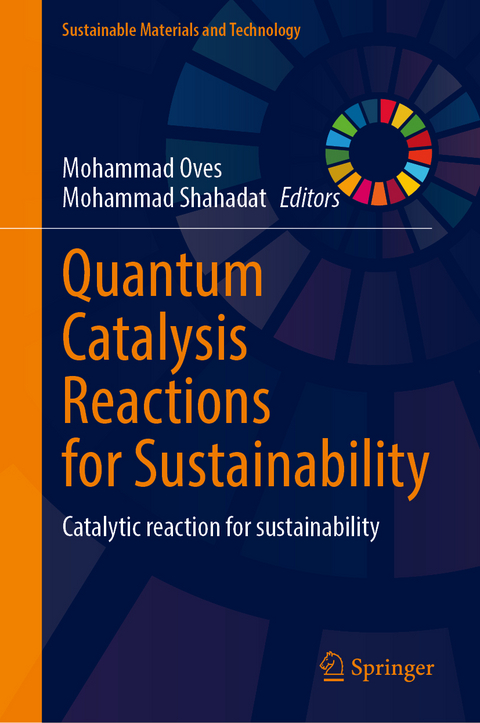
Quantum Catalysis Reactions for Sustainability
Springer Verlag, Singapore
978-981-95-6046-2 (ISBN)
- Titel nicht im Sortiment
- Artikel merken
Dr. Mohammad Oves (Ph.D.) is an Associate Professor at the Center of Excellence in Environmental Studies (CEES), King Abdulaziz University, Jeddah, Saudi Arabia. With over 15 years of multidisciplinary research experience, Dr. Oves has made significant contributions to environmental microbiology, nanobiotechnology, and biomedical sciences. He has participated in important research projects both internationally and nationally, such as the European Union FP7-funded SWINGS project, which aims to protect water resources in India using green and sustainable technologies, and projects in India funded by ICMR/CSIR that focus on creating nanoparticles from plant and bacterial extracts. His research integrates microbial biotechnology, nanomaterials, and AI-assisted predictive modeling to address pressing global challenges in environmental remediation, antimicrobial resistance, and sustainable nanomedicine development. Dr. Oves’s scientific portfolio includes innovative research on heavy-metal bioremediation, the antimicrobial activity of engineered nanomaterials, and eco-friendly biogenic nanoparticle synthesis. He has authored numerous high-impact publications, accumulating over 14,000 citations with an h-index of 51, reflecting his strong international research influence. A Lifetime Member of the Association of Microbiologists of India (AMI), Dr. Oves continues to advance modern research by integrating artificial intelligence tools with environmental and biomedical nanoscience to promote sustainable technological innovations. Dr. Mohammad Shahadat (Md. Shad), Ph.D., is a Senior Lecturer at the 3Institute of Oceanography and Environment (INOS), Universiti Malaysia Terengganu, Kuala Nerus 21030, Terengganu, Malaysia . He obtained his Doctorate and Master of Science degrees in Chemistry from Aligarh Muslim University (AMU), India, an institution renowned for its strong foundation in fundamental and applied chemical sciences. Following his Ph.D., Dr. Shahadat undertook a two-year Postdoctoral Fellowship at the School of Industrial Technology, USM, where he deepened his expertise in functional nanomaterials, environmental catalysis, and green reaction engineering. He later served as a DST-SERB Project Scientist at the Indian Institute of Technology (IIT) Delhi, where he explored the design of advanced materials and catalytic interfaces for sustainable industrial applications. Dr. Shahadat’s current research focuses on the quantum-level understanding of reaction dynamics in nanocomposite systems and their translation into sustainable chemical processes. His work emphasizes polyaniline-supported hybrid nanostructures, quantum-driven catalytic reactions, and nanomaterial-assisted energy conversion systems. By integrating quantum chemistry principles with experimental nanoscience, his studies aim to enhance reaction efficiency, reduce energy barriers, and promote zero-waste, low-carbon chemical transformations. Dr. Shad has published over 100 papers, 32 book chapters, and 4 Patents, and has edited numerous books in various peer-reviewed international journals of repute. He has significantly improved the design of microbial fuel cells for wastewater treatment, created piezoelectric nanogenerators for harvesting green energy, and developed quantum-optimized photocatalytic materials to break down pollutants. His multidisciplinary approach bridges materials chemistry, quantum reaction sustainability, and environmental nanotechnology, providing transformative pathways for renewable energy production and circular economy systems. Through his groundbreaking work, Dr. Shahadat is pushing the boundaries of sustainable chemistry that utilizes quantum principles, helping to create new ideas that support the United Nations' Sustainable Development Goals (SDGs), particularly in areas such as clean water, affordable energy, and climate action. Mohammad Shahadat (Md Shad), Ph.D., is working as a Senior Lecturer at the Institute of Oceanography and Environment (INOS), Universiti Malaysia Terengganu, Kuala Nerus 21030, Malaysia. He has completed his doctorate and M. Sc. from Aligarh Muslim University (AMU, Aligarh), U.P., India. He spent two years as a Post-Doctoral Fellow at USM, Malaysia's School of Industrial Technology. Later, he joined the Indian Institute of Technology, IIT Delhi, India, as DST-SERB Project Scientist. His research interests include synthesis, polyaniline-supported nanocomposites and their significant applications in various fields, wastewater treatment using MFC, and energy harvesting using piezoelectric nanomaterials.
1. Quantum Catalysis Overview.- 2. Quantum Catalyst Advances in Photoelectrocatalytic CO₂ Reduction Technologies. 3. Quantum Catalysis in Biochemical Processes: Mechanisms, Challenges, and Emerging Technologies.- 4. Quantum-Catalyst Application in Efficient Photocatalyst Carbon Quantum Dots.- 5. Quantum-catalyst materials for wastewater remediation.- 6. Catalytic Nanomaterials and Application in Energy Generation.- 7. Catalytic materials synthesis and characterization techniques.- 8. Quantum catalysis for the removal and recovery of metal ions in textile effluents.
| Erscheint lt. Verlag | 18.5.2026 |
|---|---|
| Reihe/Serie | Sustainable Materials and Technology |
| Zusatzinfo | 50 Illustrations, color; 1 Illustrations, black and white |
| Verlagsort | Singapore |
| Sprache | englisch |
| Maße | 155 x 235 mm |
| Themenwelt | Naturwissenschaften ► Chemie ► Physikalische Chemie |
| Technik ► Maschinenbau | |
| Schlagworte | Antimicrobial therapy • Biocatalysis • Catalysis Agents • Catalysis Energy Generation • Catalysis Synthesis • catalytic materials • Hydrogen Gas Generation • Nanocatalysis Composites • Quantum Catalysis • Water purification |
| ISBN-10 | 981-95-6046-2 / 9819560462 |
| ISBN-13 | 978-981-95-6046-2 / 9789819560462 |
| Zustand | Neuware |
| Informationen gemäß Produktsicherheitsverordnung (GPSR) | |
| Haben Sie eine Frage zum Produkt? |
aus dem Bereich