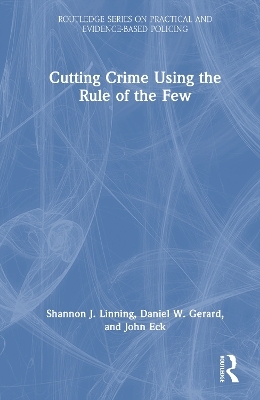
Cutting Crime Using the Rule of the Few
Routledge (Verlag)
978-1-032-55331-3 (ISBN)
- Noch nicht erschienen (ca. Mai 2026)
- Versandkostenfrei
- Auch auf Rechnung
- Artikel merken
Cutting Crime Using the Rule of the Few shows that crime is not merely a police problem. It explains how those who own or manage property and design the products we use have far more power to suppress crime opportunities than they realize. Cutting Crime reveals how to use the rule of the few to identify and solve crime problems. It provides a set of tools and spells out specific strategies the police, property owners, business owners, and government agencies can use to reduce crime. Just as it only takes a few to create a lot of crime, it only takes a few to prevent those crimes.
Shannon J. Linning, PhD, is an assistant professor in the School of Criminology at Simon Fraser University. She teaches courses in crime prevention, policing, and research methods. Her research explores how the owners and managers of property can create safer areas by suppressing crime opportunities at and around their properties. She has been invited to speak at international conferences such as the Environmental Criminology and Crime Analysis symposium, the International Association of Professional Security Consultants conference, and the Problem-Oriented Policing annual meeting. Her research appears in academic journals such as Crime Science, Journal of Criminal Justice, and Journal of Quantitative Criminology. She is the co-author of books, including Place Management and Crime: Ownership and Property Rights as a Source of Social Control. She has also co-authored several series about effective crime reduction for the International City/County Management Association’s (ICMA) publication, Public Management. Daniel W. Gerard, M.S., is a retired captain and 32-year veteran of the Cincinnati, Ohio Police Department. Daniel has published articles in both academic and practitioner journals and has served as an invited consultant, speaker, trainer, and instructor for numerous police agencies, universities and organizations throughout the United States and Canada. John E. Eck, PhD, is an Emeritus Professor of Criminal Justice at the University of Cincinnati. His work spans five decades, working with police agencies around the world, conducting research, and developing thinking tools to aid crime prevention. John is one of the key architects of some of the most widely used crime problem-solving tools, including the SARA model, the crime problem triangle, the CHEERS criteria, and the General Problem-Solving Matrix (GPSM). He received his master’s in public policy from the University of Michigan in 1977 and his doctorate in criminology from the University of Maryland in 1994. He has worked for the Police Executive Research Forum (PERF) as its Research Director, the Washington/Baltimore High Intensity Drug Trafficking Area as its Evaluation Director, and at the University of Cincinnati, where he taught courses on police effectiveness, crime prevention, and professional writing. He also carves basalt, granite, and slate in his backyard.
1. The Hockey Stick Epiphany Part 1: How Many Get Crime Wrong 2. Is Crime Widespread? 3. Do Residents Matter Most? 4. Do Arrests Reduce Crime? Part 2: Re-Thinking Crime 5. Crime as a By-Product of Everyday Life 6. Small Wins That Count 7. Power of Place Managers Part 3: What’s Your Problem? 8. What Is a Problem? 9. How Crime Problems Arise 10. Fixing Problems 11. When Place Managers Do Not Cooperate 12. Will Offenders Just Move Around the Corner? Part 4: Putting the Rule of the Few into Practice 13. Lessons from a Homicide Scene 14. Crime Radiation and Place Network Investigations 15. Deployment with Purpose 16. Finding Public Characters 17. SCRAP What Does Not Work
| Erscheint lt. Verlag | 8.5.2026 |
|---|---|
| Reihe/Serie | Routledge Series on Practical and Evidence-Based Policing |
| Zusatzinfo | 18 Tables, black and white; 16 Line drawings, black and white; 22 Halftones, black and white; 38 Illustrations, black and white |
| Verlagsort | London |
| Sprache | englisch |
| Maße | 152 x 229 mm |
| Themenwelt | Sozialwissenschaften ► Soziologie |
| Technik ► Bauwesen | |
| ISBN-10 | 1-032-55331-6 / 1032553316 |
| ISBN-13 | 978-1-032-55331-3 / 9781032553313 |
| Zustand | Neuware |
| Informationen gemäß Produktsicherheitsverordnung (GPSR) | |
| Haben Sie eine Frage zum Produkt? |
aus dem Bereich