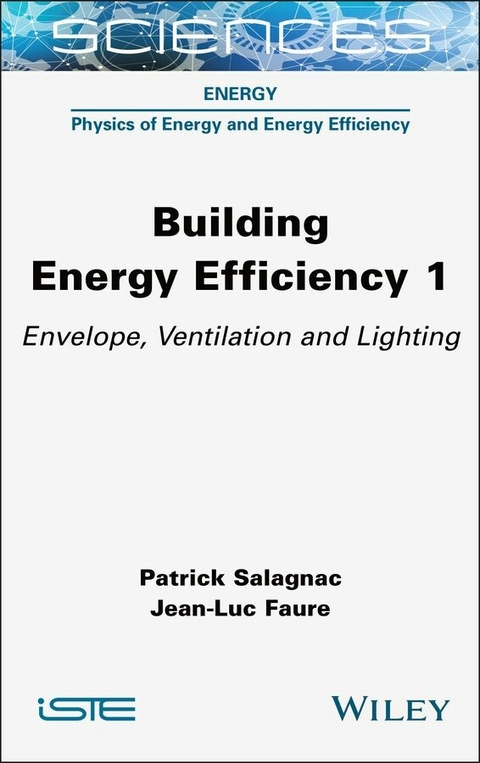
Building Energy Efficiency, Volume 1 (eBook)
418 Seiten
Wiley-Iste (Verlag)
978-1-394-42357-6 (ISBN)
The aim of this book is to present the fundamental principles of energy efficiency in construction. It is aimed at professionals, as well as masters' and engineering school students working in the field of building energy.
Volume 1 covers the building context and issues, the building envelope and how to improve it using innovative materials and construction techniques, ventilation and lighting.
Volume 2 is devoted to heating, air conditioning, domestic hot water production and centralized building management. The aim is to present more sustainable, energy-efficient solutions.
Through these different aspects, the ambition of this book is to give the reader the tools and best practices to design, renovate or manage buildings, and thus ensure the comfort of occupants while reducing the impact on the environment.
Patrick Salagnac is Professor of Heat Transfer and Building Energy at La Rochelle University, France, where he teaches heat transfer and building energy. His research focuses on building envelope optimization, passive cooling and energy production systems.
Jean-Luc Faure is Associate Professor in the Civil Engineering Department at La Rochelle University, France. His research focuses on the design, dimensioning, control and management of high-efficiency energy systems using centralized technical management tools.
1
Context and Issues
1.1. The building through the ages
The energy efficiency of a building refers to the concept of the energy performance of a building, which consists of comparing the “useful” energy produced by the building and the energy it consumes. The objective is to reduce a building’s energy consumption and carbon emissions while maintaining a level of comfort for occupants.
Over the centuries, humans initially sought comfort, safety and health quality from their habitat. Energy efficiency is a more recent issue.
The nomadic prehistoric humans protected themselves from the weather and wild animals by sheltering at the entrance of caves or by building huts from branches, bones and skins. As humans subsequently became sedentary, habitats evolved into shelters made of rammed earth and straw. In ancient times, houses evolved, and stone, brick, tile and cob started to be used as building materials. During the Middle Ages, glass gradually appeared, especially in rich houses, churches and palaces. In the 16th century, windows occupied a large part of the facades. From the 19th century onward, cities were transformed (large avenues, building industrialization, multi-story building, etc.). It was at this time that new materials (concrete, steel, aluminum, etc.) were used in the evolution of buildings. The 20th century was marked by a rural exodus with the development of cities, skyscrapers and mass housing. The notion of comfort started to be included in the housing discussion. Today, a building is expected to be healthy, comfortable, safe, energy efficient and environmentally friendly. We see new biobased materials on the market (vegetable wools, animal wools, biobased building materials, etc.). Future housing is currently moving toward energy-generating building design, energy sharing at the community level and indoor pollution reduction.
1.2. Energy and environmental issues in the building sector
The energy problem has been a major concern of global economic policies since the 1970s’ energy crisis. Major energy-saving efforts have been made, especially in the most energy-intensive sectors.
In France, the construction sector is currently the largest consumer, with 62.3 Mtoe, compared with the transport sector (45.2 Mtoe) and the industry sector (27.5 Mtoe). In 2019, the construction sector accounted for 45% of the total energy consumed (Ministère de la Transition écologique 2020).
Figure 1.1. Evolution of final energy consumption in France in Mtoe by sector for all energies between 2011 and 2019 (SDES, Bilan énergétique de la France 2019; Ministère de la Transition Écologique (2021)).
Figure 1.2. Evolution of GHG emissions in France from 2011 to 2019 in Mt CO2 eq. (SDES, Bilan énergétique de la France 2019; Ministère de la Transition Écologique (2021)).
In 2019, this energy consumption caused the emission of 64.1 Mt CO2 eq. (million tons of CO2 equivalent), namely, 21% of national emissions (approximately two-thirds for residential and one-third for tertiary) (Citepa n.d.). Retrofitting poorly insulated buildings offers opportunities to reduce carbon emissions.
The figures are consistent for European (European Parliament n.d.) and non-European (Plan Bâtiment Durable n.d.) countries, with 40% versus 36% for energy consumption and 36% versus 40% for CO2 emissions, respectively, in 2017.
The building sector is also a major consumer of raw materials. A study carried out by ADEME (2019) gave the following figures. For new single-family dwellings, the quantity of materials was 1,190 kg.m−2 SHONRT (net floor area or adjusted gross floor area) compared with 1,570 kg/m2 SHONRT for collective housing. This quantity was 28 kg.m−2 SHONRT for a low-energy-certified house (BBC in French) refurbishment and 20 kg.m−2 SHONRT for collective housing. In France, for the entire housing stock, by 2050, new construction could require up to 1.3 billion tons of materials, with 85% only for aggregate, sand and cement.
The urgent need to reduce CO2 emissions and the gradual depletion of resources requires a significant reduction in the consumption of non-renewable energy in housing. This consumption is primarily associated with heating and the production of domestic hot water, which accounts for more than 90% of energy use in these areas. Many European countries share this perspective. European members have come together to establish a strategic framework for addressing climate change. This includes an energy policy that emphasizes the critical role of the building sector. The first European directive, called the Energy Performance of Buildings Directive (EPBD), was established in December 2002. Member states must adopt new rules regarding thermal insulation and ventilation. The second directive, established in December 2008, known as the “Climate Initiative” (or 20–20–20 Directive), imposed three targets for the building sector: (1) raise the share of renewable energies to 20% of consumption by 2020; (2) improve energy efficiency by 20% by 2020; (3) and reduce by 2020 the greenhouse gas (GHG) emissions by 20% from 1990 levels.
The building sector is undergoing a significant transformation, shifting from being one of the most energy-intensive sectors to aiming for Nearly Zero Energy Building (NZEB), as defined in Directive 2010/31/EU. This transition requires a ten-fold increase in research and development efforts across various areas, including materials, components, envelopes, systems or control of indoor environments. Ensuring the comfort, health and safety of occupants at virtually zero energy cost is crucial.
The construction of high-energy-efficiency buildings and the thermal retrofitting of existing buildings have resulted in a decrease in energy consumption for residential and tertiary buildings over the past decade. In 2019, the final energy consumption adjusted for climate change was 41.7 Mtoe (487 TWh) for residential buildings and 24.7 Mtoe (289 TWh) for tertiary buildings.
Figure 1.3. Final consumption by energy for residential and tertiary buildings from 2000 to 2019 (Ministère de la Transition Écologique 2021).
For residential buildings, electricity is the primary energy source, accounting for 34% of usage. This is followed by natural gas at 29%, renewable energies at 23% and petroleum products at 11%. Over the past few years, the shares of natural gas and oil have decreased in favor of renewable energy and electricity.
In tertiary buildings, electricity accounts for 52% of consumption, followed by natural gas (28%), petroleum products (13%), renewable energy (4%) and grid-distributed heat (4%).
Figure 1.4 shows the energy consumption for a dwelling in 2000 and 2016. The energy used for heating decreased (73% vs. 66%), whereas the specific electricity increased (12% vs. 17%) because of the diversity of electrical equipment (Internet, computer, etc.).
Figure 1.4. Distribution of energy consumption by households in their dwellings per use (Ceren 2017).
Figure 1.5. Residential electricity consumption per use in France (according to ADEME (2019)).
If we focus on electrical energy, we see its strong presence in all residential uses (Figure 1.5).
The construction sector faces numerous challenges, including the need to address energy consumption, the use of raw materials and the impact of buildings on their environment. One of the most pressing issues is climate change.
The production of GHGs during construction and the refurbishment of buildings as well as their use could contribute to climate change. However, buildings may also suffer from the effects of climate change. For example, global warming can lead to drought, which can generate cracks in buildings constructed on clay soils. Additionally, rising sea levels necessitate adaptations to buildings along the coast. Heat waves also contribute to increased air conditioning usage, leading to higher energy costs and additional sources of GHG emissions. As illustrated in Figure 1.6 (heat waves observed in mainland France from 1947 to 2017 and projections for 2017–2100), heatwaves are expected to become more frequent, numerous and intense in the future.
Figure 1.6. Heat waves in France – bubble sizes: seriousness (Météo-France n.d.).
Construction stakeholders must find innovative solutions to increase resilience against climate change, enabling adaptations during extreme heat periods.
The French construction sector faces several immediate and significant challenges. With respect to older buildings, we can identify issues such as fuel poverty, the poor condition of some houses, the aging of the building stock and its low renewal rate of only 1% per year. The emergence of water-related issues along with fungal development creates significant challenges during refurbishment projects. Poor indoor air quality (VOC, particulate pollution, viruses like SARS-CoV-2, bacteria, etc.) can lead to adverse health effects. Additionally, there are concerns surrounding interseasonal energy storage and the intermittent nature of renewable energy sources such as wind and solar gains.
1.3. Characteristics of the building stock
The building stock in France includes...
| Erscheint lt. Verlag | 6.11.2025 |
|---|---|
| Reihe/Serie | ISTE Invoiced |
| Sprache | englisch |
| Themenwelt | Technik ► Bauwesen |
| Schlagworte | Air Conditioning • building envelope • centralized building management • Construction Techniques • energy efficiency • Heating • hot water production • Lighting • ventilation |
| ISBN-10 | 1-394-42357-8 / 1394423578 |
| ISBN-13 | 978-1-394-42357-6 / 9781394423576 |
| Informationen gemäß Produktsicherheitsverordnung (GPSR) | |
| Haben Sie eine Frage zum Produkt? |
 EPUB (Adobe DRM)
Kopierschutz: Adobe-DRM
Adobe-DRM ist ein Kopierschutz, der das eBook vor Mißbrauch schützen soll. Dabei wird das eBook bereits beim Download auf Ihre persönliche Adobe-ID autorisiert. Lesen können Sie das eBook dann nur auf den Geräten, welche ebenfalls auf Ihre Adobe-ID registriert sind.
Details zum Adobe-DRM
Dateiformat: EPUB (Electronic Publication)
EPUB ist ein offener Standard für eBooks und eignet sich besonders zur Darstellung von Belletristik und Sachbüchern. Der Fließtext wird dynamisch an die Display- und Schriftgröße angepasst. Auch für mobile Lesegeräte ist EPUB daher gut geeignet.
Systemvoraussetzungen:
PC/Mac: Mit einem PC oder Mac können Sie dieses eBook lesen. Sie benötigen eine
eReader: Dieses eBook kann mit (fast) allen eBook-Readern gelesen werden. Mit dem amazon-Kindle ist es aber nicht kompatibel.
Smartphone/Tablet: Egal ob Apple oder Android, dieses eBook können Sie lesen. Sie benötigen eine
Geräteliste und zusätzliche Hinweise
Buying eBooks from abroad
For tax law reasons we can sell eBooks just within Germany and Switzerland. Regrettably we cannot fulfill eBook-orders from other countries.
aus dem Bereich