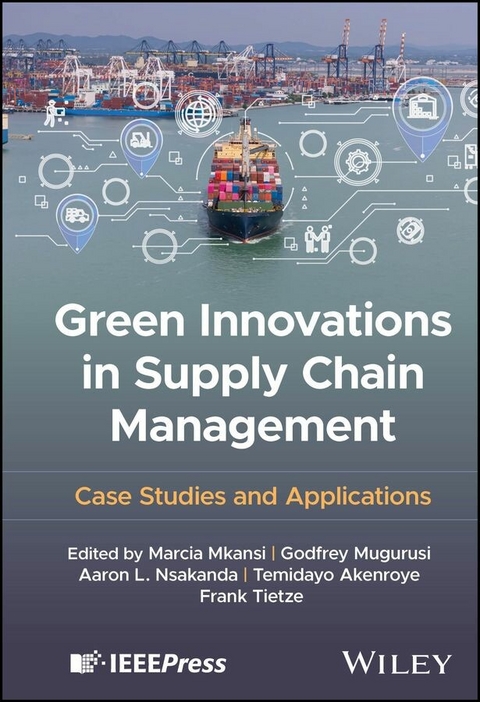
Green Innovations in Supply Chain Management (eBook)
657 Seiten
Wiley-IEEE Press (Verlag)
978-1-394-28901-1 (ISBN)
An incisive discussion of the applications of digital technology to sustainable supply chain management
In Green Innovations in Supply Chain Management, a team of distinguished researchers deliver an up-to-date and authoritative account of contemporary green technology applications in supply chain management. This book discusses digital technologies that address longstanding development and supply chain challenges associated with sustainability.
Split into five sections - green tech logistics, sustainable packaging, sustainable harvesting, e-waste, and green investments - Green Innovations in Supply Chain Management dives into robotics, mobile applications, sustainability packaging initiatives, sustainable seafood sourcing, green health initiatives, business case studies, and other green investments critical to management of modern supply chains.
Readers will also find:
- A thorough introduction to green innovations in practice
- Comprehensive explorations of continental and regional case studies
- Practical discussions of green investments
Perfect for supply chain management professionals and policymakers with an interest in the field, Green Innovations in Supply Chain Management will also benefit students and researchers of green and sustainable technology, renewable energy, and a wide variety of engineering specialties.
Marcia Mkansi, PhD, is the Head of Research, Post-Graduate Studies, Innovation, and Commercialisation, and Professor of Operations and Supply Chain Management, College of Economic & Management Sciences, University of South Africa.
Godfrey Mugurusi is an Associate Professor in Logistics and SCM, Department of Industrial Economics and Technology Management, Norwegian University of Science and Technology, Norway.
Aaron L. Nsakanda is an Associate Professor in Supply Chain Management and Business Analytics, Sprott School of Business at Carleton University, Canada.
Temidayo Akenroye, PhD, is an Associate Professor, Supply Chain Management at the University of Missouri-St Louis, USA, Academic Advisor for the Kuehne Foundation, Germany, a Senior Visiting Fellow at Lagos Business School, Nigeria, and a member of the Peer Review College of the British Academy of Management.
Frank Tietze is Professor of Innovation Engineering at the University of Cambridge. He leads the Innovation and Intellectual Property Management Laboratory. He was President of the European Policy for Intellectual Property Association (2022-2023).
An incisive discussion of the applications of digital technology to sustainable supply chain management In Green Innovations in Supply Chain Management, a team of distinguished researchers deliver an up-to-date and authoritative account of contemporary green technology applications in supply chain management. This book discusses digital technologies that address longstanding development and supply chain challenges associated with sustainability. Split into five sections green tech logistics, sustainable packaging, sustainable harvesting, e-waste, and green investments Green Innovations in Supply Chain Management dives into robotics, mobile applications, sustainability packaging initiatives, sustainable seafood sourcing, green health initiatives, business case studies, and other green investments critical to management of modern supply chains. Readers will also find: A thorough introduction to green innovations in practice Comprehensive explorations of continental and regional case studies Practical discussions of green investments Perfect for supply chain management professionals and policymakers with an interest in the field, Green Innovations in Supply Chain Management will also benefit students and researchers of green and sustainable technology, renewable energy, and a wide variety of engineering specialties.
1
Introduction: Green Innovations in the Supply Chain Management: Cases and Applications
Marcia Mkansi1, Godfrey Mugurusi2, Aaron L. Nsakanda3, Temidayo Akenroye4, and Frank Tietze5
1 Department of Operations Management, University of South Africa, Pretoria, South Africa
2 Department of Industrial Economics and Technology Management at Gjøvik, Norwegian University of Science and Technology, Trondheim, Norway
3 Sprott School of Business, Carleton University, Ottawa, ON, Canada
4 Department of Supply Chain and Analytics, College of Business Administration, University of Missouri St. Louis, St. Louis, MO, USA
5 Institute for Manufacturing, University of Cambridge, Cambridge, UK
1.1 Motivation
Global environmental challenges, particularly those driven by the rise in greenhouse gas (GHG) emissions such as CO2, CH4, N2O, and F‐gases, have been widely recognized by the United Nations Framework Convention on Climate Change (UNFCCC) and the 23rd Conference of the Parties (CoP23) as the primary drivers of global warming. There is a global need for innovative systems, as the overexploitation of nonrenewable resources, excessive consumption, and unsustainable modes of production threaten the triple bottom line thinking in most organizations. Global supply chain demands across various sectors are contributing to unsustainable trends in industrialization, storage, passenger transport, inventory and production (Castillo et al., 2018; Kafle et al., 2017). These practices accelerate environmental degradation and exacerbate poverty and global socioeconomic inequalities. However, Green technologies appear to offer ways to reconfigure the trajectory of socioeconomic inequalities and environmental degradation toward more sustainable industrialization.
In Africa for example, the effects of GHG emissions are becoming increasingly ubiquitous (DeWitt et al., 2019). The consequences include the decline in air quality that, together with other types of pollution, is linked to thousands of cases of child mortality (The Big Debate, 2014). Technology‐enabled green innovation promises to safeguard the environment and, in some cases, reverse past environmentally harmful trends (Sahoo et al., 2022; Shafiei & Abadi, 2017; Walker et al., 2022). Various approaches have been identified and in some cases implemented to address GHG emissions, as reviewed in reports such as the Emissions Gap Report 2019 (UNEP, 2019) and the Intergovernmental Panel on Climate Change (IPCC) Special Report on the impact of global warming (Masson‐Delmotte et al., 2019).
Most of these approaches appear to cut across three key areas: policies, industrial action, and societal issues. Policies encompass emission targets, carbon emission reporting standards, reductions in fossil fuel subsidies, and energy‐specific target taxes (Christensen & Olhoff, 2019). The UN has already instituted various policies, platforms, protocols, and agreements that have been adopted by its member nations over the years. Most of these were implemented under the UNFCCC, and include but are not limited to the following: the Kyoto Protocol introduced in 1997 and formally adopted in 2005, the Copenhagen Accord in 2009, the Cancun Pledge in 2010, and the Paris Agreement in 2015 (French, 1998; United Nations, 2019). The goal of these frameworks is to bind industrialized nations to commit to certain agreed‐upon targets, which are individualized for each member nation in order to keep global temperatures within 2 °C, and that ultimately aim to keep global temperatures within 1.5 °C of preindustrial levels (Mulvaney et al., 2012).
In addition to policies, scientists have estimated that focusing on a few key industrial areas could reduce CO2 emissions enough to reach the 2030 Paris Agreement targets of 56.24 GtCO2eq (Christensen & Olhoff, 2019). These areas include renewable energy sources and transport. However, significant hurdles remain. Many countries are not equipped or prepared for a shift to low‐carbon societies, and the costs can be prohibitive. Additionally, the technical readiness of cleaner energy technologies is often insufficient for large‐scale implementation or currently too expensive to make a significant impact (Christensen & Olhoff, 2019).
Other carbon emission reduction strategies include electrification and the use of biofuels instead of oil‐based products or even hydrogen (Bednar‐Friedl et al., 2015). The work by Mkansi et al. (2019) refers to an approach called Design for Environment (DfE) as a carbon reduction approach, whereby the transport industry makes use of hybrid drives and alternative energy sources to mitigate carbon emissions. The abovementioned authors again highlight the importance of electrification of the transport industry as an important DfE approach in sustainable development. Yet today, we find very few studies that have explored green innovations or clearly documented, through case studies, practical approaches to reducing GHG emissions, hence the goal of this book.
Lifestyle‐based strategies including carpooling, environmental education, and support for green transport behaviors are often mentioned; however, their effectiveness needs to be well documented (Froehlich et al., 2009). This highlights the need for more evidence‐based research, including well‐documented case studies and practical applications of green innovations, especially in the domain of supply chain management.
To address research gaps, this book focuses on trends in green innovation, and presents evidence‐based case studies that tackle practical problems associated with implementing green technologies in supply chain and operations management. The book provides clarity on the questions such as: “What are green innovations across the logistics elements of the supply chain?,” “What problems are they addressing?,” “How is green technology substituting or complementing conventional operations management methods?,” and “How do green technologies contribute to reduction in global GHG targets?” The book contends that the content provided by current case studies provides clear insights into some or all the above questions. Each chapter approaches these questions from a different thematic lens. The result is a diversified interpretation of the content, contexts, and adaptations of contemporary green technologies and how they enable and augment current perspectives on green supply chain management practices.
The book also considers the arguments presented by Walker et al. (2022), who highlighted that technological adaptation will increasingly become a necessity for the world’s rapidly growing population, as well as for natural ecosystems in every region. The book acknowledges that there is no “one‐size‐fits‐all” approach to technological adaptation; solutions must be tailored to local contexts and needs (Wang, 2022).
1.2 Overview of Chapters and Cases
1.2.1 Chapter 2: Robotics and Applications in Canada and the United States
The study of Westerlund and Sharma (2026) focuses on the Uber Eats case and their adoption of autonomous delivery robots (ADRs). Uber Eats is a popular global online food delivery platform that connects customers with local restaurants. In Canada, for example, Uber Eats partnered with Coco to introduce four‐wheeled ADRs, also known as “Coco.” Coco robots are compact, four‐wheeled autonomous vehicles that navigate sidewalks to deliver food orders directly to customers’ doors. They are equipped with advanced sensors and navigation systems to ensure safe and efficient delivery. These robots are designed to enhance the efficiency and sustainability of food delivery services. The “Coco” robots serve as an environmentally friendly alternative to traditional vehicle‐based food delivery, helping to reduce carbon emissions and traffic congestion in urban areas.
Specifically, the chapter written by Mika Westerlund and Arushi Sharma (2026) examines the use of ADRs for sustainable last‐mile delivery. Their study aims to explore two interrelated things: one, the main themes in consumers’ sustainability perceptions of ADRs, and two, how companies can address these themes in their robotic delivery service models. Their findings based on social media posts about Uber Eats’ robotic delivery from Reddit show both positive benefits of ADR, such as reduction in emissions, energy efficiency, and reduced traffic congestion, and negative themes including ADR’s inferiority compared to drones and notable societal harms of ADRs. Their adoption of the SD‐X‐BM framework by Musulin and Strahonja (2023) allows them to identify different solutions across the “service design, business model, and user experience.”
1.2.2 Chapter 3: Crowd Logistics Applications in Uganda
In the study of Okello et al. (2026), the case of Easy Matatu in Uganda is explored. Easy Matatu is a mobile application that allows commuters to book and pay for seats in advance on public transport buses locally called “Matatus.” Matatus are 14‐seater public minibuses commonly used in Uganda. This system helps reduce wait times and minimizes delays, making the daily commute more...
| Erscheint lt. Verlag | 5.11.2025 |
|---|---|
| Sprache | englisch |
| Themenwelt | Technik ► Elektrotechnik / Energietechnik |
| Schlagworte | Digital Supply Chains • digital supply chain technology • Green Supply Chain Management • green supply chain technology • Supply Chain Management • Sustainable Supply Chain Management • Sustainable Supply Chains • sustainable supply chain technology |
| ISBN-10 | 1-394-28901-4 / 1394289014 |
| ISBN-13 | 978-1-394-28901-1 / 9781394289011 |
| Informationen gemäß Produktsicherheitsverordnung (GPSR) | |
| Haben Sie eine Frage zum Produkt? |
 EPUB (Adobe DRM)
Kopierschutz: Adobe-DRM
Adobe-DRM ist ein Kopierschutz, der das eBook vor Mißbrauch schützen soll. Dabei wird das eBook bereits beim Download auf Ihre persönliche Adobe-ID autorisiert. Lesen können Sie das eBook dann nur auf den Geräten, welche ebenfalls auf Ihre Adobe-ID registriert sind.
Details zum Adobe-DRM
Dateiformat: EPUB (Electronic Publication)
EPUB ist ein offener Standard für eBooks und eignet sich besonders zur Darstellung von Belletristik und Sachbüchern. Der Fließtext wird dynamisch an die Display- und Schriftgröße angepasst. Auch für mobile Lesegeräte ist EPUB daher gut geeignet.
Systemvoraussetzungen:
PC/Mac: Mit einem PC oder Mac können Sie dieses eBook lesen. Sie benötigen eine
eReader: Dieses eBook kann mit (fast) allen eBook-Readern gelesen werden. Mit dem amazon-Kindle ist es aber nicht kompatibel.
Smartphone/Tablet: Egal ob Apple oder Android, dieses eBook können Sie lesen. Sie benötigen eine
Geräteliste und zusätzliche Hinweise
Buying eBooks from abroad
For tax law reasons we can sell eBooks just within Germany and Switzerland. Regrettably we cannot fulfill eBook-orders from other countries.
aus dem Bereich