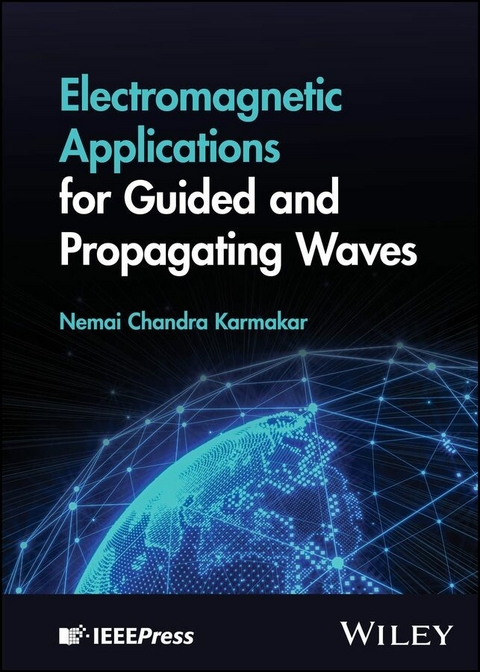
Electromagnetic Applications for Guided and Propagating Waves (eBook)
1296 Seiten
Wiley-IEEE Press (Verlag)
978-1-394-26283-0 (ISBN)
Enables readers to grasp the fundamentals of applied electromagnetics through a blended pedagogical approach
Electromagnetic Applications for Guided and Propagating Waves comprehensively covers both fundamentals and advanced topics in applied electromagnetics (EM) for the professional, going above the basic static and dynamic EM field theories that are covered in most undergraduate EM textbooks. The textbook introduces complex topics with illustrations of modern technologies that use the topics, followed by a simple presentation of the basic vector analysis and Maxwell's equations, supported by many practical examples, math essays, math puzzles, and the most modern technological developments from the websites of prominent technology companies.
The textbook includes review questions at the end of each topic to enhance the students' learning experience and outcomes. It provides the links for multimedia lecture videos and directs students to relevant open sources such as YouTube videos and lecture materials from the prestigious universities of developed and developing nations. The textbook is supported by presentation slides, a solution and instructor's manual, and MATLAB program downloads.
Written by prolific teacher Dr. Karmakar, Electromagnetic Applications for Guided and Propagating Waves discusses topics including:
- Fundamental theories of resonators, optical waveguides and fibers, antennas and antenna arrays, wireless systems, and electromagnetic compatibility
- Electrostatic field theory and detailed derivations of electromagnetic fundamentals such as electric charges and Coulomb's law
- Applications of time-varying electromagnetic fields, covering transmission lines, impedance matching techniques, and waveguides
- How electromagnetics has impacted our day-to-day life and how we use it in our workplace and on social media
- Historical anecdotes and evolution of EM theory from its inception to Maxwell and Hertz
Electromagnetic Applications for Guided and Propagating Waves is an essential reference for researchers, professionals, and policy and decision makers in the fields of electromagnetics, electrical engineering, wireless communications, and defense.
Nemai Chandra Karmakar, PhD, is the lead researcher at the Monash Microwave, Antenna, RFID and Sensor Laboratory (MMARS) at Monash University, Australia. He received his PhD in Information Technology and Electrical Engineering from the University of Queensland, Australia, in 1999. He is a pioneer in fully printable, chipless radio-frequency identification (RFID) tags and sensors, readers, signal processing, and smart antennas.
Enables readers to grasp the fundamentals of applied electromagnetics through a blended pedagogical approach Electromagnetic Applications for Guided and Propagating Waves comprehensively covers both fundamentals and advanced topics in applied electromagnetics (EM) for the professional, going above the basic static and dynamic EM field theories that are covered in most undergraduate EM textbooks. The textbook introduces complex topics with illustrations of modern technologies that use the topics, followed by a simple presentation of the basic vector analysis and Maxwell s equations, supported by many practical examples, math essays, math puzzles, and the most modern technological developments from the websites of prominent technology companies. The textbook includes review questions at the end of each topic to enhance the students learning experience and outcomes. It provides the links for multimedia lecture videos and directs students to relevant open sources such as YouTube videos and lecture materials from the prestigious universities of developed and developing nations. The textbook is supported by presentation slides, a solution and instructor s manual, and MATLAB program downloads. Written by prolific teacher Dr. Karmakar, Electromagnetic Applications for Guided and Propagating Waves discusses topics including: Fundamental theories of resonators, optical waveguides and fibers, antennas and antenna arrays, wireless systems, and electromagnetic compatibility Electrostatic field theory and detailed derivations of electromagnetic fundamentals such as electric charges and Coulomb s law Applications of time-varying electromagnetic fields, covering transmission lines, impedance matching techniques, and waveguides How electromagnetics has impacted our day-to-day life and how we use it in our workplace and on social media Historical anecdotes and evolution of EM theory from its inception to Maxwell and Hertz Electromagnetic Applications for Guided and Propagating Waves is an essential reference for researchers, professionals, and policy and decision makers in the fields of electromagnetics, electrical engineering, wireless communications, and defense.
Chapter 1
Introduction
Learning Objectives
The learning objectives of Chapter 1 are as follows:
- Introduction to emerging wireless and guided electromagnetic technologies that have impacted our everyday life.
- Introduction to the practical applications and significance of the advanced electromagnetics in our everyday life
- Introduction to topics usually covered in modern textbooks on advanced electromagnetics. The basic definitions of wireless transceivers, wireless channels and uniform plane wave propagation, various transmission lines and waveguides, optical fibres, antennas and antenna arrays, and finally, electromagnetic interference (EMI) and electromagnetic compatibility (EMC).
- The modern pedagogical practices in advanced electromagnetics at the university.
- A design project to show the applications of the learned theories of wireless and guided electromagnetics.
Learning Outcomes
At the end of the chapter, you will be able to comprehend the following:
- The contributions and significance of wireless and guided electromagnetics.
- A concrete understanding of the fundamental building blocks of wireless and guided electromagnetics.
- New pedagogical methods used in modern universities.
- A design project that sets the foundation for the practical application of the learned theories of wireless and guided electromagnetics.
Chapter Outline
The outline of the chapter is shown Figure 1.1. First, the emerging applications of advanced electromagnetics are introduced. The chapter has introduced many interesting applications of advanced electromagnetics in modern emerging technologies that have impacted our everyday life, business practices, medical treatments, social interactions and leisure. The modes of delivery of pedagogical practices have evolved from whiteboards and overhead projectors to the multi-media based interactive teaching and learning sessions with modern laboratory facilities, and cutting-edge design projects to enhance students’ learning experiences. It is a non-trivial task to design a laboratory to enhance the learning experiences through experiments in advanced electromagnetics. Usually, radio frequency (RF) and microwave sources, receivers and measuring equipment are too expensive to implement, need specific sets of expertise and the teaching methods are too abstract for students to digest. A very low-cost innovative laboratory setup that was derived for the author’s research laboratory is introduced for advanced electromagnetic teaching. A design project of wireless energy harvesting is also introduced so that students can apply their knowledge gained from the theories learned in each topic of the textbook. Laboratory experiments can be applied in a real world, emerging and ubiquitous design project with the aid of full-wave electromagnetic solvers such as computer simulation technologies (CST) Microwave Studio™ (MSW) and Keysight Advanced Design System (ADS™). These specialised software tools are used in industry for high-end design. Hands-on knowledge and skills gained in the design project develop the graduate skills and employment readiness of learners. Besides these, the knowledge and skills developed in calibration methods and measurement using a full two-port vector network analyser are also an added advantage for the students to develop graduate skills for industrial applications. The chapter concludes with Section 1.6 Summary of Chapter.
Figure 1.1 Chapter 1 outline.
1.1 Introduction
Welcome to the textbook: Electromagnetic Applications for Guided and Propagating Waves. Advanced electromagnetics (AEM) has an abstract nature with full of mathematical derivations, and many fundamental physical laws such as the laws of Coulomb, Gauss, Biot-Savart, Ampere, and Faraday. All these laws are well presented in a set of equations, which are called Maxwell’s Equations. Figure 1.2 shows a sketch of various laws of AEM in complex vector mathematical forms. These advanced and highly complex mathematical equations for the electromagnetic laws and hypotheses easily scare new learners of electrical and electronic engineering and physics. To enjoy this subject, you should look at the big picture of contemporary technologies that we are using in modern society, and then analyse with your mind how these technologies that use wireless and guided electromagnetics impact our daily lives. Then only you can appreciate the complex nature of the discipline and enjoy learning the theories that underpin the modern wireless and guided communications world in RF, microwave, millimetre wave and light wave spectra.
Figure 1.2 Laws of EM and complex perception of the AEM discipline by learning.
With the advent of fast Internet connectivity via submarine optical fibre networks, wireless fidelity (Wi-Fi), voice over internet protocol (VoIP),1 we are so well connected, as if we are living in a small global village. The motto of the modern wireless technological development is to provide boundless flexibility and scalability without any wires. It is interesting to observe how wireless and guided electromagnetic have impacted upon us through these emerging technologies in the twenty first century. The most advancements in wireless technologies, such as global positioning satellite (GPS) system, near field communications (NFC), google navigation, 4G/5G/5G+2 wireless communications that are packaged in a smartphone, are overwhelming. If the 1980s technologies had been used, it would require tens of truckloads of electronic equipment to match the functionality of a modern smartphone, forget about the scalability.3
Figure 1.3a introduces Internet of Everything (IoE), which collects data wirelessly from every tagged item, small or big. NFC devices in your smartphones use the radio frequency identification (RFID) technology to help create a cashless society. All are being done wirelessly. The smart cities and smart farming become a reality with wireless communications. The modern technology becomes multidisciplinary and requires engineers and scientists from all branches to work together. As shown in Figure 1.3b, a modern fighter jet is equipped with advanced radar systems with steerable antennas, many wired and wireless sensors for navigation, and manoeuvring in challenging situations.
Figure 1.3 (a) IoE. (b) A fighter plane is packed with so many advanced levels RF/microwave/mm-wave equipment, such as the most advanced radar systems in the world, smart antennas and signal processing algorithms.
Source: Senior Airman Gustavo Gonzalez/Wikimedia Commons/Public Domain.
The textbook addresses all of the emerging and burning issues of our society in the new millennium and shows how the new technologies utilise the theory of AEM to address and solve many of these problems. To make the complex and abstract electromagnetic theory interesting, the introductory chapter has briefly analysed the most popular technologies that have been impacting our lives in recent decades.
1.2 Emerging Technologies That Use Advanced Electromagnetics
Table 1.1 summarises the most popular and advanced technologies that have emerged as the mainstream breakthroughs in the twenty-first century. AEM is all about the analyses of the electromagnetic wave phenomena inside the wireless channels and guided structures. The most beautiful aspect of the electromagnetic theory is that we can perceive the three-dimensional (3D) field distributions and wave phenomena due to the electromagnetic stimuli inside any structure. That is why electromagnetic theory penetrates every branch of electrical and electronic engineering. For example, in a semiconductor device, we can analyse the microscopic level of 3D field distributions and associated changes in current and voltage at the junction of different doped elements due to changes in the terminal biasing conditions. The current and voltage establish the electric and magnetic fields4 at the junctions of the active devices, such as diodes and transistors. Likewise, electromagnetic theories become the backbone of power system analysis for high-voltage transmission lines, power transformers, and generators.
Table 1.1 Emerging technologies in the twenty-first century.
|
|
| Erscheint lt. Verlag | 5.11.2025 |
|---|---|
| Sprache | englisch |
| Themenwelt | Technik ► Elektrotechnik / Energietechnik |
| Schlagworte | Advanced electromagnetism • Dynamic EM Fields • Impedance Matching • optical waveguides • Static EM fields • Transmission and Reflection of Uniform Plane Waves • Transmission Lines • uniform plane wave • Vector analysis • Waveguides |
| ISBN-10 | 1-394-26283-3 / 1394262833 |
| ISBN-13 | 978-1-394-26283-0 / 9781394262830 |
| Informationen gemäß Produktsicherheitsverordnung (GPSR) | |
| Haben Sie eine Frage zum Produkt? |
 EPUB (Adobe DRM)
Kopierschutz: Adobe-DRM
Adobe-DRM ist ein Kopierschutz, der das eBook vor Mißbrauch schützen soll. Dabei wird das eBook bereits beim Download auf Ihre persönliche Adobe-ID autorisiert. Lesen können Sie das eBook dann nur auf den Geräten, welche ebenfalls auf Ihre Adobe-ID registriert sind.
Details zum Adobe-DRM
Dateiformat: EPUB (Electronic Publication)
EPUB ist ein offener Standard für eBooks und eignet sich besonders zur Darstellung von Belletristik und Sachbüchern. Der Fließtext wird dynamisch an die Display- und Schriftgröße angepasst. Auch für mobile Lesegeräte ist EPUB daher gut geeignet.
Systemvoraussetzungen:
PC/Mac: Mit einem PC oder Mac können Sie dieses eBook lesen. Sie benötigen eine
eReader: Dieses eBook kann mit (fast) allen eBook-Readern gelesen werden. Mit dem amazon-Kindle ist es aber nicht kompatibel.
Smartphone/Tablet: Egal ob Apple oder Android, dieses eBook können Sie lesen. Sie benötigen eine
Geräteliste und zusätzliche Hinweise
Buying eBooks from abroad
For tax law reasons we can sell eBooks just within Germany and Switzerland. Regrettably we cannot fulfill eBook-orders from other countries.
aus dem Bereich