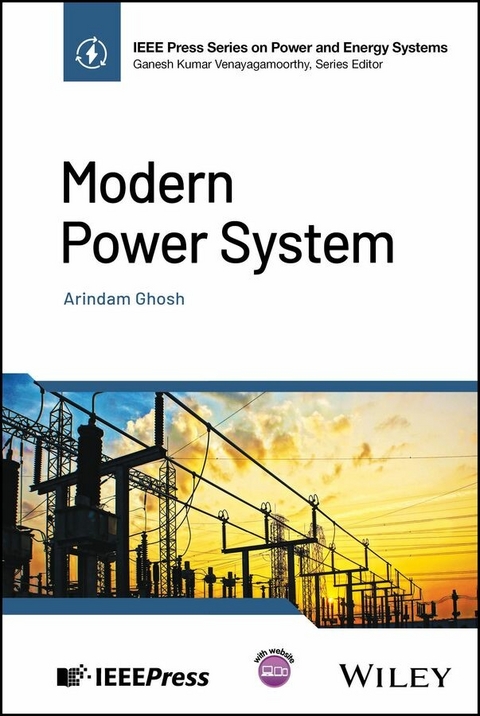
Modern Power System (eBook)
941 Seiten
Wiley-IEEE Press (Verlag)
978-1-394-28992-9 (ISBN)
Comprehensive reference exploring fundamentals of power systems analysis and operation through a unique blend of traditional and modern concepts
Modern Power System explains the fundamentals of power systems analysis and operation, the latest developments with regard to transformation of energy sources from the conventional synchronous generators to the inverter-based sources, and the techniques and hardware used for this purpose. The book includes information on traditional power system concepts such as load flow, fault studies, protection, and stability as well as modern concepts including reactive power control, Flexible AC Transmission Systems (FACTS), HVDC transmission, renewable energy, and smart grids.
Readers will find insights on topics such as phasor measurement unit (PMUs), wide-area measurements and control, and SCADA systems as well as distribution side aspects such as smart meters, demand management, and energy trading. Readers will also learn about point-to-point HVDC transmission using line commutated converters and multiterminal HVDC transmission.
Additional topics discussed in include:
- Power system components such as transmission line parameters, transformer models, per-unit representation, and modeling of transmission lines
- Economic operation of power plants and systems, with information on unit commitment and automatic generation control
- Power system protection through instrument transformers, protective relays, and overcurrent relay coordination
- Reactive power compensation, covering voltage stability and ideal reactive compensation
- Water, solar, wind, hydrogen, and nuclear fusion as alternative energy sources
Modern Power System is an excellent textbook for undergraduate and graduate students in electrical engineering with a power engineering specialization, as well as practicing power system engineers seeking to keep up with the latest developments in the field.
Arindam Ghosh, PhD, is a Research Academic Professor at Curtin University, Perth, Australia. He obtained his PhD from the University of Calgary, Canada. He was conferred the IEEE PES Nari Hingorani Custom Power Award in 2019. He has published over 450 peer reviewed journal and conference articles and has authored two books. He is a Fellow of the Indian National Academy of Engineering (INAE) and a Fellow of the Institute of Electrical and Electronics Engineers (IEEE).
Preface
The electric power industry is a cornerstone of global infrastructure, vital for modern society and economic development. According to the International Energy Agency report on world energy employment in 2023, the power sector employed over 68 million people worldwide. Of these, over 36 million people were employed in the clean energy sector, while over 32 million people were employed in the fossil fuel‐based power industry. According to the US Bureau of Labor Statistics report of 2023, 17,870 electrical engineers were employed in the power sector. Amongst all the technical societies of the Institute of Electrical and Electronic Engineers (IEEE), the Power and Energy Society (PES) is the second largest, having around 42,000 members worldwide.
Given its vast impact, the power industry requires a multidisciplinary approach for its secured operation and continues to evolve, a journey that I have followed with fascination. My early studies of foundational texts like W. D. Stevenson's book [1] have deeply influenced the structure and focus of this book, blending traditional principles with modern advancements. Most of the topics covered in Stevenson's book are still valuable to gain knowledge in the area. However, the power sector has seen a sea of changes since the time the fourth edition of the book appeared in 1982. These days, power electronic technology plays a crucial role in both power transmission and distribution systems. Thyristor‐based high voltage DC (HVDC) transmission systems started appearing in the 1970s. Subsequently, voltage source converter (VSC)‐based HVDC systems were adopted on a large scale at the turn of this century. Currently, VSC‐HVDC systems are used for offshore windfarms. Moreover, point‐to‐point HVDC systems have given way to multiterminal HVDC systems for offshore wind collection systems.
Also, thyristor‐based static var compensators (SVCs) also started appearing in large scales during the 1970s to enhance voltage stability in long transmission lines, as well as, for power oscillation damping. There were hundreds of SVCs installed throughout the world. Fixed series compensation of transmission lines to enhance power flow was initially hindered by incidents at Mojave power station, where resonance issues caused turbine damage in the early 1970s. These were caused due to the resonance between the series capacitors and line reactors at frequencies that are below the synchronous frequency. However, the initial hesitation was overcome using thyristor‐controlled series compensators (TCSCs), which can effectively change the series reactance to avoid the subsynchronous oscillations reaching the rotor shafts. Moreover, other thyristor‐based devices have become common like voltage regulator, phase angle regulator, etc.
With the advancement in power electronic technology, voltage source converter‐based flexible AC transmission (FACTS) devices have found their applications in both voltage regulation and power flow control in long transmission systems. Shunt compensation was achieved using static compensators (STATCOMs), which started replacing the SVCs. On the other hand, static synchronous series compensators were placed in series with the lines to replace TCSCs. Both shunt and series compensations can be achieved simultaneously using a unified power flow compensator.
Due to the rising concerns of climate change and the resultant global temperature rise, more and more renewable energy generators are getting integrated into both power transmission and distribution systems. This has caused disruptions in the traditional operations of power systems. Most of the renewable energy generators are connected to power systems through power converters, which cannot provide inertia to maintain stability margins required in bulk power transmission systems. These systems require smarter converter controls and storage devices. In distribution systems, for instance, rooftop photovoltaics introduce challenges like voltage imbalances, voltage rises, and reverse power flow. Furthermore, there is a concern that renewable generators are intermittent and thus they cannot supply the required baseload.
To modernize the power system, the concept of the smart grid has been introduced, through which the power system is integrated with information and communication technology (ICT) to facilitate a smooth two‐way power flow and to provide near instantaneous balance between generation and consumption. Power transmission systems can have modern energy management systems integrating phasor measurement units, which can be used in load control centers for more accurate state estimation and power dispatch. Distribution systems will be equipped with smart meters, through which the load demand can be managed. Parts of distribution systems can form virtual power plants or can have several microgrids. Substations can be modernized using tailored computer programs that can communicate between different protective relays without the complicated layout of cables. Since the smart grid relies heavily on ICT, measures must be taken to ensure that the communication and computation devices are cybersecure.
Against the backdrop of all the changes that have occurred in the power systems over the last three decades, this book aims to combine the traditional power systems with the newer technologies that are increasingly appearing in power systems. The materials covered in the book have been taught over several years over different courses at four different universities. The book can be used for a basic course on power systems on the undergraduate level, as well as, for a higher‐level undergraduate course or a first‐level graduate course on power engineering. For example, Chapters 2–7 (excluding Sections 3.4, 6.6, 7.2, and 7.3) can be used for a first‐level course, and the rest of the book can be used for a second‐level course.
The book is organized into 12 chapters. Chapter 1 introduces the book. Most of us take the use of electricity for granted – for comfort and household appliances, for entertainment, for knowledge, for medical treatment, or for transportation. However, the history of how we came to this stage is fascinating. In Section 1.1, a brief history of electricity is presented. In the subsequent sections, the development stages leading to the modern power systems are discussed, including interconnections of electric grids, deregulations, blackouts, and smart grid.
Chapter 2 discusses the main components of power systems. It begins with discussions on transmission system parameters. It is easy to comprehend that transmission lines will have resistance. However, how they are represented by line inductance and capacitance is derived using the laws of magnetics. Following these, simplified models of synchronous generators and transformers are presented. A power system may contain different power equipment with different voltage and power levels connected together through various step‐up or step‐down transformers. The presence of different voltage levels makes power system calculations extremely difficult. To simplify this, a power system is represented in its per unit form where all quantities are normalized to a common base. The final section of this chapter discusses different ways of modeling a power transmission system depending on its length and how they can be simplified for power system calculations.
Chapter 3 discusses load flow techniques. A power system is a network of transmission lines, loads and generators. Even though such a system can be visualized as an RLC circuit, the network is so complicated that the node voltage and loop current analyses are impossible to perform. For a set of given loads and generations, the complex bus voltages and power flow through different lines are determined using load flow (or power flow) studies. The first step in this process is to combine all the elements of the power system in a bus admittance matrix. Then, step‐by‐step iterative procedures are executed for the accurate determination of the bus voltages. Three different load flow procedures – Gauss–Siedel, Newton–Raphson, and fast decouples – are presented. Furthermore, the DC load flow is also presented, through which rough estimates of bus voltage magnitudes and angle can be computed using a simplified noniterative procedure. However, power flow calculations may not be accurate due to erroneous measurements. Power system state estimation, on the other hand, is a mixture of load flow and statistical estimation theory that can provide a much more accurate snapshot of the power system status. This is discussed in Section 3.4.
A power system may contain several generators. How these generators must be scheduled to cater to load demands economically is discussed in Chapter 4. Economic operations depend on the most economically efficient generators catering for a higher portion of load demand. Furthermore, the method of committing a particular number of units to serve the load demand is also discussed in the chapter. The basic concepts of automatic generation control and load frequency control are also discussed in the chapter.
Power system fault studies are presented in Chapter 5. Power system faults can be balanced or unbalanced. For balanced faults, it is assumed that all the three phases have been short‐circuited to the earth at the same location. These faults can be analyzed using the single‐line diagram assuming the balanced operation of the faulted circuit....
| Erscheint lt. Verlag | 31.10.2025 |
|---|---|
| Reihe/Serie | IEEE Press Series on Power and Energy Systems |
| Sprache | englisch |
| Themenwelt | Naturwissenschaften ► Physik / Astronomie |
| Technik ► Elektrotechnik / Energietechnik | |
| Schlagworte | conventional synchronous generators • inverter-based generators • modern power system • power system concepts • Power System Engineering • Power Systems Analysis • Power Systems Operation • power system textbook • Reactive Power Control |
| ISBN-10 | 1-394-28992-8 / 1394289928 |
| ISBN-13 | 978-1-394-28992-9 / 9781394289929 |
| Informationen gemäß Produktsicherheitsverordnung (GPSR) | |
| Haben Sie eine Frage zum Produkt? |
 EPUB (Adobe DRM)
Kopierschutz: Adobe-DRM
Adobe-DRM ist ein Kopierschutz, der das eBook vor Mißbrauch schützen soll. Dabei wird das eBook bereits beim Download auf Ihre persönliche Adobe-ID autorisiert. Lesen können Sie das eBook dann nur auf den Geräten, welche ebenfalls auf Ihre Adobe-ID registriert sind.
Details zum Adobe-DRM
Dateiformat: EPUB (Electronic Publication)
EPUB ist ein offener Standard für eBooks und eignet sich besonders zur Darstellung von Belletristik und Sachbüchern. Der Fließtext wird dynamisch an die Display- und Schriftgröße angepasst. Auch für mobile Lesegeräte ist EPUB daher gut geeignet.
Systemvoraussetzungen:
PC/Mac: Mit einem PC oder Mac können Sie dieses eBook lesen. Sie benötigen eine
eReader: Dieses eBook kann mit (fast) allen eBook-Readern gelesen werden. Mit dem amazon-Kindle ist es aber nicht kompatibel.
Smartphone/Tablet: Egal ob Apple oder Android, dieses eBook können Sie lesen. Sie benötigen eine
Geräteliste und zusätzliche Hinweise
Buying eBooks from abroad
For tax law reasons we can sell eBooks just within Germany and Switzerland. Regrettably we cannot fulfill eBook-orders from other countries.
aus dem Bereich