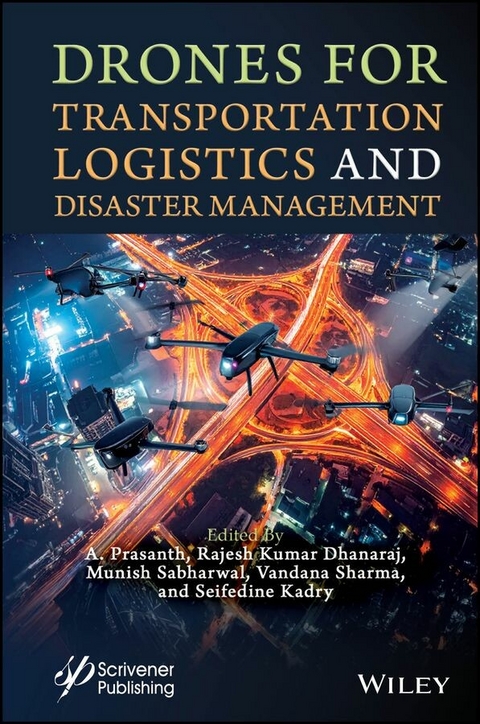
Drones for Transportation Logistics and Disaster Management (eBook)
594 Seiten
Wiley-Scrivener (Verlag)
978-1-394-38643-7 (ISBN)
Explore the future of logistics and disaster management with this essential guide to the design, applications, and challenges of integrating advanced drone technology into intelligent transportation systems.
Drones are quickly becoming an essential technology for navigating inaccessible areas, especially during emergency situations. However, the implementation of these drones requires strict standards, policies, and procedures. Currently, drones are being used in several industrial and service sectors, extending the possibilities of handling transportation and logistics. The future of transportation is based on unmanned vehicles, and it is important to identify their challenges and futuristic applications.
Drones for Transportation Logistics and Disaster Management introduces the essential aspects of the technological advancement of drones, the challenges faced in current practices, and their advanced applications. The book describes future intelligent and resilient transportation systems backed by the Internet of Vehicle Things, the problems of big data analytics, and optimization techniques for in-house supply-chain management. Using a global multi-sector perspective, this volume will comprehensively cover essential components of drone systems, including their modeling, design, and maintenance, making it an essential guide for anyone looking to the future of disaster management.
A. Prasanth, PhD is an associate professor at Vel Tech Rangarajan Dr. Sagunthala Research and Development Institute of Science and Technology. He has published more than 45 research articles in international journals and conference proceedings, 12 books, and ten patents. His research interests include the Internet of Things, machine learning, wireless sensor networks, ad-hoc networks, and computer networks.
Rajesh Kumar Dhanaraj, PhD is a distinguished professor at Symbiosis International University. He has authored and edited more than 50 books on various cutting-edge technologies, holds 22 patents, and has contributed more than 115 articles to esteemed international journals and conferences. His research interests encompass machine learning, cyber-physical systems, and wireless sensor networks.
Munish Sabharwal, PhD is the Chief Operating Officer and a Professor of Computer Science and Engineering at the Institute of Integrated Learning in Management and an adjunct professor in the School of Digital Technologies at Samarkand State University with more than 25 years of experience. He has published more than 100 research papers in international journals and conferences. His current research interests include data sciences, biometrics, and e-banking.
Vandana Sharma, PhD is an associate professor at CHRIST University. She has published more than 75 research papers in international journals and conferences and is a member of the Women in Engineering Society. Her primary areas of interest include artificial intelligence, blockchain technology, and the Internet of Things.
Seifedine Kadry, PhD is Professor of Data Science at Beirut Arab University. He serves as Editor-in-Chief of the International Journal of Quality Control and Standards in Science and Engineering. He is an IEEE Senior Member, and IET Fellow. His research focuses are Data Science, AI applications, system prognostics, stochastic systems, and probability and reliability analysis.
Explore the future of logistics and disaster management with this essential guide to the design, applications, and challenges of integrating advanced drone technology into intelligent transportation systems. Drones are quickly becoming an essential technology for navigating inaccessible areas, especially during emergency situations. However, the implementation of these drones requires strict standards, policies, and procedures. Currently, drones are being used in several industrial and service sectors, extending the possibilities of handling transportation and logistics. The future of transportation is based on unmanned vehicles, and it is important to identify their challenges and futuristic applications. Drones for Transportation Logistics and Disaster Management introduces the essential aspects of the technological advancement of drones, the challenges faced in current practices, and their advanced applications. The book describes future intelligent and resilient transportation systems backed by the Internet of Vehicle Things, the problems of big data analytics, and optimization techniques for in-house supply-chain management. Using a global multi-sector perspective, this volume will comprehensively cover essential components of drone systems, including their modeling, design, and maintenance, making it an essential guide for anyone looking to the future of disaster management.
1
Journey to Transportation and Logistics Management Using Drone: Digitization and Technological Evolution
Seema Rani1, Misbah Anjum1*, Shivangi Chawla2 and Vandana Sharma3
1Amity Institute of Information Technology, Amity University, Noida, India
2Department of Computer Science, Jamia Millia Islamia, Delhi, India
3Computer Science Department, Christ University, Bengaluru, India
Abstract
The speedy adoption and amalgamation of drone technology in every sector of life have correlated environmental implications. It has come to reality due to revolutionization on the technology front and the movement for a digitized world by adopting digitization in the course of action. The drones have the capacity to decrease the rate of carbon emissions at significant levels in transportation and logistics management. So, this is becoming the need of an hour to apply the technology for the well-being of an individual. The comprehensive study and assessment in this chapter will address the implications of an environment connected to drone-based transportation and logistics operations. It will comprise the assessment based on academic studies, industry reports, and environmental assessments in terms of carbon emissions, energy consumption, and ecological footprint. The chapter will highlight the concerns and contributions in view of mitigating the environmental implications linked with the deployment of drones in transportation and logistics, enabling stakeholders to develop strategies that foster sustainability in the industry.
Keywords: Drones, environment, transportation, logistics, sustainability, industry
1.1 Introduction
Rapid technological improvements have revolutionized several industries, including transportation and logistics management. Globally commerce and economic growth depend critically on the logistics and transportation sectors. Digital technologies are becoming ever more important in the transport and logistics sectors as technology developments continue to change several sectors. As technology breakthroughs continue to transform numerous industries, digital technologies are becoming more important in transportation and logistics. These technologies have the potential to transform how items are moved, tracked, and managed, resulting in greater efficiency and cost-effectiveness. Drones are an emerging technology in the transportation and logistics business. Drones are among the most promising and disruptive technologies in recent years.
Drones, also known as Unmanned Aerial Vehicles (UAVs), have swiftly progressed from being mostly used for recreational purposes to being an important tool in transportation and logistics management [1]. These small, remote-controlled aircraft have the potential to simplify and enhance various aspects of supply chain management, such as keeping track of inventory, warehouse management, and last-mile delivery [2]. The Journey to Transportation and Logistics Management Using Drones examines how drones may be used to reform key supply chain phases. This journey delves into the technological aspects of drone design and operation, as well as the logistical issues required for successfully integrating drones into existing transportation and distribution networks. This study offers light on how drones boost productivity, lower costs, and reduce environmental impact in domains ranging from automated storage and inventory management to last-mile delivery in both urban and rural areas.
Traditional transportation and logistics management has suffered from congestion, high operating costs, and time-consuming processes. Drone technology addresses these issues in a unique way by providing an efficient and versatile form of transportation [3]. Drones have various advantages, including the ability to fly autonomously, travel fast between places, and avoid road network and congestion limits [4]. The advantages of drone technology have created new opportunities in transportation and logistics, defense, agriculture, and public safety. Industry leaders and researchers are interested in this technology because of its potential to transform how things are moved and managed across the supply chain.
Drone transportation and logistics management are intriguing examples of digitalization and technological innovation. The combination of drone technology and internet platforms creates limitless opportunities for information exchange, allowing decision-makers to make more informed decisions, optimize routes, and reduce environmental impact. This convergence of technology creates an enthralling frontier in which age-old difficulties are tackled head-on with ground-breaking solutions, revolutionizing the very nature of transport and logistics. At the center of this technical growth is the critical subject of sustainability.
With the urge to bring down the carbon footprints and embrace ecofriendly in today’s time becoming the emerging necessity for realization of drone ideas in reality as guiding light. Their extraordinary capability and operational functionality circumnavigate formidable scenarios and dense locations or cities position them as sustainable substitutes to conventional means of transportation. The amalgamation of drones seamlessly fixes the need of an hour with environment friendly means in the transportation sector. Drone technological developments, legal reforms, and the incorporation of digital tools have all contributed to this transition. The following subsections will brief about development and advancements along with concerns in the context of sustainability.
The future of Transportation Logistics and Disaster Management with Drones is covered in later chapters. “Challenges of Big Data Implementation in Drones-based Logistics” examines the rise of drones to tackle e-commerce last-mile delivery issues. Big Data’s function in logistics efficiency, drone hazards, and optimization, as well as research trends, is examined.
Practical Drone Logistics Big Data Methods. Next, the “Frameworks for Handover Management for the Networks of Future Drones” tackles HOM-FDN and aerial communication. In the ever-growing field of drone technology, effective transfers across network nodes optimize resources and ensure continuous, productive drone operations. “Sustainable Practices for Energy Optimization” in UAV Systems discusses HOM-FDN, FDN, and aerial communication. The growing field of drone technology requires efficient network node transfers to maximize resource use and drone productivity. “Convergence of Internet of Vehicle Things and Drones” emphasizes drone-IoVT compatibility across disciplines.
“5G Communication in Drones for Surveillance” covers 5G integration, drone network design, security and privacy, legislative, and ethical issues, and future trends and advances. The “Impact and Assessment of Artificial Intelligence-enabled UAV for Real-Time Data Streaming Application” will discuss UAV technology, applications across industries, data analytics implications, problems and limitations, and ethical and regulatory consequences. In “Blockchain-Based Security and Privacy Solutions for Drones Systems”, blockchain technology is used to secure drone communication. A modular UAV with an amphibious landing and edging sense segment is discussed in “Design and Development of Modular and Multifunctional UAV for Amphibious Landing and Surround Sense Module”.
“Implementing Mission Critical Public Safety through Drone Network Communication” examines public safety drone communications. Remote areas, hazardous conditions, and slow reaction times hinder traditional public safety operations. In “Assessing the Impact of Drones on Students’ Engagement and Learning Outcomes” the current study design, participant selection, and data collecting for drone-based student learning outcomes assessment will be covered. “Implementation of Delivery Drones in Logistics Business Process” discusses how delivery drones could change logistics. In “Social and Ethical Issues of Using Drones in Logistics and Disaster Management” the community, technology, environment, health, and safety ethical issues are examined.
The “Regulatory Overview and Challenges of Drone Technology in Safety Regulation” examines drone safety regulations and issues. For an understanding of drones in transportation and logistics, the case studies on “Drones-based Application of Warehouse Logistics”, “Data-Driven Emergency Response Management for UAV-based Future Transportation”, and “Remote Assessments and Aerial Imaging Using UAV for Disaster Management and Precision Agriculture with Immediate Response” are discussed.
1.1.1 Drone Development and Advancements
Drones were mainly utilized for military objectives. However, drones have become smaller, more inexpensive, and easier to control as technology has advanced. Drone design, battery life, propulsion systems, and sensor advancements have allowed drones to transport bigger payloads over longer distances. The incorporation of Global Positioning System (GPS), Light Detection and Ranging, cameras, and other sensors increased navigation, obstacle avoidance, and data collecting [5].
Developing Regulations and Revolutionary Uses
Drones were initially used in logistics for mapping, aerial photography, and surveying, paving the path for their application in more complex activities. Companies began experimenting with drones for last-mile delivery,...
| Erscheint lt. Verlag | 29.10.2025 |
|---|---|
| Sprache | englisch |
| Themenwelt | Technik ► Elektrotechnik / Energietechnik |
| Technik ► Maschinenbau | |
| Schlagworte | Airspace • autonomous aerial vehicles • Control Link and Data Link • Drone Application • Drone Application Services • Emergency Response Procedure • Flight Control System • Global Positioning System • Navigational Parameters • remotely operated vehicles • Transmission and Processing • Transportation and Processing • Unmanned Aerial System (UAS) • Unmanned Vehicle Dynamics • Variable Structure Systems |
| ISBN-10 | 1-394-38643-5 / 1394386435 |
| ISBN-13 | 978-1-394-38643-7 / 9781394386437 |
| Informationen gemäß Produktsicherheitsverordnung (GPSR) | |
| Haben Sie eine Frage zum Produkt? |
 EPUB (Adobe DRM)
Kopierschutz: Adobe-DRM
Adobe-DRM ist ein Kopierschutz, der das eBook vor Mißbrauch schützen soll. Dabei wird das eBook bereits beim Download auf Ihre persönliche Adobe-ID autorisiert. Lesen können Sie das eBook dann nur auf den Geräten, welche ebenfalls auf Ihre Adobe-ID registriert sind.
Details zum Adobe-DRM
Dateiformat: EPUB (Electronic Publication)
EPUB ist ein offener Standard für eBooks und eignet sich besonders zur Darstellung von Belletristik und Sachbüchern. Der Fließtext wird dynamisch an die Display- und Schriftgröße angepasst. Auch für mobile Lesegeräte ist EPUB daher gut geeignet.
Systemvoraussetzungen:
PC/Mac: Mit einem PC oder Mac können Sie dieses eBook lesen. Sie benötigen eine
eReader: Dieses eBook kann mit (fast) allen eBook-Readern gelesen werden. Mit dem amazon-Kindle ist es aber nicht kompatibel.
Smartphone/Tablet: Egal ob Apple oder Android, dieses eBook können Sie lesen. Sie benötigen eine
Geräteliste und zusätzliche Hinweise
Buying eBooks from abroad
For tax law reasons we can sell eBooks just within Germany and Switzerland. Regrettably we cannot fulfill eBook-orders from other countries.
aus dem Bereich