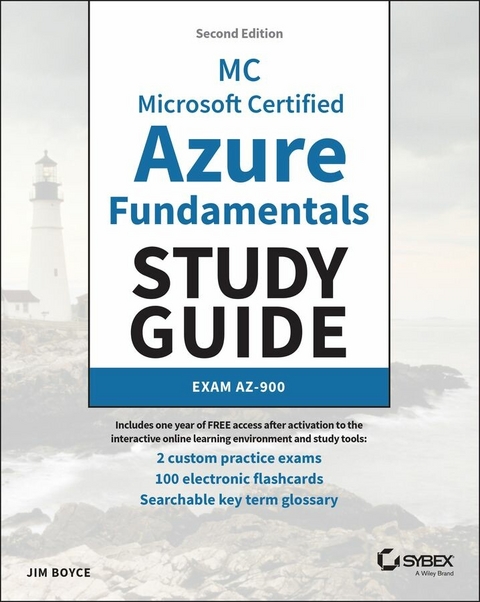
MC Microsoft Certified Azure Fundamentals Study Guide (eBook)
451 Seiten
Sybex (Verlag)
978-1-394-35003-2 (ISBN)
The fastest and most effective way to learn the fundamentals of Azure cloud technology and prepare for the AZ-900 certification exam
The newly updated second edition of MC Microsoft Certified Azure Fundamentals Study Guide is an accurate and up-to-date roadmap to the AZ-900 certification exam and a reliable, effective resource for everyone seeking to learn about or reinforce their knowledge of Azure services, pricing, security and compliance, resource management, and more. In the book, experienced Microsoft Principal Customer Success Account Manager and long-time author, Jim Boyce, covers every foundational Azure competency, including:
- General and foundational cloud concepts
- Azure Core Services, including architecture, subscription and billing options, data services, and virtual machines
- Azure Core Networking Services, like virtual networks, load balancers, and VPN gateways
- Security, compliance, privacy, and trust features
- Azure Solutions, like AI and machine learning, serverless computing, and IoT
- Azure pricing, service levels, and lifecycles
- Azure Resource creation and management
Ideal for technical and non-technical professionals alike, this straightforward Study Guide draws on the proven Sybex model to explain core Azure features and concepts. It will get you ready to succeed on the widely used AZ-900 certification test and elevate your understanding of Azure cloud software, improving your day-to-day performance in any role that directly or indirectly intersects with the cloud platform.
Inside the book
- End-of-chapter review questions, with answers and explanations, you can use to measure your progress and help you focus on the areas where you need to improve
- Concise and intuitive explanations of core Azure services, functions, and features
- Complimentary access to the superior Sybex online learning environment and test bank, including practice test questions, digital flashcards, and a glossary of key terms
With authoritative, concise coverage of all relevant cloud concepts, Azure architecture and services, and management and governance features tested by the AZ-900 certification exam, this edition of MC Microsoft Certified Azure Fundamentals Study Guide is the fastest, most efficient way to get up to speed on foundational Azure cloud competencies.
ABOUT THE AUTHOR
JIM BOYCE is a Principal Customer Success Account Manager at Microsoft. He's authored more than 60 books covering a wide range of technology topics, including Windows, Microsoft Office, AutoCAD, Unix, networking, programming, and hardware.
The fastest and most effective way to learn the fundamentals of Azure cloud technology and prepare for the AZ-900 certification exam The newly updated second edition of MC Microsoft Certified Azure Fundamentals Study Guide is an accurate and up-to-date roadmap to the AZ-900 certification exam and a reliable, effective resource for everyone seeking to learn about or reinforce their knowledge of Azure services, pricing, security and compliance, resource management, and more. In the book, experienced Microsoft Principal Customer Success Account Manager and long-time author, Jim Boyce, covers every foundational Azure competency, including: General and foundational cloud concepts Azure Core Services, including architecture, subscription and billing options, data services, and virtual machines Azure Core Networking Services, like virtual networks, load balancers, and VPN gateways Security, compliance, privacy, and trust features Azure Solutions, like AI and machine learning, serverless computing, and IoT Azure pricing, service levels, and lifecycles Azure Resource creation and management Ideal for technical and non-technical professionals alike, this straightforward Study Guide draws on the proven Sybex model to explain core Azure features and concepts. It will get you ready to succeed on the widely used AZ-900 certification test and elevate your understanding of Azure cloud software, improving your day-to-day performance in any role that directly or indirectly intersects with the cloud platform. Inside the book End-of-chapter review questions, with answers and explanations, you can use to measure your progress and help you focus on the areas where you need to improve Concise and intuitive explanations of core Azure services, functions, and features Complimentary access to the superior Sybex online learning environment and test bank, including practice test questions, digital flashcards, and a glossary of key terms With authoritative, concise coverage of all relevant cloud concepts, Azure architecture and services, and management and governance features tested by the AZ-900 certification exam, this edition of MC Microsoft Certified Azure Fundamentals Study Guide is the fastest, most efficient way to get up to speed on foundational Azure cloud competencies.
Introduction
I currently manage the support and proactive services experience for a portfolio of Microsoft customers, many of whom have either already made a significant transition from on-premises to Azure or are in the process of evaluating a move to Azure. Some of the customers I’ve managed are very large enterprise customers with massive Azure implementations that spend millions of dollars a month in Azure, while others are very small and have very small Azure footprints.
I field questions daily about Azure services, deployment strategies, and proactive services designed to not only educate our customers on Azure and Microsoft 365 but also assist them in planning, deploying, and supporting their Azure and M365 workloads.
Continuing technical training is one of the commitments that most Microsoft employees have in addition to the core responsibilities of their roles. As part of that commitment, I completed the AZ-900 Microsoft Azure Fundamentals Certification several years ago. The certification helped broaden my background across the entire Azure service portfolio. It also reinforced my understanding that not only highly technical roles benefit from the training and certification—less technical roles benefit from the certification as well.
That’s the approach I’ve taken for this book. The content is intended to help you understand the requirements of the AZ-900 Fundamentals exam and prepare to successfully pass the exam. The book does not go deep in Azure but rather focuses on core concepts, services, and resources in Azure that are covered by the exam objectives. The goal of the AZ-900 exam is not to give you a technical depth in Azure, but rather to give you a broad understanding that will enable you to understand the benefits that Azure offers and begin to integrate Azure into your role, whether technical or not.
Microsoft AZ-900 Certification Exam
Microsoft currently offers over 30 certifications at many levels across the Azure cloud offering, ranging from fundamental to very technical. The AZ-900 exam and certification should be the first certification step in your Azure certification path if you do not yet have a fundamental understanding of cloud offerings and Azure in particular. So, whether you are interested in certification in Azure solutions, data, AI, or other areas, your certification path often begins with AZ-900.
The following sections explore the certification paths and process in more detail.
How Do You Become Certified on Azure?
As explained earlier, Microsoft currently offers over 30 certifications for Azure. Obviously, fundamentals is one certification area, but there are multiple certification paths for Azure administration, app development, data, AI, security, DevOps, IoT, and Power Platform, to name some. These certifications are currently supported by many exams. Even if you plan to pursue certification in, for example, Azure AI, you should consider AZ-900 Fundamentals to give you a broader understanding of Azure; the knowledge you gain will supplement your understanding of your selected certification. It will also help you leverage and integrate additional Azure workloads in your area of specialization.
Becoming certified in Azure is relatively simple. Choose the certification you want to achieve, work through the prescribed learning path for the certification, prepare for the exam, and pass it. Preparation can take many forms, and this book is intended to be your primary one. People have different learning styles, varying backgrounds and experiences, differing amounts of time to study, and so on. So, this book can be one of a handful of key resources you use to prepare for the exam.
To begin, work through the chapters of this book and develop a strong understanding of the questions and answers offered in each one. Practice does make perfect, so consider working through additional practice test options before taking the exam. Microsoft offers some knowledge checks online within the content at the following URL:
docs.microsoft.com/en-us/learn/certifications/azure-fundamentals You will also find other sample test options online, some for free and some for a fee. All of them provide good additional preparation for the exam. The more questions you work through before taking the exam, the more likely you are to be successful on your first attempt.
Types of Exam Questions
I have tried to model the sample questions in this book as closely to the types of questions you will see in the official AZ-900 exam. Because the test is online, however, some types of questions are difficult to model in print. The following sections explore the types of questions you will experience in the official, online AZ-900 exam.
Multiple Choice
These are generally straightforward and come in two variants. The first is a simple question followed by a selection of possible answers. The test question indicates whether there is a single answer or multiple correct answers. Each correct response counts toward your point total. Example (you would choose one answer):
Which one of the following provides container orchestration services for containers in Azure?
- Azure Container Instances (ACI)
- Azure Kubernetes
- Azure Logic Apps
- Azure Container Orchestration Services
Many multiple-choice questions are scenario based, describing a planning, deployment, or management scenario, followed by a question about the scenario. Example (you would choose one or more correct solutions):
You are the IT director for Contoso Corporation. Your CIO has asked you to recommend a solution that will enable the development team to quickly deploy VMs for testing applications. The solution must provide flexibility but also result in the least cost. Which of the following solutions meets these requirements?
Drag-and-Drop and Select Questions
Drag-and-drop questions provide a list of answers that you must match with a corresponding description. For example, the answers might include Disaster Recovery, Fault Tolerance, Low Latency, and Dynamic Scalability. You would drag each of these answers into a box beside the correct description of each.
Select questions describe a scenario and you must choose the correct answer from a drop-down list that typically offers three possible answers. Example:
Which cloud deployment model is used for Azure VMs and Azure SQL Database instances?
(You would choose Infrastructure-as-a-Service from a drop-down list beside Azure VMs and choose Platform-as-a-Service from the drop-down list beside Azure SQL Database.)
Yes/No Questions
These questions typically include three questions related to a specific topic and are essentially a collection of true or false questions. You answer by selecting either Yes or No beside each one. Example (for each you would select Yes or No):
Azure resources can access other resources only in the resource group in which they reside. Yes No
Deleting a resource group also deletes all resources in the group. Yes No
A resource group can include resources from multiple Azure regions. Yes No
Text Replacement Questions
These questions offer a statement with part of the statement underlined. The statements sometimes include leading sentences providing additional information. The question offers four options, A through D. Three offer alternative text that you would use in place of the underlined text to make it correct. Or, you choose the answer No change is needed if the underlined text is correct. Example:
Azure Data Lake Analytics is a PaaS solution that enables you to query data in a data lake and build visualizations without deploying hardware or supporting services.
- is built on SQL Managed Service to provide analytics for large SQL implementations
- is a component of Azure IoT Central that provides deep analysis of IoT telemetry
- integrates with Azure DevTest Labs to provide code analysis capabilities
- No change is needed.
In this example, the underlined text makes the statement correct, so the appropriate answer is D (no change is needed). But, if Azure Data Lake Analytics were instead a component of Azure IoT that provided deep analysis of IoT telemetry (it is not), then you would choose B.
Achieving AZ-900 Fundamentals Certification
The previous sections have explored the concepts surrounding AZ-900 certification. The following sections offer guidance on preparing and registering for the exam, and for taking the exam.
Preparing for the Exam
Each person has a unique learning style, and one preparation method is not necessarily the best for everyone. However, the following list of preparation methods will help anyone be successful if used as a whole:
- Studying: This book obviously provides a great set of resources for learning about Azure fundamentals, but you might prefer a deeper discussion of some topics to help you better understand them. Many online sources are available, but Microsoft’s website is perhaps the best, most authoritative source. When I need to go deeper in a particular topic, I usually open Bing in a browser and use a search similar to the following, specifying where to confine the search and the search terms (replace Service Health with the topic you need to find): site: docs.microsoft.com Azure Service Health.
- Your favorite AI partner: I often use Copilot to gain insight and understanding in a particular area or topic. I’ve used ChatGPT, as well. You can ask both to create...
| Erscheint lt. Verlag | 29.10.2025 |
|---|---|
| Reihe/Serie | Sybex Study Guide |
| Sprache | englisch |
| Themenwelt | Mathematik / Informatik ► Informatik ► Netzwerke |
| Technik ► Elektrotechnik / Energietechnik | |
| Schlagworte | az-900 certification • AZ-900 certification exam • az-900 certification test • Az-900 exam • az-900 practice • az-900 practice exams • AZ-900 practice questions • az-900 practice tests • AZ-900 study guide • azure fundamentals practice tests |
| ISBN-10 | 1-394-35003-1 / 1394350031 |
| ISBN-13 | 978-1-394-35003-2 / 9781394350032 |
| Informationen gemäß Produktsicherheitsverordnung (GPSR) | |
| Haben Sie eine Frage zum Produkt? |
 EPUB (Adobe DRM)
Kopierschutz: Adobe-DRM
Adobe-DRM ist ein Kopierschutz, der das eBook vor Mißbrauch schützen soll. Dabei wird das eBook bereits beim Download auf Ihre persönliche Adobe-ID autorisiert. Lesen können Sie das eBook dann nur auf den Geräten, welche ebenfalls auf Ihre Adobe-ID registriert sind.
Details zum Adobe-DRM
Dateiformat: EPUB (Electronic Publication)
EPUB ist ein offener Standard für eBooks und eignet sich besonders zur Darstellung von Belletristik und Sachbüchern. Der Fließtext wird dynamisch an die Display- und Schriftgröße angepasst. Auch für mobile Lesegeräte ist EPUB daher gut geeignet.
Systemvoraussetzungen:
PC/Mac: Mit einem PC oder Mac können Sie dieses eBook lesen. Sie benötigen eine
eReader: Dieses eBook kann mit (fast) allen eBook-Readern gelesen werden. Mit dem amazon-Kindle ist es aber nicht kompatibel.
Smartphone/Tablet: Egal ob Apple oder Android, dieses eBook können Sie lesen. Sie benötigen eine
Geräteliste und zusätzliche Hinweise
Buying eBooks from abroad
For tax law reasons we can sell eBooks just within Germany and Switzerland. Regrettably we cannot fulfill eBook-orders from other countries.
aus dem Bereich