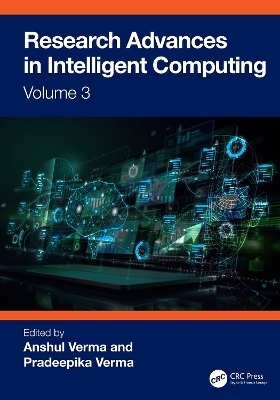
Research Advances in Intelligent Computing
CRC Press (Verlag)
978-1-041-14516-5 (ISBN)
- Noch nicht erschienen (ca. Mai 2026)
- Versandkostenfrei
- Auch auf Rechnung
- Artikel merken
Showcases recent, impactful applications of intelligent computing across diverse domains, supported by detailed case studies.
Offers deep insights into the latest research developments and outlines promising areas for future exploration in intelligent computing.
Combines theoretical foundations with algorithmic, simulation-based, and implementation-oriented research to provide a holistic understanding of IC systems.
Balances foundational theory for beginners with practical simulations and real-life implementations for intermediate and advanced readers.
Anshul Verma received his M.Tech. and Ph.D. degrees in Computer Science and Engineering from ABV–Indian Institute of Information Technology and Management (IIITM), Gwalior, India. He pursued his postdoctoral research at the Indian Institute of Technology (IIT) Kharagpur, India. He is currently serving as an Assistant Professor in the Department of Computer Science, Institute of Science, Banaras Hindu University (BHU), Varanasi, India, with over 10 years of academic and research experience. Prior to joining BHU, he was associated with the Department of Computer Science and Engineering at Motilal Nehru National Institute of Technology (MNNIT) Allahabad and the National Institute of Technology (NIT) Jamshedpur as a faculty member. His research interests span Cloud Computing, Distributed Systems, Mobile Ad-hoc Networks, and Formal Verification. He has successfully organized four editions of the International Conference on Advanced Network Technologies and Intelligent Computing (ANTIC) as General Chair and Convener since 2021. He has published extensively in renowned journals, books, and conferences. He is currently leading three externally funded and three institutionally funded research projects as Principal Investigator/Co-Principal Investigator. He also contributes actively to the academic publishing community, serving as an Associate Editor of the Journal of Scientific Research of the Banaras Hindu University and as an Editorial Board Member of Scientific Reports of Springer. Pradeepika Verma received her Ph.D. degree in Computer Science and Engineering from the Indian Institute of Technology (ISM) Dhanbad, India. She has received M.Tech in Computer Science and Engineering from Banasthali University, Rajasthan, India. Currently, she is working as a Faculty Fellow in Technical Innovation Hub at Indian Institute of Technology, Patna, India. She has worked as a Post-Doctoral Fellow in Department of Computer Science and Engineering at Indian Institute of Technology (BHU), Varanasi, India. She has also worked as an Assistant Professor in the Department of Computer Science and Engineering at Pranveer Singh Institute of Technology, Kanpur, India, and as a Faculty Member in the Department of Computer Application at the Institute of Engineering and Technology, Lucknow, India. Her current research interests include Natural Language Processing, Optimization Approaches, Artificial Intelligence, Cloud Computing, and Distributed Systems.
Chapter 1: A Review on Global Land Use/Land Cover Change Analysis using Digital Image Processing
Chapter 2: Reduction of Two-Dimensional Data for Speeding up Convex Hull Computation
Chapter 3: Enhancing Brain Tumor Detection with an Ensemble Model
Chapter 4: Optical Character Recognition -Based Intelligent Grading System for Handwritten Text
Chapter 5: Quantum-Inspired Neural Networks: Bridging Quantum Computing and Deep Learning for Next-Generation AI Systems
Chapter 6: Deep Learning-Based Approach for Robust Image Authentication
Chapter 7: AI-driven Autonomous Cyber Threat Intelligence (CTI) Curation and Lifecycle Management
Chapter 8: Enhancing Brain Tumor Classification Using Transfer Learning and Convolutional Neural Networks
Chapter 9: Real-Time Feedback for Teachers using Multi modal Emotion Detection in Classroom Teaching
Chapter 10: Enhanced Approach for Chronic Disease Diagnosis and Prediction using Ensemble Deep Learning
Chapter 11: Empowering Industry 5.0 with Large Language Models for Phishing Defense
Chapter 12: AI-Generated Text Detection: A Hybrid CNN-BiLSTM and BERT-Based Large Language Model Approach
Chapter 13: Swarm Intelligence Algorithms for Autonomous Robotics in Unknown and Dynamic Environments
Chapter 14: Classification of Sleep Stage for Human Wellness from Single-Channel EEG using Convolutional Neural Network of Deep Learning
Chapter 15: Minimum Flow Rates Maximization using Graph Conversion Techniques In Rechargeable Wireless Sensor Networks (rWSN) of IoT
Chapter 16: Explainable Transformer-Augmented U-Net for Brain Tumor Segmentation in MRI
Chapter 17: CycleGAN-Based MRI-to-CT Image Synthesis for Tumor-Centric Medical Image Translation
Chapter 18: Preprocessing in Colorectal Cancer Histopathology: A Prerequisite for Effective Computational Analysis
Chapter 19: A Hybrid Machine Learning Approaches for Detecting Intrusions in Wireless Sensor Networks (WSN)
| Erscheint lt. Verlag | 1.5.2026 |
|---|---|
| Zusatzinfo | 76 Tables, black and white; 199 Line drawings, black and white; 53 Halftones, black and white; 252 Illustrations, black and white |
| Verlagsort | London |
| Sprache | englisch |
| Maße | 178 x 254 mm |
| Themenwelt | Mathematik / Informatik ► Informatik ► Software Entwicklung |
| Technik ► Elektrotechnik / Energietechnik | |
| ISBN-10 | 1-041-14516-0 / 1041145160 |
| ISBN-13 | 978-1-041-14516-5 / 9781041145165 |
| Zustand | Neuware |
| Informationen gemäß Produktsicherheitsverordnung (GPSR) | |
| Haben Sie eine Frage zum Produkt? |
aus dem Bereich