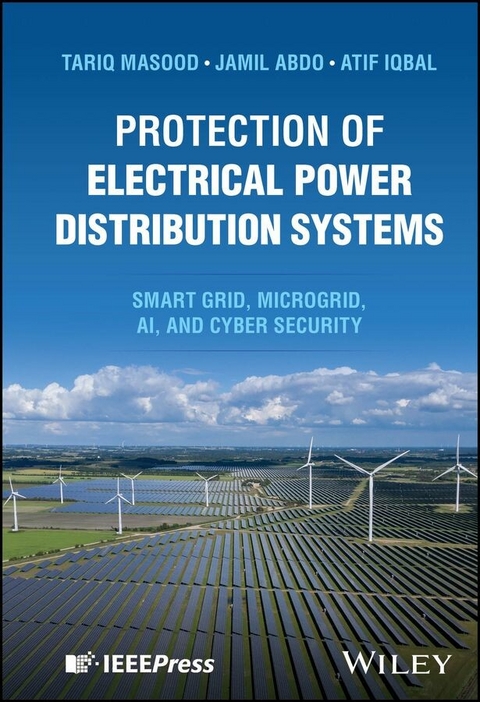
Protection of Electrical Power Distribution Systems (eBook)
622 Seiten
Wiley-IEEE Press (Verlag)
978-1-394-32765-2 (ISBN)
Comprehensive reference on safeguarding electrical power systems from faults and failures, exploring emerging technologies such as AI and ML
Supported by case studies of real-world power system faults, Protection of Electrical Power Distribution Systems offers an in-depth examination of the methods and technologies used to safeguard electrical grids from faults and failures. The book begins with a comprehensive introduction to power system fundamentals, emphasizing the critical role of protection mechanisms in maintaining system stability and ensuring operational safety. It thoroughly explores various types of faults, including short circuits, ground faults, and overloads, detailing their potential impacts on system performance, reliability, and safety.
The book introduces foundational concepts such as protection overlay, unit protection, and non-unit protection, before diving into the core principles of power system protection. These include the key attributes of selectivity, sensitivity, speed, and reliability, essential for designing effective protection systems. A detailed discussion follows on the wide range of protective devices used in modern power systems, such as fuses, circuit breakers, and relays, along with strategies for their coordination to ensure optimal performance.
To enhance reader engagement and understanding, the book includes practical exercises and self-assessment questions that focus on protection system design and implementation. These tools encourage deeper learning and provide valuable insights into the real-world application of power system protection technologies.
Protection of Electrical Power Distribution Systems includes information on:
- Differences between restricted and unrestricted protection and criteria to determine ideal boundaries of protection zones
- Modern technologies applied to protection such as digital relays and intelligent electronic devices (IEDs)
- Different kinds of busbar protection and the main types of faults affecting the busbar
- Types of transformer protection and their constraints and the operation of current and voltage transformers
- Future trends in the field such as the application of AI and ML in predictive maintenance and fault diagnosis
Protection of Electrical Power Distribution Systems serves as an essential reference for engineers, researchers, and students, offering a deep understanding of power system protection principles and practices to enhance the reliability and safety of electrical power systems.
Tariq Masood, M.Phil., PhD, P.E. is an Assistant Professor of Electrical Engineering at Frostburg State University, USA. He earned his PhD in Electrical Power System Smart Grid and Renewable Energies from the University of Bath, UK.
Jamil Abdo, PhD, is a Professor and the Chair of the Department of Engineering at Frostburg State University, USA. He obtained his PhD in Mechanical Design from Southern Illinois University, Carbondale, USA.
Atif Iqbal, DSc, PhD, is a Full Professor of the Department of Electrical Engineering at Qatar University, Qatar. He serves as the Vice-Chair of the IEEE Qatar Section, and is an Associate Editor of the IEEE Transactions on Industrial Electronics and Senior Editor of IEEE Access.
Comprehensive reference on safeguarding electrical power systems from faults and failures, exploring emerging technologies such as AI and ML Supported by case studies of real-world power system faults, Protection of Electrical Power Distribution Systems offers an in-depth examination of the methods and technologies used to safeguard electrical grids from faults and failures. The book begins with a comprehensive introduction to power system fundamentals, emphasizing the critical role of protection mechanisms in maintaining system stability and ensuring operational safety. It thoroughly explores various types of faults, including short circuits, ground faults, and overloads, detailing their potential impacts on system performance, reliability, and safety. The book introduces foundational concepts such as protection overlay, unit protection, and non-unit protection, before diving into the core principles of power system protection. These include the key attributes of selectivity, sensitivity, speed, and reliability, essential for designing effective protection systems. A detailed discussion follows on the wide range of protective devices used in modern power systems, such as fuses, circuit breakers, and relays, along with strategies for their coordination to ensure optimal performance. To enhance reader engagement and understanding, the book includes practical exercises and self-assessment questions that focus on protection system design and implementation. These tools encourage deeper learning and provide valuable insights into the real-world application of power system protection technologies. Protection of Electrical Power Distribution Systems includes information on: Differences between restricted and unrestricted protection and criteria to determine ideal boundaries of protection zonesModern technologies applied to protection such as digital relays and intelligent electronic devices (IEDs)Different kinds of busbar protection and the main types of faults affecting the busbarTypes of transformer protection and their constraints and the operation of current and voltage transformersFuture trends in the field such as the application of AI and ML in predictive maintenance and fault diagnosis Protection of Electrical Power Distribution Systems serves as an essential reference for engineers, researchers, and students, offering a deep understanding of power system protection principles and practices to enhance the reliability and safety of electrical power systems.
Preface
The transition toward the protection of power systems, smart grids, and microgrid systems is a technical evolution and a key enabler for achieving and strengthening global sustainability and asset reliability in the energy sector. This book, a practical guide and a key contributor to the global effort to advance the UN Sustainable Development Goals (SDGs), particularly in promoting sustainable energy (SDG 7), industry innovation (SDG 9), and climate action (SDG 13), provides actionable frameworks that can be implemented in power distribution systems to safeguard operations and equipment. The content is not just theoretical insights, but also practical solutions that can be applied, with the ultimate goal of ensuring safe and reliable energy production, while advancing sustainability in a way that aligns with the broader global movement toward achieving the SDGs.
Practical Solutions for Sustainable Energy Operations
Power distribution systems, particularly those embedded within Smart Grid and Microgrid architectures, must prioritize health, safety, and security to ensure operational efficiency and the well‐being of personnel and the broader public. As the leader and principal author of Operational Excellence 20 Initiatives in the Energy Sector, I emphasize the critical need for a robust maintenance strategy that ensures both preventive and corrective maintenance. This strategy directly supports SDG 9, which calls for innovation in industry infrastructure. By maintaining asset reliability and system integrity, energy utilities can reduce downtime, enhance performance, and minimize environmental impacts, contributing to sustainable production – a core aim of SDG 12 (Responsible Consumption and Production). This book provides a step‐by‐step guide for implementing these maintenance strategies, focusing on optimizing OPEX (Operating Expenses) and CAPEX (Capital Expenditures). This approach is essential for securing the continuity of energy delivery – safeguarding sustainable energy production processes and optimizing operational costs, aligning with SDG 7 for affordable and clean energy.
Supporting Health, Safety, Security, and Environmental (HSSE) Protection
Safe and sustainable energy production is at the core of achieving SDG 7: Affordable and Clean Energy. Smart Grids enable the seamless incorporation of renewable energy sources such as solar, wind, and hydropower, reducing the carbon footprint of energy production.
In alignment with SDG 3 (Good Health and Well‐Being) and SDG 8 (Decent Work and Economic Growth), the techniques outlined in this book also focus on Health, Safety, Security, and Environmental (HSSE) Protection. Through safe production practices, reliable maintenance strategies, and minimizing operational risks, energy producers can foster a working environment that prioritizes the health and safety of employees while reducing environmental impact. The HSSE framework presented in this book is not just about protecting human and ecological resources; it's about ensuring that energy production can continue safely and sustainably, contributing to climate action (SDG 13).
Inspiring Innovation in Achieving Sustainable Goals in the Energy Sector
The reliability and integrity of grid assets are fundamental to operational efficiency and long‐term environmental sustainability. Unreliable systems result in energy waste, increased emissions, and higher maintenance costs. By focusing on predictive maintenance and real‐time asset management, smart distribution systems ensure that infrastructure remains robust against natural disasters, climate change, and technical failures. Ultimately, this book seeks to inspire action by providing actionable and proven methods that power utilities can use to ensure safe and reliable energy delivery. By promoting innovation in maintenance strategies, the content aligns with the themes of equality, sustainability, and environmental protection set out by the UN SDGs. This effort, alongside the UN's mission, underscores the importance of maintaining asset reliability and integrity and fostering an environment, where safe and sustainable production is possible. Through ongoing training, improvement initiatives, and risk management, this book equips energy professionals with the tools they need to contribute to the global SDG effort.
A comprehensive maintenance strategy is crucial to prolonging the life of grid assets and ensuring they operate safely and sustainably. Through AI‐enhanced predictive maintenance, grid operators can foresee potential issues before they escalate, thereby preventing hazardous and costly outages. This book fully aligns with the UN SDGs, emphasizing sustainability, asset reliability, and safe production. It serves as a valuable resource for energy sector stakeholders committed to fostering a sustainable, secure, and resilient energy future, and its strong alignment with the UN SDGs underscores its potential impact on the global sustainability effort.
This book does not discuss the details of distribution systemdesign and system analysis, which have already been the subject of several good, published books.
- Section 1: This book provides the basics and advances of the art and science of protection for distribution systems. It will empower those interested in this area, enhance their knowledge, and enable them to delve deeper into the specifics of the subject. Although several leading textbooks cover the topic, the most excellent understanding of the subject can be best achieved by working with the schemes and exploring the history behind their development.
- Section 2: By the end of this section, you will have a solid understanding of the general principles of the protection overlay. This knowledge will enable you to differentiate between non‐unit or nonrestricted protection and unit or restricted protection. You will also be equipped to divide a power system network into manageable protection zones and determine their ideal boundaries. Moreover, you will be able to assess the capabilities of the protection system to safeguard the power system as a whole and identify fundamental weaknesses in a protection scheme, thereby applying your learning in practical scenarios.
- Section 3: In this section, you will be introduced to the practical application of non‐unit protection to safeguard distribution feeders through a series of exercises. These exercises will guide you on how to operate a fuse to protect distribution feeders, choose suitable values to preserve a radial distribution feeder, and appreciate fuses with circuit breakers for high‐voltage feeders. You will also learn to select the appropriate setting for inverse definite minimum time‐delayed overcurrent relays to protect a radial distribution feeder system and understand the limitations of these relays when protecting interconnected feeder circuits. Ultimately, you will gain a comprehensive understanding of the application of directional overcurrent relays to protect interconnected distribution feeders.
- Section 4: In this section, you will learn the operation and application of current and voltage transformers (also known as protection transducers) used in the protection of distribution systems. You will be able to distinguish clearly between the primary differences in design criteria for the two types of transducers for the protection system. The section will also define the accuracy requirements of the two transducers, emphasizing the need for precision in protecting each piece of equipment in the power distribution system. This focus on precision will make you feel more attentive and detail‐oriented in your approach.
- Section 5: In this section, you will be able to learn to define the basic principle of unit protection, identify the need for bias, and derive both bias and operating quantities. You will also assess the advantages and disadvantages of different differential protection schemes (including pilot wire and digital) used in practice. Finally, you will have an appreciation of directional earth fault and rough balance protection.
- Section 6: In this section, you will be able to learn and list the main types of faults affecting transformers, describe the different types of transformer protection, and demonstrate some of the typical constraints and application considerations for various types of transformer protection.
- Section 7: In this section, you will be able to learn and list the main types of faults affecting the busbar, describe the different kinds of busbar protection available, and determine some of the typical constraints and application considerations for various types of busbar protection.
- Section 8: In this section, you will be able to learn and define the essential motor characteristics involved in protection, determine the motor protection requirements, and describe the basic principles of motor protection against winding faults, overload, and phase unbalance.
- Section 9: In this section, you will be introduced to the implications of introducing embedded generation into a utility supply network. Understanding these implications is crucial, as it prepares you for the future challenges in the field. You will also learn about the techniques used to protect the embedded generator and the utility intertie, equipping you with the knowledge to navigate the evolving...
| Erscheint lt. Verlag | 28.10.2025 |
|---|---|
| Sprache | englisch |
| Themenwelt | Technik ► Elektrotechnik / Energietechnik |
| Schlagworte | AI in power system • Busbar Protection • Cyber Security in Power System • electrical power systems failure • electrical power systems faults • electric system performance • electric system safety • fault detection • ground faults • IDMT relays • Isolation and Restoration • Microgrid • protection overlay • short circuits • Smart Grid • voltage and current transformers |
| ISBN-10 | 1-394-32765-X / 139432765X |
| ISBN-13 | 978-1-394-32765-2 / 9781394327652 |
| Informationen gemäß Produktsicherheitsverordnung (GPSR) | |
| Haben Sie eine Frage zum Produkt? |
 EPUB (Adobe DRM)
Kopierschutz: Adobe-DRM
Adobe-DRM ist ein Kopierschutz, der das eBook vor Mißbrauch schützen soll. Dabei wird das eBook bereits beim Download auf Ihre persönliche Adobe-ID autorisiert. Lesen können Sie das eBook dann nur auf den Geräten, welche ebenfalls auf Ihre Adobe-ID registriert sind.
Details zum Adobe-DRM
Dateiformat: EPUB (Electronic Publication)
EPUB ist ein offener Standard für eBooks und eignet sich besonders zur Darstellung von Belletristik und Sachbüchern. Der Fließtext wird dynamisch an die Display- und Schriftgröße angepasst. Auch für mobile Lesegeräte ist EPUB daher gut geeignet.
Systemvoraussetzungen:
PC/Mac: Mit einem PC oder Mac können Sie dieses eBook lesen. Sie benötigen eine
eReader: Dieses eBook kann mit (fast) allen eBook-Readern gelesen werden. Mit dem amazon-Kindle ist es aber nicht kompatibel.
Smartphone/Tablet: Egal ob Apple oder Android, dieses eBook können Sie lesen. Sie benötigen eine
Geräteliste und zusätzliche Hinweise
Buying eBooks from abroad
For tax law reasons we can sell eBooks just within Germany and Switzerland. Regrettably we cannot fulfill eBook-orders from other countries.
aus dem Bereich