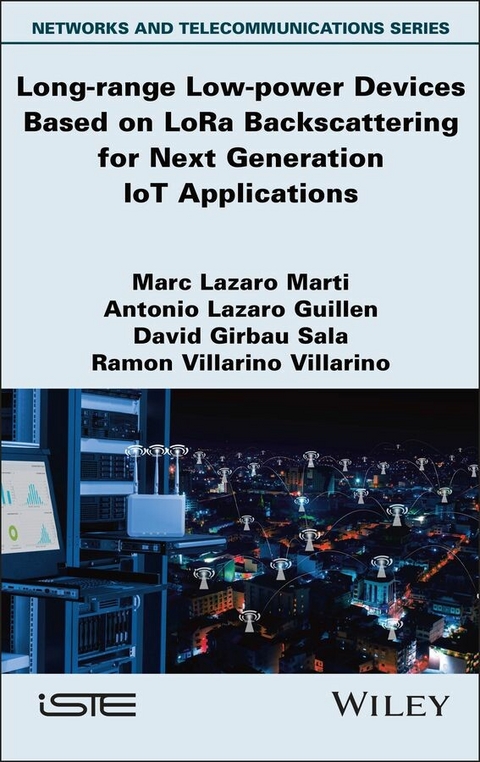
Long-range Low-power Devices Based on LoRa Backscattering for Next Generation IoT Applications (eBook)
354 Seiten
Wiley-Iste (Verlag)
978-1-394-41794-0 (ISBN)
This book explores a novel approach to ultra-low-power and long-range wireless communication for next-generation Internet of Things (IoT) devices through LoRa-based backscatter technology. It begins by analyzing the challenges in traditional IoT systems - energy consumption, scalability, interoperability and security - before introducing backscatter communication as a promising alternative. By leveraging LoRa's long-range capabilities and the energy efficiency of the backscatter technique, it proposes a solution that significantly reduces power consumption while preserving effective communication performance.
Long-range Low-power Devices Based on LoRa Backscattering for Next Generation IoT Applications presents theoretical foundations, system architecture and tag design, including various modulation schemes and front-end implementations. Several real-world applications are examined, such as indoor localization, smart medical implants, wearable health monitoring and smart home automation. Through practical experiments and performance evaluations, it is demonstrated that LoRa backscattering systems offer a viable and scalable path toward sustainable, maintenance-free IoT nodes. This book serves as a comprehensive reference for researchers and engineers specializing in low-power wireless communication systems for IoT.
Marc Lazaro Marti is Professor at Universitat Rovira i Virgili, Spain. His research focuses on semi-passive RFID systems, backscatter communication and radar applications.
Antonio Lazaro Guillen is Professor at Universitat Rovira i Virgili, Spain. His research interests include microwave device modeling, MMICs, low phase noise oscillators, RFID, UWB systems and MEMS.
David Girbau Sala is Professor at Universitat Rovira i Virgili, Spain. His research includes microwave systems, UWB, RFID, RF-MEMS and wireless sensing, as well as low-power, high-frequency technologies for IoT and sensor networks.
Ramon Villarino Villarino is Professor at Universitat Rovira i Virgili, Spain. His research focuses on radiometry, UWB systems, RFID and metamaterial-based frequency-selective structures.
This book explores a novel approach to ultra-low-power and long-range wireless communication for next-generation Internet of Things (IoT) devices through LoRa-based backscatter technology. It begins by analyzing the challenges in traditional IoT systems energy consumption, scalability, interoperability and security before introducing backscatter communication as a promising alternative. By leveraging LoRa s long-range capabilities and the energy efficiency of the backscatter technique, it proposes a solution that significantly reduces power consumption while preserving effective communication performance. Long-range Low-power Devices Based on LoRa Backscattering for Next Generation IoT Applications presents theoretical foundations, system architecture and tag design, including various modulation schemes and front-end implementations. Several real-world applications are examined, such as indoor localization, smart medical implants, wearable health monitoring and smart home automation. Through practical experiments and performance evaluations, it is demonstrated that LoRa backscattering systems offer a viable and scalable path toward sustainable, maintenance-free IoT nodes. This book serves as a comprehensive reference for researchers and engineers specializing in low-power wireless communication systems for IoT.
Introduction
I.1. Why ultra-low-power long-range IOT matters
Envision a world where countless devices are connected to the Internet, constantly collecting, exchanging and processing data; not only conventional electronic devices such as computers, tablets or smartphones, but also everyday objects such as clothes, furniture, keys or even your wallet. This is the reality of the Internet of Things (IoT), a rapidly growing network of interconnected devices that is reshaping the way we live, work and interact with technology. From wearables that track our fitness to smart homes that automatically adjust the lighting and temperature, applications are unbounded. With billions of devices already connected and waiting for billions more in the coming years, the IoT is transforming industries ranging from healthcare to manufacturing, and promises to revolutionize our daily lives in ways we cannot yet imagine (Al-Sarawi et al. 2020; Yaici 2020).
At first glance, connecting mundane objects to the Internet may seem implausible to some, why add unnecessary complexity to everyday things? Collecting the temperature of clothes or detecting the humidity of a plant substrate can be interesting, but is it worth it? Does it really simplify our lives? It is certainly a controversial matter, and answers are always subjective. IoT nodes should always have a social–economic equilibrium, considering resources, costs, social benefits or security among others, and it is in this balance that the answer lies. A major critique of the IoT field arises from the use of devices that do not respect this balance, since they are usually designed from a flawed perspective, such as a marketing-driven approach, which unfortunately can lead to the creation of dysfunctional devices. However, it should be emphasized that the goal of the IoT is nothing other than improving the well-being of individuals, and never the opposite.
Sir Francis Bacon wrote in his work Meditationes Sacrae – ipsa scientia potestas est –, knowledge itself is power (Bacon 1859). Paraphrasing this in the 21st century, we could say that data is power, and in fact, IoT nodes are providing exceedingly large amounts of data, bringing insightful knowledge in many fields, which would be impossible to obtain through other methods.
The primary milestone for the next generation of IoT devices is to become imperceptible to users, requiring no battery replacements or periodic maintenance. IoT nodes must work seamlessly in the background, freeing users from having to be conscious of them, similar to how anti-lock braking systems (ABS) work in cars or how solar lights turn on and off automatically in smart cities. However, there are several challenges that need to be addressed for the IoT to reach its full potential (Bagchi et al. 2020; Firouzi et al. 2020; Souri et al. 2022):
- Security: one of the biggest challenges for the next generation of IoT will be to ensure the security of devices and data. As more and more devices are connected to the internet, there will be a greater risk of cyber-attacks and data breaches.
- Interoperability: a significant challenge is the lack of standardization between the wide variety of devices and technologies that are part of the IoT ecosystem, and ensuring that they can communicate and work together seamlessly.
- Privacy: the data collected by IoT devices can be highly sensitive and personal. With the growing amount of data being collected and analyzed by IoT devices, privacy concerns will become more critical than ever. Users will need to have control over their data and be confident that it is being handled securely and ethically.
- Scalability: the next generation of IoT will involve billions of devices and systems, which will require a scalable infrastructure and data processing capabilities.
- Reliability: IoT devices must be reliable and usually be capable of operating effectively in harsh conditions such as extended sun exposure or varying weather, without experiencing malfunctions or failures.
- Complexity: the IoT ecosystem is highly complex, with many different devices, protocols and technologies involved. Managing this complexity and ensuring that the IoT is easy to use and deploy is another challenge.
- Energy efficiency: many IoT devices are powered by batteries or other limited power sources, and optimizing their power consumption to extend their battery life is a major challenge. Devices will need to be designed to be energy-efficient and powered by sustainable sources.
- Cost: the cost of IoT devices and systems can be a barrier to adoption, especially in developing countries. To overcome this challenge, IoT technology needs to be made more affordable and accessible to everyone.
Great scientific efforts, both in public and private sectors, are underway to tackle each of these challenges. Although many of them are interconnected, each one of these challenges belongs to different fields and deserves its own independent research line. For instance, while privacy must be addressed from the ethical–legal field, security must be addressed through engineering with robust communication protocols, and the optimal way to address interoperability is through standardization bodies. Addressing all of them in the same work would be an impractical and arduous task. Furthermore, it is crucial to acknowledge that a comprehensive solution must account for the interplay between hardware and software, as hardware alone cannot achieve its full potential without the support of suitable software measures.
There is currently a wide range of devices and communication protocols designed specifically for IoT (e.g. MQTT, CoAP, XMPP LoRa, ZigBee, NB-IoT, Z-wave, etc.). These protocols are intended to handle a large number of nodes ensuring compliance with the aforementioned requirements, while the devices are optimized to consume minimal amounts of energy. Unfortunately, in many cases, some of the requirements can only be met by sacrificing others, such as reducing energy consumption (El Alami and Najid 2020; Vinitha et al. 2022).
Despite continuous efforts to optimize transceiver power consumption, the power consumption of these devices remains orders above what is required to make them unnoticeable to users. Reducing energy demand below one milliampere is not an easy goal and is a crucial requirement to give a boost to the next generation of IoT devices. To reach this milestone, the hardware design must be approached from a completely different perspective. This is where the work presented in this book focuses.
I.2. A new approach: backscatter meets LoRa
Consumption, range and data rate are the three immovable pillars that govern wireless communications. Improving the performance of any one of them always involves, at least, sacrificing one of the other two. This trade-off must always be tailored to meet the requirements of each specific application.
The use of optimized radio frequency (RF) modulations, adjusting active operation cycles or biasing the circuit below the standard voltage are just some of the techniques used to deal with the aforementioned trade-off, improving one of the three properties while minimizing the negative effect on the others. Even so, the margin of action is limited, especially with commercial hardware.
In order to provide a clearer visual representation of the problem, Figure I.1 depicts the coverage of the main commercially available wireless technologies as a function of their power consumption. Two primary categories can be distinguished based on their power consumption: active and passive. Active transceivers cover the vast majority of technologies, starting from consumption levels of 10 mA and upwards. These consumption levels require the use of batteries in prototypes, increasing their manufacturing and maintenance costs. However, they are the only ones capable of providing long-range wireless communications and high data rates. Passive transceivers, on the other hand, operate in the range of μA, allowing devices to be powered using energy harvesting techniques or using alternative energy storage systems such as supercapacitors. The most common technology operating under this principle is radio frequency identification (RFID) (Ahson and Ilyas 2017).
Figure I.1. Current consumption as a function of read-range for different wireless technologies.
At first glance, we can observe that there is currently no commercial technology available to achieve wireless communications over tens or hundreds of meters while maintaining power consumption in the range of μA. This capability is an indispensable requirement for a subset of the next generation of IoT devices.
The work presented in this book focuses on the study of backscattering communications based on LoRa wireless technology for low-power, long-range links as an alternative to the recently exposed challenge. The backscattering communication is the basis of RFID and consists of reflecting RF waves instead of directly radiating them, reducing the consumption of the device by several orders.
RFID and backscattering communications have been limited to a few meters for several decades. However, with the advent of new, more complex modulations, such as spread spectrum, it has become possible to decouple backscattering communications from conventional RFID, which have historically relied on dedicated readers. This development has opened up a wide range of...
| Erscheint lt. Verlag | 27.10.2025 |
|---|---|
| Reihe/Serie | ISTE Invoiced |
| Sprache | englisch |
| Themenwelt | Technik ► Elektrotechnik / Energietechnik |
| Schlagworte | Energy Consumption • indoor localization • Internet of Things (IoT) • Interoperability • long-range wireless communication • LoRa-based backscatter technology • Scalability • security • Smart Home Automation • smart medical implants • wearable health monitoring • wireless communication |
| ISBN-10 | 1-394-41794-2 / 1394417942 |
| ISBN-13 | 978-1-394-41794-0 / 9781394417940 |
| Informationen gemäß Produktsicherheitsverordnung (GPSR) | |
| Haben Sie eine Frage zum Produkt? |
 EPUB (Adobe DRM)
Kopierschutz: Adobe-DRM
Adobe-DRM ist ein Kopierschutz, der das eBook vor Mißbrauch schützen soll. Dabei wird das eBook bereits beim Download auf Ihre persönliche Adobe-ID autorisiert. Lesen können Sie das eBook dann nur auf den Geräten, welche ebenfalls auf Ihre Adobe-ID registriert sind.
Details zum Adobe-DRM
Dateiformat: EPUB (Electronic Publication)
EPUB ist ein offener Standard für eBooks und eignet sich besonders zur Darstellung von Belletristik und Sachbüchern. Der Fließtext wird dynamisch an die Display- und Schriftgröße angepasst. Auch für mobile Lesegeräte ist EPUB daher gut geeignet.
Systemvoraussetzungen:
PC/Mac: Mit einem PC oder Mac können Sie dieses eBook lesen. Sie benötigen eine
eReader: Dieses eBook kann mit (fast) allen eBook-Readern gelesen werden. Mit dem amazon-Kindle ist es aber nicht kompatibel.
Smartphone/Tablet: Egal ob Apple oder Android, dieses eBook können Sie lesen. Sie benötigen eine
Geräteliste und zusätzliche Hinweise
Buying eBooks from abroad
For tax law reasons we can sell eBooks just within Germany and Switzerland. Regrettably we cannot fulfill eBook-orders from other countries.
aus dem Bereich