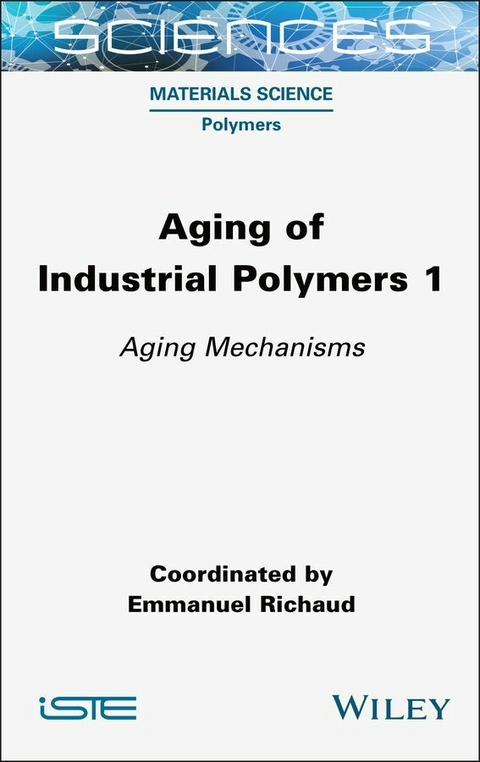
Aging of Industrial Polymers, Volume 1 (eBook)
498 Seiten
Wiley-Iste (Verlag)
978-1-394-41782-7 (ISBN)
As a result, users need to consider the maximum duration of use during which these materials will retain acceptable levels of properties. This questioning is even more crucial as it responds to societal requirements linked to limiting end-of-life waste flows and preserving the resources necessary for their production.
Emmanuel Richaud is Professor in Arts et Métiers Sciences and Technologies, and Researcher in the Process and Engineering in Mechanics and Materials lab (PIMM), France. His research focuses on predicting the service life of polymer materials and composites.
Polymers and composites are omnipresent in our daily lives, enabling the lightening of structural materials and food packaging. Their performance not only depends on their chemical structure, synthesis, architecture and forming process, but also evolves over time under the effect of processes that modify sometimes slowly but irreversibly the structure of the material. As a result, users need to consider the maximum duration of use during which these materials will retain acceptable levels of properties. This questioning is even more crucial as it responds to societal requirements linked to limiting end-of-life waste flows and preserving the resources necessary for their production.
1
Mechanistic and Kinetic Aspects of Oxidative Aging
Emmanuel RICHAUD
PIMM, CNRS, CNAM, ENSAM, Paris, France
1.1 Introduction
The first observations of hydrocarbons getting oxidized date back to the late 19th century (for example, Engler and Weissberg (1898)). According to Hock et al.’s (1950) works, in the first half of the 20th century, hydroperoxides could be isolated as products of the oxidation of liquid hydrocarbons. Moreover, Semenov (1936) demonstrated that free radical oxidation was a branched chain mechanism.
In 1946, Bolland and Gee (1949) proposed an adaptation of these works to polymers. In the following years, studies on free radical oxidation allowed a better comprehension of hydroperoxide decomposition reactions, for example, thanks to the works of Bolland and Gee (Bateman et al. 1953), of termination reactions thanks to the works of Russell (1957) and of propagation reactions leading to the formation of hydroperoxides thanks to the works of Howard et al. (1968).
Moreover, the works of Niki (1973) and Gillen et al. (1995) laid the foundations for the kinetic modeling of oxidative processes.
The objective of this first chapter is to review some of the key elements required for understanding oxidative aging problems.
1.2 Oxidation mechanisms
1.2.1 General mechanism
1.2.1.1 Initiation
There are two main paths for the initiation of polymer oxidative aging mechanisms.
- Extrinsic initiation is induced, for example, by UV or ionizing radiation.
- Intrinsic initiation induced by structures present in the polymer structure can be grouped into three families:
- homolysis of polymer bonds: these occur at temperatures significantly higher than those of polymer aging under use conditions;
- decomposition of impurities that were initially present in the material (denoted by X), generally at quite low concentrations;
- unimolecular or bimolecular decomposition of hydroperoxides, which are, as we shall see in this chapter, the species produced during the propagation stages.
The relative concentrations of these two last types of species are schematically represented in Figure 1.1.
Figure 1.1. Concentration of “extrinsic” species (X) and “intrinsic” species (hydroperoxides POOH) participating at the aging initiation
From a thermochemical perspective, the energy required for the homolytic dissociation of a C–C or C–H bond is on the order of 350 or 400 kJ mol-1, whereas that of a peroxide bond is on the order of 150 kJ mol-1. It can thus be understood that under service conditions, thermooxidative aging is exclusively initiated by hydroperoxide decomposition. Two possible paths are schematically represented in Figure 1.2 for polyethylene.
Figure 1.2. (a) Mechanisms of decomposition of hydroperoxides via (a) a unimolecular path and (b) a bimolecular path
The two initiation modes can, in principle, coexist, but they are competing with one another, according to the expression of their rate:
Therefore, the two rates are equal when:
In other words, unimolecular initiation predominates (i) at low concentrations, and (ii) when POOH is very unstable (ku high), which appears to be, for example, the case of polyamides and other polymers in which the attracting inductive effects due to neighboring heteroatoms destabilize hydroperoxides. Importantly, the energy required for the initiation of the unimolecular reaction is always higher than that of the bimolecular reaction, with the latter being favored at low temperatures.
As will be explained in what follows, the decomposition of alkoxy PO° is not a stage of initiation, stricto sensu, but it is part of a series of reactions that are kinetically comparable to a reaction of initiation. There are several paths for the decomposition of alkoxy radical:
- cage decomposition, possible only if the alkoxy radical is not tertiary (Figure 1.3(a));
- β-scission (Figure 1.3(b));
- the removal of one hydrogen atom leading to the formation of an alcohol (Figure 1.3(c)).
Figure 1.3. Decomposition of an alkoxy (note: RH is a chain involving a methylene group CH2 and R° corresponding to the methyl radical –CH°–)
In the end, initiation is a reaction involving the decomposition of at least one hydroperoxide, which leads to:
- The formation of stable oxygenated products (alcohols, ketones and aldehydes). This is, in fact, a simplified view: aldehydes are oxidized, for example, into carboxylic acids and other products (esters) eventually appear. Consequently, the comparison of the infrared spectra of a new or oxidized polymer reveals several peaks in the region centered on 1,700 cm-1. Figure 1.4 illustrates, for example, the case of an oxidized PE.
- The appearance of chain scissions or volatile compounds that can be detected by, for example, gas chromatography–mass spectrometry (GC—MS) (Philippart et al. 1995).
Figure 1.4. Schematic representation of the IRTF spectrum in the carbonyl region for new and thermo-oxidized PE (various aging times ranging between 0 and 50 h at 100°C)
(adapted from Gardette et al. (2013))
1.2.1.2 Propagation
During the propagation stages, radical species react with non-radical compounds, leading to a new radical species. The two propagation stages shared by all of the polymerization mechanisms are as follows:
- The reaction between an alkyl radical and oxygen (Figure 1.5(a)). O2 being, in reality, a diradical, this reaction is very rapid, and its rate constant is among the highest of the kinetics, namely, on the order of 108 L mol-1 s-1.
- The reaction in which a POO° radical removes an unstable C–H, which leads to the formation of a hydroperoxide and an alkyl (Figure 1.5(b)). Although semiempirically, it is possible to link the rate constant of this reaction to the C–H bond dissociation energy (BDE) (Korcek 1972). Although only approximate, this relation can be used to identify the main oxidizable sites in the polymers and the preferred position of the hydroperoxides (Figure 1.6) and to establish a first ranking based on the “intrinsic” polymer stability: for example, aromatic polymers are significantly more stable than polymers containing aliphatic hydrogen (PE, PP), which in turn are more stable than dienic elastomers (that contain allylic hydrogens), and polymers carrying C-H in the a position of heteroatoms (polyamides, polyethers and epoxies).
Figure 1.5. Stages of propagation (illustrated for polyethylene)
Figure 1.6. (a) Structure of hydroperoxides predominating in polypropylene; (b) dienic elastomers; (c) polyamides
Figure 1.7. Reactions of propagation involving the opening of double bonds
Two other reactions are possible in non-saturated polymers: it is the opening of double bonds by radicals (Figure 1.7). These reactions are responsible for the appearance of an insoluble gel in the case of oxidation of non-cross-linked polydienes or an increase in the rubbery module in the case of cross-linked elastomer materials (Delor-Jestin et al. 2000; Le Gac 2016).
1.2.1.3 Termination
Termination corresponds to the stage in which radicals react together to form inactive species. There are three types of processes involving P° and POO° radicals, whose proportion depends on the external concentration of oxygen (Richaud et al. 2006), as illustrated in Figure 1.8:
Figure 1.8. Global oxidation rate and termination rates represented as a function of the external oxygen pressure
Figure 1.9. Termination between two alkyl radicals
From a more mechanistic perspective, terminations can be cross-linking paths, such as the termination reaction between two alkyls (Figure 1.9).
The relative proportion of these two reactions was quantified based on PE radiolysis experiments in an inert atmosphere, for which we have the following mechanism:
- Initiation: polymer (PH) + hν → P° + ½ H2 (ri).
- Propagation: P° + PH → PH + P° (kp).
- Termination by coupling: P° + P° → P–P (+ x) (kc).
- Termination by disproportionation: P° + P° → double bond + PH (kd):
The termination between two peroxy radicals POO° + POO° has also been extensively researched. The result is that radicals start by coupling to form a tetroxy POOOOP, but this is unstable and leads to the formation of a pair known as a caged pair of radicals:
There are several ways to terminate this pair of radicals, such as follows:
- the formation of a dialkyl peroxide POOP (which is itself unstable);
- the disproportionation by Russell reaction;
- the decomposition of each alkoxy is as follows:
1.2.2 Kinetic aspects
For a...
| Erscheint lt. Verlag | 24.10.2025 |
|---|---|
| Reihe/Serie | ISTE Invoiced |
| Sprache | englisch |
| Themenwelt | Naturwissenschaften ► Chemie |
| Technik ► Maschinenbau | |
| Schlagworte | chemical structure • Composites • Duration • Food Packaging • Polymers • Structural Materials • Waste Flows |
| ISBN-10 | 1-394-41782-9 / 1394417829 |
| ISBN-13 | 978-1-394-41782-7 / 9781394417827 |
| Informationen gemäß Produktsicherheitsverordnung (GPSR) | |
| Haben Sie eine Frage zum Produkt? |
 EPUB (Adobe DRM)
Kopierschutz: Adobe-DRM
Adobe-DRM ist ein Kopierschutz, der das eBook vor Mißbrauch schützen soll. Dabei wird das eBook bereits beim Download auf Ihre persönliche Adobe-ID autorisiert. Lesen können Sie das eBook dann nur auf den Geräten, welche ebenfalls auf Ihre Adobe-ID registriert sind.
Details zum Adobe-DRM
Dateiformat: EPUB (Electronic Publication)
EPUB ist ein offener Standard für eBooks und eignet sich besonders zur Darstellung von Belletristik und Sachbüchern. Der Fließtext wird dynamisch an die Display- und Schriftgröße angepasst. Auch für mobile Lesegeräte ist EPUB daher gut geeignet.
Systemvoraussetzungen:
PC/Mac: Mit einem PC oder Mac können Sie dieses eBook lesen. Sie benötigen eine
eReader: Dieses eBook kann mit (fast) allen eBook-Readern gelesen werden. Mit dem amazon-Kindle ist es aber nicht kompatibel.
Smartphone/Tablet: Egal ob Apple oder Android, dieses eBook können Sie lesen. Sie benötigen eine
Geräteliste und zusätzliche Hinweise
Buying eBooks from abroad
For tax law reasons we can sell eBooks just within Germany and Switzerland. Regrettably we cannot fulfill eBook-orders from other countries.
aus dem Bereich