


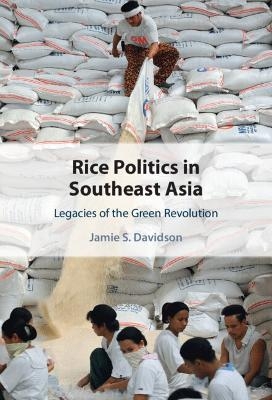
Rice Politics in Southeast Asia
Legacies of the Green Revolution
Seiten
2026
Cambridge University Press (Verlag)
978-1-009-62464-0 (ISBN)
Cambridge University Press (Verlag)
978-1-009-62464-0 (ISBN)
- Noch nicht erschienen (ca. April 2026)
- Versandkostenfrei
- Auch auf Rechnung
- Artikel merken
In this comparative historical analysis, Jamie S. Davidson argues that the performance legitimacy stemming from the Green Revolution of the 1960s and 1970s, along with the formation of rice import regimes, best explain durable rice protectionism in the Philippines, Malaysia, and Indonesia, Southeast Asia's large rice importers.
Rice is the foremost foodstuff in terms of caloric intake for Southeast Asians and for bolstering national food security, yet writings on the region's politics have overlooked the crucial role rice production programs have played in shaping signal political and development outcomes. In this comparative historical analysis, Jamie S. Davidson argues that the performance legitimacy stemming from the Green Revolution of the 1960s and 1970s, along with the formation of rice import regimes, best explain durable rice protectionism in the Philippines, Malaysia, and Indonesia, the region's large rice importers. Even though the direct effects of the Green Revolution eventually faded, he demonstrates that past policy success can inform policymaking for decades after remarkable sectoral performance subsides. This innovative account and its conclusions will be of interest to scholars and students of development studies, comparative political economy and Asian studies.
Rice is the foremost foodstuff in terms of caloric intake for Southeast Asians and for bolstering national food security, yet writings on the region's politics have overlooked the crucial role rice production programs have played in shaping signal political and development outcomes. In this comparative historical analysis, Jamie S. Davidson argues that the performance legitimacy stemming from the Green Revolution of the 1960s and 1970s, along with the formation of rice import regimes, best explain durable rice protectionism in the Philippines, Malaysia, and Indonesia, the region's large rice importers. Even though the direct effects of the Green Revolution eventually faded, he demonstrates that past policy success can inform policymaking for decades after remarkable sectoral performance subsides. This innovative account and its conclusions will be of interest to scholars and students of development studies, comparative political economy and Asian studies.
Jamie S. Davidson teaches political science at the National University of Singapore where he also heads the Asia Research Institute's Food Politics and Society cluster.
Introduction; Part I. Preconditions and Revolutionary Change: 1. Predicaments of the pre-green revolution period; 2. The green revolution: performance success; Part II. Post-Green Revolution Rice Import Regimes: 3. Malaysia: continuity amid innovation; 4. Indonesia: persistence personified; 5. The Philippines: breaking the model; Conclusion; Appendix; Bibliography; Index.
| Erscheint lt. Verlag | 30.4.2026 |
|---|---|
| Zusatzinfo | Worked examples or Exercises |
| Verlagsort | Cambridge |
| Sprache | englisch |
| Themenwelt | Sozialwissenschaften ► Politik / Verwaltung |
| Sozialwissenschaften ► Soziologie ► Spezielle Soziologien | |
| Technik ► Lebensmitteltechnologie | |
| Wirtschaft ► Volkswirtschaftslehre ► Wirtschaftspolitik | |
| ISBN-10 | 1-009-62464-4 / 1009624644 |
| ISBN-13 | 978-1-009-62464-0 / 9781009624640 |
| Zustand | Neuware |
| Informationen gemäß Produktsicherheitsverordnung (GPSR) | |
| Haben Sie eine Frage zum Produkt? |
Mehr entdecken
aus dem Bereich



aus dem Bereich
Bullshit als politische Strategie
Buch | Softcover (2025)
Kohlhammer (Verlag)
CHF 33,55
eine Einführung
Buch | Softcover (2024)
De Gruyter Oldenbourg (Verlag)
CHF 41,90
Antisemitismus und postkoloniale Debatte auf der documenta fifteen
Buch | Softcover (2025)
Campus (Verlag)
CHF 41,95


