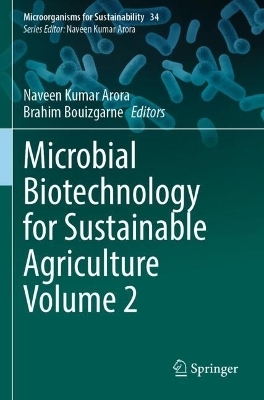
Microbial Biotechnology for Sustainable Agriculture Volume 2
Springer Verlag, Singapore
978-981-97-2357-7 (ISBN)
- Titel nicht im Sortiment
- Artikel merken
PGPMs play important roles in survival and health of the plant. These useful microorganisms provide plants with nutrients, protect them from pathogens and help in combating abiotic stresses. It is important that these mutualistic interactions between plant and soil microbes are well understood so as to develop reliable products in the form of biostimulants, biopesticides and manage biotic and abiotic stresses in crops. Apart from enhancing crop productivity, plant-microbe interactions can also perform activities such as reclamation of degraded lands, degradation of pollutants and remediation of saline or marginal lands.
This book is of interest to teachers, researchers, plant scientists and microbiologists. Also, the book serves as an additional reading material for undergraduate and graduate students of agriculture, microbiology, ecology, soil science, and environmental sciences.
Naveen Kumar Arora, Professor, Department of Environmental Science, Babasaheb Bhimrao Ambedkar University, Lucknow, India Brahim Bouizgarne, Professor, Department of Soil Microbiology, Ibn Zohr University, Agadir, Morocco
Chapter 1. Role of microbial bio-inoculants in sustainable agriculture.- Chapter 2. Microbe based biostimulants: Latest developments and future perspectives.- Chapter 3. Effect of Engineered Nanoparticles on Rhizospheric Microbes.- Chapter 4. Nanobiofungicides: effective tools for control of fungal pathogens.- Chapter 5. Biotechnological applications of phosphate solubilizing microorganisms: Biological alternative to improve phosphorus availability.- Chapter 6. Diazotrophs for enhancement of productivity of major cereal crops under abiotic stresses.- Chapter 7. Role of Transcriptomics in Elucidating Mechanism of Abiotic Stress Tolerance in Plants.- Chapter 8. Exploring the potential of Endophytes in Phytoremediation.- Chapter 9. Tomato bacterial canker disease management: molecular interactions and role of biocontrol agents (BCAs) against Clavibacter michiganensis .- Chapter 10. Recovery of tomato plant residues through composting: Potential and challenges to promote circular economy.- Chapter 11. The evolution of date palm tolerance to salinity stress via arbuscular mycorrhizal fungi and compost application.- Chapter 12. Suppressive effect of different compost extracts against Fusarium oxysporum f. sp. ciceri, causal agent of Fusarium wilt of chickpea (Cicer arietinum.- Chapter 13. Nutrient and pest-managing microbial inoculants for sustainable production of rice.- Chapter 14. Augmenting of Bioremediation through Quorum sensing and Biofilm.
| Erscheinungsdatum | 22.10.2025 |
|---|---|
| Reihe/Serie | Microorganisms for Sustainability |
| Zusatzinfo | 32 Illustrations, color; 14 Illustrations, black and white |
| Verlagsort | Singapore |
| Sprache | englisch |
| Maße | 155 x 235 mm |
| Themenwelt | Naturwissenschaften ► Biologie ► Mikrobiologie / Immunologie |
| Technik ► Umwelttechnik / Biotechnologie | |
| Weitere Fachgebiete ► Land- / Forstwirtschaft / Fischerei | |
| Schlagworte | Agri-wastes • Bioinoculants • compost • Organic Farming • Plant growth promoting microorganisms • plant-microbe interactions • sustainable agriculture |
| ISBN-10 | 981-97-2357-4 / 9819723574 |
| ISBN-13 | 978-981-97-2357-7 / 9789819723577 |
| Zustand | Neuware |
| Informationen gemäß Produktsicherheitsverordnung (GPSR) | |
| Haben Sie eine Frage zum Produkt? |
aus dem Bereich