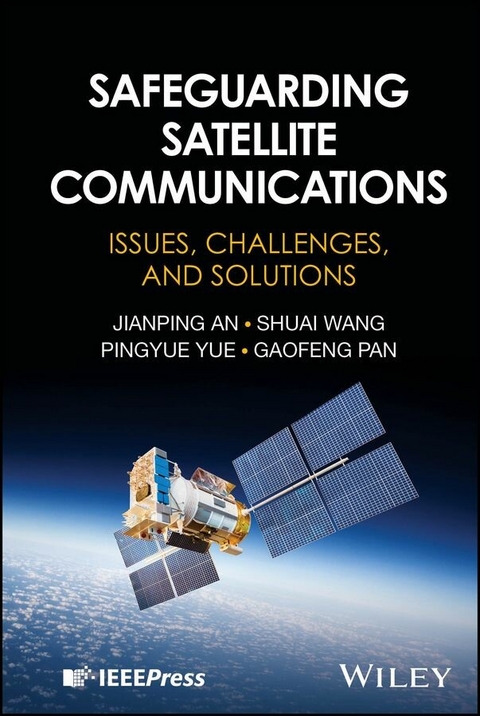
Safeguarding Satellite Communications (eBook)
499 Seiten
Wiley-IEEE Press (Verlag)
978-1-394-30430-1 (ISBN)
An up-to-date discussion about the mitigation of satellite communications vulnerabilities
In Safeguarding Satellite Communications: Issues, Challenges, and Solutions, a team of distinguished researchers deliver an expert discussion of the most relevant issues in contemporary satellite communications security. Over 13 chapters, the authors discuss key vulnerabilities in satellite communications, including potential security attacks and reliability risks. They also explain proposed solutions based on artificial intelligence technologies, blockchain, terahertz, and spaceborne laser communication.
The book describes several promising research directions - like integrated sensing and computer vision-aided communications - and highlights ISAC-aided secure transmission, CV-aided space communications, mega-constellation security problems, and commercialization issues.
Readers will also find:
- A thorough introduction to satellite communication vulnerabilities and how to mitigate them
- A comprehensive performance evaluation method of satellite communication systems in the presence of randomly distributed terminals
- Practical discussions of the relationship between satellite communication network performance and system factors
- Complete treatments of inter- and intra-system interference in satellite communication systems
Perfect for professionals working in satellite communications and engineers designing and developing satellite communication systems, Safeguarding Satellite Communications will also benefit researchers and students interested in areas like wireless communications, telecommunications engineering, and computer engineering.
Jianping An received the Ph.D. degree from the Beijing Institute of Technology, China, in 1996. He is a Full Professor and currently the Dean of the School of Cyberspace Science and Technology, Beijing Institute of Technology. His research interests include digital signal processing, wireless communications, and satellite networks. He has received two national awards for technological inventions and science and technology progress.
Shuai Wang received his Ph.D. degree in Communications Systems from Beijing Institute of Technology (BIT), P.R. China, in 2012. He is currently the Chair Professor of Cyberspace Security Technology at School of Cyberspace Science and Technology, Beijing Institute of Technology. Prof. Wang's research interests include satellite communications, anti-interference communications and datalink technologies for various aero and space platforms.
Pingyue Yue received his Ph.D. degree in Communications Systems from Beijing Institute of Technology (BIT), P.R. China, in 2024, where he is a Researcher with interests in satellite communication, physical-layer security, and interference suppression.
Gaofeng Pan received the Ph.D. degree in Communication and Information Systems from Southwest Jiaotong University, Chengdu, China, in 2011. He is currently a Professor with the School of Cyberspace Science and Technology, Beijing Institute of Technology, China. His research interests span special topics in communications theory, signal processing, and protocol design. He serves as the Editor for several journals including IEEE TCOM, IEEE TGCN, and more.
An up-to-date discussion about the mitigation of satellite communications vulnerabilities In Safeguarding Satellite Communications: Issues, Challenges, and Solutions, a team of distinguished researchers deliver an expert discussion of the most relevant issues in contemporary satellite communications security. Over 13 chapters, the authors discuss key vulnerabilities in satellite communications, including potential security attacks and reliability risks. They also explain proposed solutions based on artificial intelligence technologies, blockchain, terahertz, and spaceborne laser communication. The book describes several promising research directions like integrated sensing and computer vision-aided communications and highlights ISAC-aided secure transmission, CV-aided space communications, mega-constellation security problems, and commercialization issues. Readers will also find: A thorough introduction to satellite communication vulnerabilities and how to mitigate them A comprehensive performance evaluation method of satellite communication systems in the presence of randomly distributed terminals Practical discussions of the relationship between satellite communication network performance and system factors Complete treatments of inter- and intra-system interference in satellite communication systems Perfect for professionals working in satellite communications and engineers designing and developing satellite communication systems, Safeguarding Satellite Communications will also benefit researchers and students interested in areas like wireless communications, telecommunications engineering, and computer engineering.
Chapter 1
Introduction
As an exceptional amalgamation of scientific principles and technological advancements, satellite communication represents a complex system that facilitates interactions between the terrestrial and celestial spheres. This system is meticulously engineered to traverse extensive distances, thereby allowing for seamless real-time communication across nations, seas, and isolated regions. The basic principle is the transmission of data through electromagnetic waves, which are dispatched from a ground station, transmitted via a satellite positioned in orbit, and subsequently received by another terrestrial station. The synchronized interaction between ground-based infrastructure and space-based technology forms the essential paradigm of worldwide communication [1].
The fundamental tenet of satellite communication encompasses the propagation of electromagnetic waves, thereby enabling extensive geographical connectivity. A ground station transmits signals toward orbiting satellites utilizing high-frequency carriers, wherein the uplink procedure necessitates precise calibration of signal intensity and directional alignment to effectively reach the satellite’s communication payload [2]. Upon receipt, the satellite’s transponder amplifies and reconfigures the received signal via modulation, frequently employing frequency conversion techniques to mitigate interference from concurrent transmissions. The processed signal is subsequently prepared for downlink transmission to guarantee an undistorted return of information to the terrestrial domain. Following this procedure, the satellite dispatches the modified signal toward specified terrestrial receivers. These signals are subsequently decoded by ground stations or terminal devices into their original informational formats, which may include voice communications, video transmissions, or Internet data packets. The downlink mechanism underscores the importance of transmission reliability, notwithstanding the inherent challenges posed by planetary-scale propagation phenomena.
Typically, satellite communications have revolutionized television broadcasting by facilitating the global distribution of signals, particularly benefiting regions that lack robust terrestrial communication infrastructures. This technological advancement guarantees that remote locales receive high-quality programming and additionally functions as an essential component of infrastructure during natural disasters and humanitarian emergencies. In scenarios where terrestrial systems become nonoperational, the utilization of satellites ensures the persistence of dependable communication channels, thereby enabling a multitude of critical operations. These operations encompass emergency response coordination, the swift deployment of relief services, and the dissemination of essential information crucial for survival [3].
1.1 A Brief History of Satellite Communications
In the era characterized by an unprecedented proliferation of information, the radio waves traveling over the satellites silently announce the story of human wisdom. Communication satellites function as “messengers” in the sky, facilitating the transmission of information across vast distances on the terrestrial globe. The inception of satellite communication stands as one of the extraordinary accomplishments of contemporary science and technology. From the nascent idea to the advanced technological iterations, satellite communication has not only transformed the modalities of human interaction but has also exerted a substantial influence on socioeconomic progress. Figure 1.1 delineates a chronological depiction of the evolution of satellite communication, highlighting the motivations for its inception, the contextual background, and significant milestones [4].
Figure 1.1 History of satellite communications.
The Conceptualization: Arthur C. Clarke and the idea of Geostationary Satellites in 1945. During World War II, advancements in global communication technologies encountered formidable obstacles. Conventional radio wave communication was constrained by the Earth’s curvature, thereby limiting the transmission range of signals. Long-distance communication, particularly over oceanic expanses, necessitated intricate relay stations or the deployment of undersea cables. The exigencies of military operations during the conflict motivated scientists to investigate innovative solutions aimed at surmounting the limitations associated with long-distance communication. The British scientist and author Arthur C. Clarke articulated a groundbreaking concept in his 1945 paper published in Wireless World, titled “Extra-Terrestrial Relays,” wherein he proposed the implementation of geostationary satellites to facilitate global telecommunications. His transformative proposition delineated an orbital altitude of 35,786 km, at which satellites would exhibit synchronous rotation with Earth, thereby enabling continuous signal coverage over specified terrestrial areas through fixed orbital trajectories. Clarke’s foresight established the theoretical groundwork for the development of contemporary communication satellites. Despite the visionary nature of Clarke’s proposal, the technological infrastructure of the era was inadequate to actualize the concept of geostationary satellites. The domain of rocket technology was nascent, and the precise electronic apparatus requisite for satellite operations had yet to be developed. Consequently, Clarke’s concept remained within the realm of theory, as the necessary technological capabilities to actualize it were unavailable.
The inaugural artificial satellite, Soviet Sputnik 1, was successfully launched in 1957. During the Cold War, the domain of space exploration emerged as a pivotal battleground for the United States and the Soviet Union to assert their supremacy on a global scale. The Soviet Union sought to exhibit its scientific prowess through the launch of the inaugural artificial satellite, which concurrently served to evaluate the reliability of rocket technology crucial for subsequent advancements. On 4 October 1957, the Soviet Union ushered in the space age by achieving a significant historical milestone: the deployment of Sputnik 1, recognized as humanity’s first artificial satellite orbiting Earth. With a mass of 83.6 kg, it functioned within low Earth orbit (LEO) and transmitted fundamental radio signals. Although it was not specifically engineered for communication purposes, it validated the concept that terrestrial objects could be successfully placed in space, thereby igniting a worldwide fascination with space exploration. Notwithstanding its achievements, Sputnik 1 exhibited several significant limitations. It facilitated only rudimentary scientific experiments, experienced constrained coverage attributable to its low orbital altitude, and endured for merely a few weeks before disintegrating upon reentry. These constraints underscored the imperative for subsequent technological advancements.
Geostationary satellites, heralding the advent of the Communication Era, commenced their deployment in 1963. Following the Soviet Union’s successful launch of Sputnik 1, the United States expedited its space exploration initiatives to attain technological supremacy. Geostationary satellites, which are proficient in providing fixed coverage over designated regions, emerged as the optimal solution for facilitating global communication. The United States successfully launched Syncom 1, marking the inception of geostationary satellites. Despite its experimental nature, this satellite demonstrated the viability of geostationary orbits, establishing a foundation for subsequent communication satellites. The ensuing launches facilitated the transition of satellite communication from abstract theory to tangible application. Initial geostationary satellites encountered several challenges, including limited signal capacity, significant latency attributable to orbital distance, and elevated costs. These constraints underscored the imperative for continued technological advancement.
Syncom 3 and the live transmission of the Tokyo Olympics in 1964. The 1964 Tokyo Olympics offered Japan a platform to exhibit its economic resurgence and technological sophistication to a global audience. In order to facilitate a worldwide live transmission of the event, Japan opted to employ satellite communication technology, thereby surmounting the constraints associated with conventional television signal transmission. Japan adeptly launched the Syncom 3 communication satellite. For the inaugural instance, a worldwide live transmission of the Tokyo Olympics was accomplished via satellite technology. This event signified the initial application of satellite communication within the context of a significant international occasion. It not only illustrated the operational utility of satellite communication but also expedited the commercialization of satellite technology. Nonetheless, Syncom 3 possessed certain deficiencies. Its coverage area was limited, and the quality of the broadcast was constrained by the technological capabilities prevalent at the time. Furthermore, the transmission of live content still depended on terrestrial infrastructure, and the overall expenditure remained substantial.
The inaugural commercial communication satellite, known as the International Telecommunications Satellite Organization (INTELSAT), was successfully launched in the year 1965. The escalating necessity for international communication, particularly in terms of transoceanic linkages, underscored the inadequacies of conventional submarine...
| Erscheint lt. Verlag | 18.10.2025 |
|---|---|
| Sprache | englisch |
| Themenwelt | Technik ► Elektrotechnik / Energietechnik |
| Schlagworte | Satellite communication security • satellite communication security book • satellite communication security risk mitigation • satellite communication security risks • satellite risk mitigation • satellite security • satellite security issues |
| ISBN-10 | 1-394-30430-7 / 1394304307 |
| ISBN-13 | 978-1-394-30430-1 / 9781394304301 |
| Informationen gemäß Produktsicherheitsverordnung (GPSR) | |
| Haben Sie eine Frage zum Produkt? |
 EPUB (Adobe DRM)
Kopierschutz: Adobe-DRM
Adobe-DRM ist ein Kopierschutz, der das eBook vor Mißbrauch schützen soll. Dabei wird das eBook bereits beim Download auf Ihre persönliche Adobe-ID autorisiert. Lesen können Sie das eBook dann nur auf den Geräten, welche ebenfalls auf Ihre Adobe-ID registriert sind.
Details zum Adobe-DRM
Dateiformat: EPUB (Electronic Publication)
EPUB ist ein offener Standard für eBooks und eignet sich besonders zur Darstellung von Belletristik und Sachbüchern. Der Fließtext wird dynamisch an die Display- und Schriftgröße angepasst. Auch für mobile Lesegeräte ist EPUB daher gut geeignet.
Systemvoraussetzungen:
PC/Mac: Mit einem PC oder Mac können Sie dieses eBook lesen. Sie benötigen eine
eReader: Dieses eBook kann mit (fast) allen eBook-Readern gelesen werden. Mit dem amazon-Kindle ist es aber nicht kompatibel.
Smartphone/Tablet: Egal ob Apple oder Android, dieses eBook können Sie lesen. Sie benötigen eine
Geräteliste und zusätzliche Hinweise
Buying eBooks from abroad
For tax law reasons we can sell eBooks just within Germany and Switzerland. Regrettably we cannot fulfill eBook-orders from other countries.
aus dem Bereich