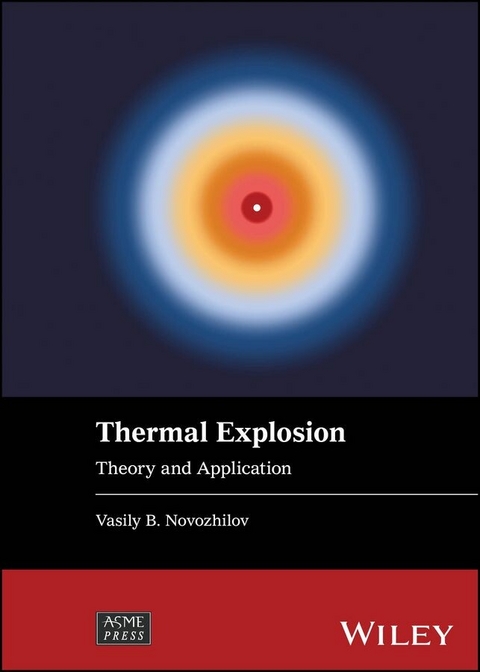
Thermal Explosion (eBook)
302 Seiten
Wiley-Asme Press Series (Verlag)
978-1-119-83068-9 (ISBN)
Thermal Explosion
A full review of thermal explosion theory featuring a new universal notation as a framework to develop and report research results
Summarizing all significant and notable developments made in the field over nearly 100 years, Thermal Explosion provides a single, authoritative source of information on the subject that connects the theory with examples from practical applications. After opening with an introduction to prerequisite technical information, the book goes on to cover the mathematical theory behind thermal explosion, with detailed explanations of how thermal explosion can develop in different media and under different conditions and strategies and techniques that can be used to prevent thermal explosion.
Readers will learn how to recognize thermal explosion hazards within technical designs and operation procedures, including for lithium ion batteries, biofuels, biomaterials, and microcombustors, predict the circumstances that may cause a thermal explosion in a particular design or process, and develop optimal mitigating strategies for these risks. Each chapter is supported by extensive example problems that introduce readers to a universal notation that can be used as a framework for developing and reporting their own research results.
Topics covered in Thermal Explosion include:
- Steady-state theory: the Semenov formulation and planar, cylindrical, and spherical symmetry cases in the Frank-Kamenetskii formulation
- Generalized boundary conditions, dynamical regimes, thermal explosion in a region of arbitrary shape, and nonsteady thermal explosion theory
- Thermal explosion in two-phase porous systems and spotted, diffusion, and conjugate thermal explosion
- One- and two-variable thermal explosion models of fire flashover
- Thermal explosion prevention through management of cooling flows and other passive methods, inertization, and cooling one- and two-phase media injections
Thermal Explosion is an essential, up-to-date reference on the subject for engineering researchers and professionals, along with mathematicians and other scientists working in related fields. The book is also an excellent learning aid within an academic setting for graduate-level researchers or as supplemental reading in upper-level courses.
Vasily B. Novozhilov is Professor of Mathematics at Victoria University in Melbourne, Australia. He previously held professorial positions at the Institute of Fire Safety Engineering Research and Technology at the University of Ulster, UK and at Nanyang Technological University, Singapore. He is a member of The Combustion Institute and has authored or co-authored over 150 publications, including the book Theory of Solid-Propellant Nonsteady Combustion, also from Wiley.
Thermal Explosion A full review of thermal explosion theory featuring a new universal notation as a framework to develop and report research results Summarizing all significant and notable developments made in the field over nearly 100 years, Thermal Explosion provides a single, authoritative source of information on the subject that connects the theory with examples from practical applications. After opening with an introduction to prerequisite technical information, the book goes on to cover the mathematical theory behind thermal explosion, with detailed explanations of how thermal explosion can develop in different media and under different conditions and strategies and techniques that can be used to prevent thermal explosion. Readers will learn how to recognize thermal explosion hazards within technical designs and operation procedures, including for lithium ion batteries, biofuels, biomaterials, and microcombustors, predict the circumstances that may cause a thermal explosion in a particular design or process, and develop optimal mitigating strategies for these risks. Each chapter is supported by extensive example problems that introduce readers to a universal notation that can be used as a framework for developing and reporting their own research results. Topics covered in Thermal Explosion include: Steady-state theory: the Semenov formulation and planar, cylindrical, and spherical symmetry cases in the Frank-Kamenetskii formulation Generalized boundary conditions, dynamical regimes, thermal explosion in a region of arbitrary shape, and nonsteady thermal explosion theory Thermal explosion in two-phase porous systems and spotted, diffusion, and conjugate thermal explosion One- and two-variable thermal explosion models of fire flashover Thermal explosion prevention through management of cooling flows and other passive methods, inertization, and cooling one- and two-phase media injections Thermal Explosion is an essential, up-to-date reference on the subject for engineering researchers and professionals, along with mathematicians and other scientists working in related fields. The book is also an excellent learning aid within an academic setting for graduate-level researchers or as supplemental reading in upper-level courses.
| Erscheint lt. Verlag | 15.10.2025 |
|---|---|
| Reihe/Serie | Wiley-ASME Press Series |
| Sprache | englisch |
| Themenwelt | Technik ► Maschinenbau |
| Schlagworte | Biofuels • biomaterials • explosion hazard • fire flashover • fire hazard • lithium ion batteries • microcombustors • prevent thermal explosion • semenov formulation • Thermal Engineering • thermal explosion predict • thermal explosion research |
| ISBN-10 | 1-119-83068-0 / 1119830680 |
| ISBN-13 | 978-1-119-83068-9 / 9781119830689 |
| Informationen gemäß Produktsicherheitsverordnung (GPSR) | |
| Haben Sie eine Frage zum Produkt? |
 PDF (Adobe DRM)
Kopierschutz: Adobe-DRM
Adobe-DRM ist ein Kopierschutz, der das eBook vor Mißbrauch schützen soll. Dabei wird das eBook bereits beim Download auf Ihre persönliche Adobe-ID autorisiert. Lesen können Sie das eBook dann nur auf den Geräten, welche ebenfalls auf Ihre Adobe-ID registriert sind.
Details zum Adobe-DRM
Dateiformat: PDF (Portable Document Format)
Mit einem festen Seitenlayout eignet sich die PDF besonders für Fachbücher mit Spalten, Tabellen und Abbildungen. Eine PDF kann auf fast allen Geräten angezeigt werden, ist aber für kleine Displays (Smartphone, eReader) nur eingeschränkt geeignet.
Systemvoraussetzungen:
PC/Mac: Mit einem PC oder Mac können Sie dieses eBook lesen. Sie benötigen eine
eReader: Dieses eBook kann mit (fast) allen eBook-Readern gelesen werden. Mit dem amazon-Kindle ist es aber nicht kompatibel.
Smartphone/Tablet: Egal ob Apple oder Android, dieses eBook können Sie lesen. Sie benötigen eine
Geräteliste und zusätzliche Hinweise
Buying eBooks from abroad
For tax law reasons we can sell eBooks just within Germany and Switzerland. Regrettably we cannot fulfill eBook-orders from other countries.
aus dem Bereich