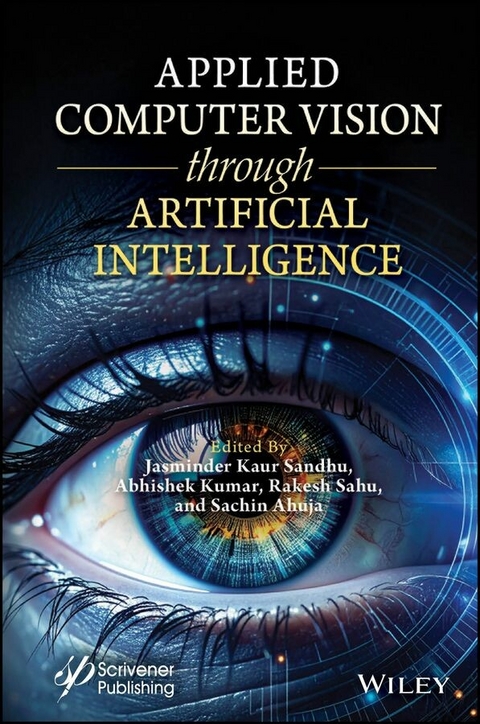
Applied Computer Vision through Artificial Intelligence (eBook)
693 Seiten
Wiley-Scrivener (Verlag)
978-1-394-27260-0 (ISBN)
Master the cutting-edge field of computer vision and artificial intelligence with this accessible guide to the applications of machine learning and deep learning for real-world solutions in robotics, healthcare, and autonomous systems.
Applied Computer Vision through Artificial Intelligence provides a thorough and accessible exploration of how machine learning and deep learning are driving breakthroughs in computer vision. This book brings together contributions from leading experts to present state-of-the-art techniques, tools, and frameworks, while demonstrating this technology's applications in healthcare, autonomous systems, surveillance, robotics, and other real-world domains. By blending theory with hands-on insights, this volume equips readers with the knowledge needed to understand, design, and implement AI-powered vision solutions.
Structured to serve both academic and professional audiences, the book not only covers cutting-edge algorithms and methodologies but also addresses pressing challenges, ethical considerations, and future research directions. It serves as a comprehensive reference for researchers, engineers, practitioners, and graduate students, making it an indispensable resource for anyone looking to apply artificial intelligence to solve complex computer vision problems in today's data-driven world.
Jasminder Kaur Sandhu, PhD is a professor and the Head of the Department of Machine Learning and Data Science at IILM University. With over 13 years of academic and research experience, she has published more than 70 research papers in reputed international journals. Her research interests include machine learning, ensemble modelling, artificial intelligence, wireless sensor networks, and soft computing.
Abhishek Kumar, PhD is a professor and the Assistant Director of the Computer Science and Engineering Department at Chandigarh University, Punjab with over 13 years of teaching experience. He is an award-winning researcher that has published more than 170 peer-reviewed papers in international journals of repute. His research interests span artificial intelligence, renewable energy systems, image processing, and data mining.
Rakesh Sahu, PhD is a dedicated academician and researcher with over a decade of experience. He has made significant contributions as a post-doctoral scholar at IIT Bombay and as a faculty member at esteemed institutions, where his work focuses on Himalayan glacier dynamics. His research interests include glacier mapping, modelling, and climate change.
Sachin Ahuja, PhD has an illustrious academic and research career, marked by numerous impactful contributions. An accomplished editor, he has contributed to numerous books and served as a guest editor for special issues in reputed international journals. His research focuses on artificial intelligence, machine learning, and data mining.
1
An Overview of Medical Diagnostics through Artificial Intelligence-Powered Histopathological Imaging and Video Analysis
Atul Rathore1*, Praveen Lalwani1, Pooja Lalwani1 and Rabia Musheer2
1School of Computing Science and Engineering, VIT University, Bhopal, M.P., India
2School of Advance Science and Language, VIT University, Bhopal, M.P., India
Abstract
Histopathological imaging has a substantial impact on the diagnosis and prognosis of many illnesses, including cancer, infectious infections, and autoimmune disorders. The introduction of artificial intelligence (AI) techniques to histological analysis, such as mammography, endoscopy, ultrasound, and MRI, has recently transformed medical diagnostics. The intent of this research is to give the lector with a thorough accepting of the present state of video analysis also AI-assisted histopathological imaging in the context of medical diagnosis. This article demonstrates how deep learning and machine learning algorithms can be used to automate data analysis and activities like segmentation, detection, and classification. The importance of interpretability in medical applications, as well as the usage of artificial intelligence (AI) in medical picture analysis, are also discussed. To obtain the best results, it will be necessary to give clinical decision support, disease diagnostics, and customized treatment strategies. The researchers thoroughly reviewed previous studies on the use of AI-contributed histopathology imaging for the diagnosis and treatment of medical illnesses. Furthermore, we advocate for increased multidisciplinary collaboration and research in this area.
Keywords: Medical diagnostics, artificial intelligence, medical image analysis, classification, machine learning, disease diagnostics, metaheuristics algorithm, deep learning
1.1 Introduction
In order to provide patients with the best medical and nursing care possible, the field of healthcare has to prioritize efficiently and sustainability. It is estimated that artificial intelligence (AI) will have a significant influence on healthcare in numerous of diverse areas, like drug development, personalized treatment plans, diagnostic support, preventive medicine, and extending healthy lifespans. Among the healthcare sectors where AI and ML are anticipated to be quickly implemented are drug discovery, genomic medical procedures, diagnosis and treatment support, and imaging diagnostic support (medical image analysis). Medical field is a vast and complicated commercial industry, making it an attractive target for the world’s premier information technology (IT) firms [1]. In 2018, Over 11 billion US dollars were invested in digital healthcare startups by US investors, a 16% rise from the year before.
Managing large amounts of data, such as patient records, exam results, and medical imaging, has always been necessary for doctors practicing clinical medicine [2]. Artificial intelligence (AI) is increasingly invading the medical domain, having a substantial influence on medical managerial, disease diagnostics, and automation [3]. The ability of AI to analyze massive datasets from various sources can greatly advance research in the pharmaceutical and healthcare industries [4]. Recent research evaluates whether AI is being used in many industries, most notably healthcare. The healthcare industry is implementing technologies like robotic process automation, natural language processing (NLP), physical robots, and machine learning (ML) [5]. In machine learning, different features are analyzed using neural network models and deep learning techniques to identify clinically significant elements early on, particularly in cancer diagnosis [6, 7]. To analyze and interpret human communication, NLP applies computer methodologies. Recently, natural language processing (NLP) is increasingly using machine learning techniques to analyze unstructured data from databases, like lab reports and doctor’s notes. lab reports, and so forth by outlining important information from diverse visual and textual data, which supports the decision-making process for diagnosis and possible treatments [8]. Patient access to timely and accurate diagnosis as well as individualized treatment options is being made possible by ongoing disruptive innovation [9]. AI-powered solutions are recognized, including systems that can use a wide range of data sources, such as symptoms reported by patients, biometrics, imaging, biomarkers, and so on. With advancements in artificial intelligence, it is now possible to predict impending illness, increasing the likelihood of prevention due to early identification. Corporal robots are being employed in a range of healthcare settings, including nursing, telemedicine, cleaning, imaging, surgery, and rehabilitation [10, 11]. Medical picture elucidation has always been accomplished by human medical practitioners in ordinary clinical practices; nevertheless, it has begun to profit from computer-assisted therapies due to the vast amount of data produced by various clinical exams. Big data and artificial intelligence (AI) technologies have improved and been applied quickly, which has resulted in the widespread use of data-driven methods that enable precise, real-time predictions of a variety of diseases [12]. Healthcare is transforming right before our eyes as a result of breakthroughs in computational medical technologies, such as artificial intelligence (AI), 3D printing, robots, nanotechnology, and others. Among the several advantages of digitizing healthcare are the numerous opportunities it offers to decrease human error, enhance treatment outcomes, and collect data over time. AI approaches ranging from machine learning to deep learning are critical in a number of health-related areas, including the development of new healthcare systems, patient information and records, and the treatment of various ailments [13]. AI techniques are also the most successful at recognizing and diagnosing a wide range of illnesses. The application of artificial intelligence (AI) as a technique for improving medical services offers unprecedented opportunities to improve patient and clinical group outcomes, reduce costs, and so on. The models used are not limited to computerization; for example, patients can be given “family” [14, 15]. Recent decades have seen a major increase in the amount of research focused on machine learning (ML), which is used in numerous areas, such as text mining, multimedia concept retrieval, spam detection, video recommendations, and image classification [16–19]. Additionally, the deficiency of radiologists can make it difficult and time-consuming to analyze medical images. One possible remedy for this problem is artificial intelligence (AI). A subset of artificial intelligence called machine learning (ML) uses data to learn from and make predictions or decisions based on past knowledge without the need for explicit programming. ML makes use of three types of learning methods: supervised learning, unsupervised learning, and semi-supervised learning. ML techniques include feature extraction, and picking appropriate attributes for a certain problem needs the expertise of a domain expert. To overcome the challenge of feature selection, deep learning (DL) algorithms are applied. DL is a subclass of ML that can extract essential characteristics automatically from raw input data [18].
1.1.1 A Focus on Digital Image and Video Analysis
Several terminologies have been used to identify, prevent, and treat various disorders [20–27]. These technologies include digital image analysis and video analysis, which can be utilized to identify various medical disorders. Histopathological images and films, which are microscopic photographs of breast tissue and cardiographs, considerably improve diagnosis and treatment of diseases such as cancer, heart attacks, and others. Furthermore, techniques like biopsy, ultrasound imaging, mammography, echocardiography, endoscopy, and ultrasonography produce these types of movies and images for identifying illnesses including polyps in bodily organs and cardiomyopathy. There are several types of videos used for analysis and instruction, including surgery and training videos [23–27].
Below are the various techniques employed in imaging and videos modalities (Figure 1.1):
Figure 1.1 Various medical diseases diagnoses techniques.
Mammography: A mammogram is a radiographic picture of the breast and other body organs made by x-rays. Its major goal is to help doctors discover early signs of cancer and heart diseases. Regular mammograms are the most effective early detection method for cancer and other diseases, typically finding abnormalities up to three years before they become palpable or apparent through other means.
Thermography: A non-invasive technology called thermography uses an infrared camera to detect heat radiating from specific regions of the body. Through digital infrared thermal imaging, it aids in the diagnosis of cancer and other diseases. By capturing and analyzing temperature trends, this method of detecting illnesses has been shown to be both exact and cost-effective, providing vital data for early diagnosis and screening.
Ultrasound: Ultrasound is a low-cost technique that is commonly used to diagnose the reasons of discomfort, edema, and inflammation in many bodily locations such as the kidney, gallbladder, and liver. It examines numerous organs...
| Erscheint lt. Verlag | 13.10.2025 |
|---|---|
| Sprache | englisch |
| Themenwelt | Informatik ► Theorie / Studium ► Künstliche Intelligenz / Robotik |
| Technik ► Elektrotechnik / Energietechnik | |
| Schlagworte | Applied Computer Vision • Artificial Intelligence • Autonomous Systems • computer vision • convolutional neural networks • Deep learning • Facial Recognition • Healthcare Imaging • Image Processing • machine learning • Neural networks • Object detection • pattern recognition • Robotics • smart cities |
| ISBN-10 | 1-394-27260-X / 139427260X |
| ISBN-13 | 978-1-394-27260-0 / 9781394272600 |
| Informationen gemäß Produktsicherheitsverordnung (GPSR) | |
| Haben Sie eine Frage zum Produkt? |
 EPUB (Adobe DRM)
Kopierschutz: Adobe-DRM
Adobe-DRM ist ein Kopierschutz, der das eBook vor Mißbrauch schützen soll. Dabei wird das eBook bereits beim Download auf Ihre persönliche Adobe-ID autorisiert. Lesen können Sie das eBook dann nur auf den Geräten, welche ebenfalls auf Ihre Adobe-ID registriert sind.
Details zum Adobe-DRM
Dateiformat: EPUB (Electronic Publication)
EPUB ist ein offener Standard für eBooks und eignet sich besonders zur Darstellung von Belletristik und Sachbüchern. Der Fließtext wird dynamisch an die Display- und Schriftgröße angepasst. Auch für mobile Lesegeräte ist EPUB daher gut geeignet.
Systemvoraussetzungen:
PC/Mac: Mit einem PC oder Mac können Sie dieses eBook lesen. Sie benötigen eine
eReader: Dieses eBook kann mit (fast) allen eBook-Readern gelesen werden. Mit dem amazon-Kindle ist es aber nicht kompatibel.
Smartphone/Tablet: Egal ob Apple oder Android, dieses eBook können Sie lesen. Sie benötigen eine
Geräteliste und zusätzliche Hinweise
Buying eBooks from abroad
For tax law reasons we can sell eBooks just within Germany and Switzerland. Regrettably we cannot fulfill eBook-orders from other countries.
aus dem Bereich