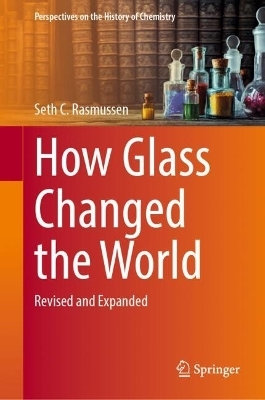
How Glass Changed the World
Springer International Publishing (Verlag)
978-3-032-11857-8 (ISBN)
- Noch nicht erschienen - erscheint am 02.02.2026
- Versandkostenfrei
- Auch auf Rechnung
- Artikel merken
This monograph explores the history and chemistry of glass technology, tracing its origins from antiquity through its evolution into a vital material for science and society. Beginning with early synthetic silica glass production around 2500 BCE, it examines its development up through the Roman period, the transformative innovations of Venetian and Murano glassmakers, and the eventual rise of Bohemian glass. The text highlights glass s crucial role in the development of mirrors, lenses, eyeglasses, and chemical apparatus, all of which enabled critical scientific advancements. Covering glass s refinement up to the 18th century, this book dives into its profound impact on both chemical practices and broader societal advancements.
This volume is an updated and extended version of the author s earlier Springer publication, How Glass Changed the World: The History and Chemistry of Glass from Antiquity to the 13th Century (2012), expanding the historical scope and deepening the analysis of glass s transformative role in science and society.
Seth C. Rasmussen is a Professor of Chemistry at North Dakota State University (NDSU) in Fargo. A native of the Seattle area, he received his B.S in chemistry from Washington State University in 1990, before continuing his graduate studies at Clemson University under the guidance of Prof. John D. Petersen. After completing his Ph.D. in inorganic chemistry in 1994, he moved to the University of Oregon to study conjugated organic polymers as a postdoctoral associate under Prof. James E. Hutchison. He then accepted a teaching position at the University of Oregon in 1997, before moving to join the faculty at NDSU in 1999. Attaining the rank of full professor in 2012, Prof. Rasmussen also spent the spring of 2018 as a Fulbright Senior Scholar and visiting professor at the Centre for Organic Electronics of the University of Newcastle, Australia.
Active in the fields of both materials chemistry and the history of chemistry, his research interests include the design and synthesis of conjugated materials, photovoltaics (solar cells), NIR photodetectors, organic light emitting diodes, the history of materials, chemical technology in antiquity, and the application of history to chemical education. As author and editor, Prof. Rasmussen has contributed to books in both materials and history and has published more than 140 research papers and book chapters. His most recent monograph was The Origins and Early History of Conjugated Organic Polymers: Organic Semiconductors, Synthetic Metals, and the Prehistory of Organic Electronics (Oxford University Press, 2025). He was named a Fellow of the American Chemical Society (ACS) in 2021, a Fellow of the Royal Society of Chemistry in 2022, and a Fellow of the History of Chemistry (HIST)division of the ACS in 2023. In 2025, his work in history was recognized with the Joseph B. Lambert HIST Award for Outstanding Achievement in the History of Chemistry. Prof. Rasmussen served as the Program Chair for HIST from 2008 to 2017, and the HIST Chair in 2021-2022. In addition, he continues to serve as the series editor for the book series Springer Briefs in History of Chemistry and Perspectives on the History of Chemistry, and as an advisory board member for the journals Chemical Science and Substantia: An International Journal of the History of Chemistry.
Introduction.- Origins of Glass: Myth and Known History.- Early Development and Growth of Glass.- Glass During the Roman Period.- Reinventing an Old Material: Venice and the New Glass.- Glass in the West: The Introduction of Potash-Lime Glass.- Applications to Chemical Apparatus.- From Windows to Lenses: Impact on Science and Society.- Conclusions.
| Erscheinungsdatum | 29.11.2025 |
|---|---|
| Reihe/Serie | Perspectives on the History of Chemistry |
| Zusatzinfo | XV, 174 p. 70 illus., 46 illus. in color. |
| Verlagsort | Cham |
| Sprache | englisch |
| Maße | 155 x 235 mm |
| Themenwelt | Technik ► Maschinenbau |
| Schlagworte | Chemical glassware • Glass • glassblowing • Laboratory Equipment/Apparatus • Potash-lime glass • Silica glass • Soda-lime glass • WINDOWS |
| ISBN-10 | 3-032-11857-3 / 3032118573 |
| ISBN-13 | 978-3-032-11857-8 / 9783032118578 |
| Zustand | Neuware |
| Informationen gemäß Produktsicherheitsverordnung (GPSR) | |
| Haben Sie eine Frage zum Produkt? |
aus dem Bereich