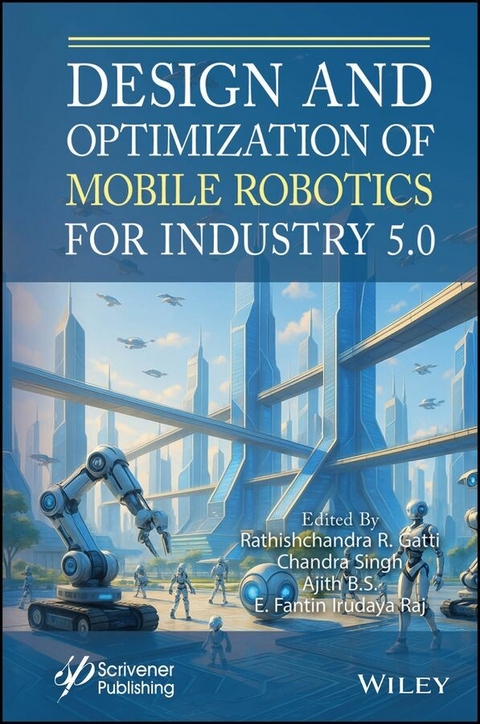
Design and Optimization of Mobile Robotics for Industry 5.0 (eBook)
602 Seiten
Wiley-Scrivener (Verlag)
978-1-394-38500-3 (ISBN)
Harness the future of automation with this comprehensive guide, offering an in-depth look at how next-generation mobile robotics are driving the transition to a human-centered and sustainable Industry 5.0.
Design and Optimization of Mobile Robotics for Industry 5.0 delivers an in-depth, interdisciplinary look at how next-generation mobile robotic systems are enabling the evolution from Industry 4.0 to a more human-centered, resilient, and sustainable Industry 5.0. This book addresses the technical, ethical, and societal dimensions of robotics technologies, from design principles and autonomous navigation to human-robot interaction and AI integration. It brings together cutting-edge research and real-world case studies across smart manufacturing, agriculture, healthcare, and industrial automation. Readers will explore topics such as digital twins, IoT-enhanced robotics, sensor fusion, and collaborative robotics. With contributions from leading global experts, this volume serves as a comprehensive guide for those involved in designing, deploying, or studying robotics systems that align with the goals of Industry 5.0.
Rathishchandra R. Gatti, PhD is the Dean of Research and Development and professor in the Departments of Mechanical Engineering and Robotics and Automation at the Sahyadri College of Engineering and Management with over 20 years of experience. He has published four patents, seven books, and more than 40 peer-reviewed publications. His research interests include robotics, AI in engineering, physical AI, and machine data analytics.
Chandra Singh is an assistant professor in the Department of Electronics and Communication Engineering at Nitte University. He has published more than 35 articles and six patents, and edited ten books. His research interests include optical networking and communication, wireless communication, Internet of Things, and machine learning.
Ajith B.S., PhD is an associate professor in the Department of Mechanical and Robotics Engineering and Associate Dean of Intellectual Property Rights at the Sahyadri College of Engineering and Management. He has published more than 18 journal papers, presented ten conference papers, authored many patents, and contributed to a number of books. His research focuses on biofuels, renewable energy, combustion, and heat transfer.
E. Fantin Irudaya Raj, PhD is a professor of Electrical and Electronics Engineering at the Aditanar College of Engineering with over a decade of experience. He has published more than 35 journal publications, 50 conference papers, patents, and book contributions. His research interests include power electronic drives, Internet of Things, smart cities, image processing, and AI techniques.
Harness the future of automation with this comprehensive guide, offering an in-depth look at how next-generation mobile robotics are driving the transition to a human-centered and sustainable Industry 5.0. Design and Optimization of Mobile Robotics for Industry 5.0 delivers an in-depth, interdisciplinary look at how next-generation mobile robotic systems are enabling the evolution from Industry 4.0 to a more human-centered, resilient, and sustainable Industry 5.0. This book addresses the technical, ethical, and societal dimensions of robotics technologies, from design principles and autonomous navigation to human-robot interaction and AI integration. It brings together cutting-edge research and real-world case studies across smart manufacturing, agriculture, healthcare, and industrial automation. Readers will explore topics such as digital twins, IoT-enhanced robotics, sensor fusion, and collaborative robotics. With contributions from leading global experts, this volume serves as a comprehensive guide for those involved in designing, deploying, or studying robotics systems that align with the goals of Industry 5.0.
Preface
The focus of this book is on design and optimization of mobile robotics, one of the most important enablers for Industry 5.0 – new generation industrial production characterized by collaboration of humans and machines. The book covers various aspects of mobile robotics optimization for Industry 5.0, including human-robot interaction, resilience, sustainability, and the integration of digital twins, NEP+, and ROS2 (Robot Operating System .It also addresses the human-centric approach of Industry 5.0,which prioritizes user-centric design principles and emphasizes the development of user-friendly interfaces that enhance productivity, minimize errors, and drive user adoption. The book is intended for a diverse audience, including engineers and technologists, researchers and academics, industry professionals, policy makers and regulators, students, and educators. It provides in-depth knowledge, insights, and advancements in the field of mobile robotics optimization for Industry 5.0, making it a valuable resource for professionals and researchers alike. The book is written at an advanced level, suitable for individuals with a background in engineering, robotics, industrial automation, or related fields. It offers a comprehensive overview of the subject matter, including the technical aspects, applications, and challenges related to integrating robotics technologies in industrial settings. The book also discusses the societal impact, ethical considerations, and regulatory frameworks associated with Industry 5.0, providing a holistic perspective on the topic.
Part 1: Foundations of Industry 5.0 and Emerging Technologies
1. Advancing Design Principles for Industry 5.0 with a Focus on Human-Centered Innovation
This chapter discusses the changing design principles towards Industry 5.0 with special attention paid to human-cantered innovation as an essential near-field fundamental feature for boosting user experience and operational performance. With industries shifting to collaborative spaces where human intelligence works in conjunction with technical capabilities, human-centric design is crucial. The literature survey reveals existing work on the user-cantered frameworks and methodologies, while indicating gaps in this area by identifying issues that need to be explored further. This chapter explores the different technological possibilities that will make human-cantered design artificial intelligence (AI), Internet of Things (IoT), and robotics.
2. Methods and Mechanics for Robot Navigation in Different Environments
This chapter presents a detailed study on robot navigation techniques including classical and reactive methods to identify research gaps in the field of path planning for mobile robots. Reactive approaches are observed to be more robust and exhibit better performance as compared to classical approaches. There are certain hybrid algorithms also being applied and observed to exhibit improved performance. Real world navigation offers a complex set of challenges to the use of simple geometric abstractions. Machine learning offers a strong method of designing a navigation system based on prior experiences. They tend to justify the physical outcomes based on the actions and exploiting patterns from real - world environments. This chapter also throws light on the toolkits for navigation skills of robots, design principles, experimental results, problems, and scope for future work.
3. Detailed Investigation of Autonomous Vehicles in the Context of Industry 5.0
This chapter deals with the overview of self–driven vehicles, types of sensors and actuators used. It also discusses the evaluation of various machine learning algorithms and processors used in autonomous vehicles. Beyond all the advantages in this system, there are also some drawbacks. Misinterpretation of sensor data may lead to suboptimal path planning of self- driven vehicles. It may result in unavoidable and unfortunate accidents. The current chapter also describes the disadvantages of the autonomous vehicles and the safety measures needed to overcome those drawbacks.
4. Emerging Technologies in Industrial Automation with Robotic Applications
This chapter discusses Industrial robots have significantly transformed manufacturing processes, and their capabilities continue to grow with technological advancements. This chapter details the latest trends in industrial robotics and their expanding applications across diverse sectors beyond just traditional manufacturing. Robots are now integral in additive manufacturing, digital twins, and logistics to enhance efficiency, precision, and safety. In logistics, the robots facilitate inventory management and order fulfillment, while in additive manufacturing; the robotic systems give geometric flexibility, enabling them to print objects in different orientations.
Part 2: Robotics and Mobile Integration in Industry 5.0
5. IoT and Mobile Robotics Integration for Transforming Smart Manufacturing in Industry 5.0
This chapter looks at how these technologies, when implemented, do improve operation performance while at the same time improving on the human and robot coexistence or symbiosis with in manufacturing plants. The use of IoT sensors for condition monitoring and prediction for maintenance, material handling, and optimization through real-time control of using the autonomous mobile robots increase production capabilities, safety for employees, and effective utilization of resources.
6. Innovative Approaches to Designing and Optimizing Mobile Robotics for Advanced Collaboration in Industry 5.0
This chapter identifies new concepts on the design and integration of mobile robotics to enhance the advanced collaboration in Industry 5.0. Major themes are AI and AI-based applications, real-time decision making, and human-robot interface (HRI) optimization. In discussing design issues, optimization approaches, and energy saving methods, the chapter presents frameworks that allow mobile robots to coexist and interact with people and other robots in an increasingly complicated and dynamic industrial context.
7. Applications and Challenges of Digital Twins in Industry 5.0 for Advanced Industrial Systems
This chapter presents an extensive literature survey on Digital Twins as well as empirical case studies demonstrating how they can transform next-generation industrial systems and the challenges that need to be addressed. The results demonstrate that solving those difficulties is crucial to unlock Digital Twins full capacities and maximize their advantages related Industry 5.0.
8. Mobile Robotics for Agriculture: Design and Implementation of an Autonomous Robo-Snake
This chapter targets the recent applications of automation and the robotic snake in agriculture. Due to their tiny cross-section-to- length ratios and flexibility in body structure of robotic snake, they can move into and through confined areas and engage in a variety of activities, including as climbing stairs or tree trunks. The structure consists of a body of robot made of silicon rubber mixture connected with several joints. The compression and expansion of the silicon body brought on by electromagnetic induction is the sole basis for the Snake robot’s Movements.
Part 3: Human–Robot Collaboration and Interaction
9. Synergistic Thinking: Human–Robot Partnerships for Smarter Decisions
This chapter focuses on recent machine learning developments, sensor fusion, and recognition of human intentions helping to address these challenges. Shared autonomy and adaptive control are some key frameworks whereby robots can predict human actions and optimize task performance collaboratively
10. Collaborative Robotics in Factory 5.0: Redefining Modern Production
This chapter presents the advances and strategic and technological developments in HRC for Factory 5.0 within three main use cases: smart assembly, quality inspection, and predictive maintenance. Future trends for the future will move toward human-robot interaction with advanced multimodal interfaces, ethical AI, and toward resilience in workforces that find symbiosis in intelligent automation. Rather than automation, Factory 5.0 focuses on systems that are cooperatively assisted by robots to perform complex, high-mix, low-volume production tasks.
11. Human-Robot Interaction in Industry 5.0
This chapter focuses on the technological advances that have characterized Industry 4.0. However, it re-emerges at the very essence of what makes industry and production centered on human beings. It aims at the harmony of skills and dexterity of human beings and the efficiency and effectiveness of robotics, smart devices, and technologies like AI, IoTs and robotics. It is a transition that is not simply aimed at working faster and more efficiently, but at making a work process more effective, creative, and providing more unique products.
Part 4: Specialized Applications and Innovations
12. Augmented Reality in Healthcare: Applications, Security, and Mobile Robotics Integration
This chapter discusses the rapid advancement of augmented reality (AR) technology and its use in medical education plays a vital role in the view of teaching perspective. A thorough assessment of the latest advancements in terms of user adoption, established AR applications, and the impact of AR on the growth of healthcare competency is analyzed. The usage of augmented reality (AR), which allows digital learning activities to be placed in a real-world physical context, is one method that might be used to give educational...
| Erscheint lt. Verlag | 10.10.2025 |
|---|---|
| Sprache | englisch |
| Themenwelt | Technik ► Elektrotechnik / Energietechnik |
| Technik ► Maschinenbau | |
| Schlagworte | AI in Robotics • autonomous navigation • Digital Twin • ethical AI • Human-Robot Collaboration • Industry 5.0 • IoT in Robotics • LiDAR Robotics • mobile robotics • NEP+ • robotics in agriculture • Robotics in healthcare • robot optimization • ROS2 • Smart factories |
| ISBN-10 | 1-394-38500-5 / 1394385005 |
| ISBN-13 | 978-1-394-38500-3 / 9781394385003 |
| Informationen gemäß Produktsicherheitsverordnung (GPSR) | |
| Haben Sie eine Frage zum Produkt? |
 EPUB (Adobe DRM)
Kopierschutz: Adobe-DRM
Adobe-DRM ist ein Kopierschutz, der das eBook vor Mißbrauch schützen soll. Dabei wird das eBook bereits beim Download auf Ihre persönliche Adobe-ID autorisiert. Lesen können Sie das eBook dann nur auf den Geräten, welche ebenfalls auf Ihre Adobe-ID registriert sind.
Details zum Adobe-DRM
Dateiformat: EPUB (Electronic Publication)
EPUB ist ein offener Standard für eBooks und eignet sich besonders zur Darstellung von Belletristik und Sachbüchern. Der Fließtext wird dynamisch an die Display- und Schriftgröße angepasst. Auch für mobile Lesegeräte ist EPUB daher gut geeignet.
Systemvoraussetzungen:
PC/Mac: Mit einem PC oder Mac können Sie dieses eBook lesen. Sie benötigen eine
eReader: Dieses eBook kann mit (fast) allen eBook-Readern gelesen werden. Mit dem amazon-Kindle ist es aber nicht kompatibel.
Smartphone/Tablet: Egal ob Apple oder Android, dieses eBook können Sie lesen. Sie benötigen eine
Geräteliste und zusätzliche Hinweise
Buying eBooks from abroad
For tax law reasons we can sell eBooks just within Germany and Switzerland. Regrettably we cannot fulfill eBook-orders from other countries.
aus dem Bereich