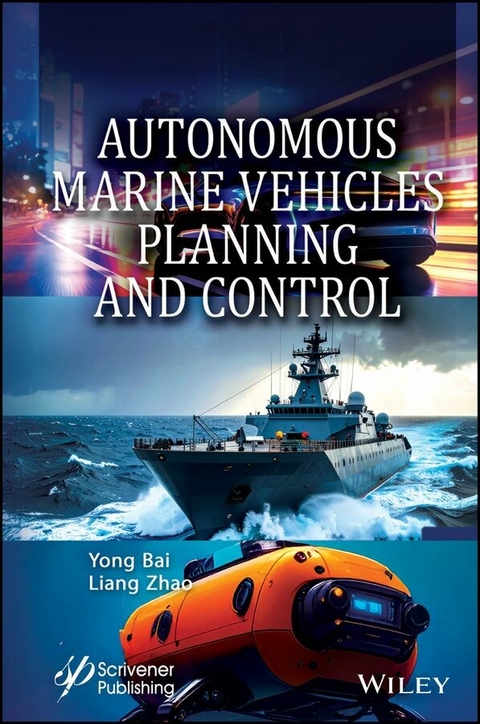
Autonomous Marine Vehicles Planning and Control (eBook)
972 Seiten
Wiley-Scrivener (Verlag)
978-1-394-35505-1 (ISBN)
Master the future of marine exploration and technology with Autonomous Marine Vehicles Planning and Control, which provides a comprehensive, interdisciplinary guide to the principles, control, and real-world applications of autonomous marine vehicles.
Autonomous Marine Vehicles Planning and Control explores the intricate and rapidly evolving field of autonomous marine vehicles, focusing on unmanned surface vehicles (USVs) and autonomous underwater vehicles (AUVs). This book is designed to provide a comprehensive overview of the fundamental principles, advanced control methodologies, and practical applications of these autonomous systems in various marine environments. Through a series of detailed chapters, the book delves into the technical aspects, innovative algorithms, and real-world challenges associated with the deployment and operation of USVs and AUVs. Through a highly technical and research-oriented approach, each chapter combines theoretical analysis with practical case studies and simulation results to illustrate the effectiveness of the proposed methods. The book also addresses the interdisciplinary nature of the field, integrating concepts from robotics, artificial intelligence, and marine engineering to provide a holistic view of autonomous marine vehicle technology.
Yong Bai, PhD is a professor in the College of Civil Engineering and Architecture at Zhejiang University. He has written over 200 academic papers in national and international academic journals and internationally published over 20 books. His research interests include marine engineering structures, unmanned surface vehicles, autonomous underwater vehicles, hydrogen vessels, marine pipelines and risers, engineering risk analysis, and safety assessment.
Liang Zhao, PhD is a research fellow at Zhejiang University. He has co-authored over 20 research articles in top engineering journals. His current research focuses on planning and decision making for marine robotics, asynchronous maritime perception, and green and intelligent shipping.
1
Introduction
Abstract
Unmanned surface vehicles (USVs) have emerged as transformative tools in modern maritime applications, offering autonomous operation, enhanced efficiency, and expanded mission capabilities. This book provides a comprehensive overview of the planning and control mechanisms that underpin USV development. It begins with a historical review of unmanned vehicle evolution, highlighting key milestones from early self-propelled devices to modern AI-integrated systems. USVs, in particular, are equipped with advanced propulsion, navigation, communication, and control systems, enabling operations in complex and hazardous environments. Their core functionality is governed by a guidance-navigation-control (GNC) architecture that integrates nonlinear maneuvering models, sensor fusion, and motion control algorithms. Practical applications include bathymetric surveys, data harvesting, shipping logistics, and search and rescue missions, where USVs offer safer, more cost-effective alternatives to manned operations. The book also presents a simplified 3-DOF mathematical model for horizontal-plane maneuvering under environmental disturbances such as waves and currents. Emphasis is placed on the need for intelligent planning algorithms to meet the growing demands of modern engineering tasks. Through detailed system analysis and application-driven research, this work aims to advance the intelligence and operational versatility of USVs, supporting their continued integration into scientific, commercial, and defense domains.
Keywords: Unmanned surface vehicles (USVs), autonomous navigation, guidance-navigation-control (GNC), marine applications, path planning and control
1.1 Overview
Unmanned vehicles (Gage, 1995), encompassing aerial, ground, surface, and underwater platforms (see Figure 1.1), have emerged as pivotal technologies in the 21st century, revolutionizing numerous sectors (Finn and Scheding, 2010; Verfuss et al., 2019). Their significance lies in their ability to perform tasks that are dangerous, repetitive, or otherwise infeasible for humans, thus enhancing efficiency, safety, and capabilities across various domains. In the realm of aerial vehicles, unmanned aerial systems (UAS) or drones have transformed industries such as agriculture, logistics, surveillance, and environmental monitoring, offering unprecedented access to remote or hazardous areas (Deng et al., 2022; Huang et al., 2023; Shao et al., 2022). Ground unmanned vehicles (UGVs) are pivotal in applications ranging from military operations and search-and-rescue missions to automated farming and mining, providing robust solutions in challenging terrains and conditions (Asadi et al., 2020; Tokekar et al., 2016). Unmanned surface vehicles (USVs) and underwater vehicles (UUVs) extend human reach and capability beneath and on the water surface (Liu et al., 2024). These vehicles are instrumental in marine research, environmental monitoring, offshore oil and gas exploration, and naval operations (Abdullah et al., 2023). By enabling detailed and continuous monitoring of oceanographic parameters, underwater vehicles contribute significantly to our understanding of marine ecosystems and climate change impacts. Unmanned surface vehicles enhance maritime security, survey and mapping efforts, and disaster response capabilities (Ai et al., 2021; Baum-Talmor and Kitada, 2022; Yao et al., 2021).
Figure 1.1 (a) UGV (Defense turkey), (b) UAV (Raima), (c) USV (Maritime Robotics Ltd.), (d) AUV (REMUS).
The integration of advanced technologies such as artificial intelligence, machine learning, and sophisticated sensor arrays further augments the autonomy and functionality of unmanned vehicles (see the fundamental questions (Durrant-Whyte, 1994) for autonomy in Figure 1.2), positioning them at the forefront of modern innovation. As these systems continue to evolve, their role in shaping a safer, more efficient, and data-driven world becomes increasingly profound, marking a significant shift in how we approach complex challenges and harness technological advancements for societal benefit.
Uninhabited (or unmanned) surface vehicles are finding ever increasing applications in today’s world, and are being developed by numerous organizations (Bingham et al., 2010; Sharma and Sutton, 2012). USVs enable the ocean monitoring to go far beneath the ocean surface, collect diverse first-hand data, and see how the oceans behave (Karimi and Lu, 2021). Clearly, the manned marine technology was firstly focused. Since 1962 when the first submarine was constructed (Motwani, 2012), dramatic progress has been made in the design and manufacturing of manned marine vehicles. However, the intrinsic weakness of reliance on human pilots limits its applications. In contrast, advances in navigation, control, computer, sensor, and communication technologies have turned the idea of USV into reality.
The concept of unmanned vehicles is far from modern: as far back as 425 BC, the Greek mathematician Archytas of Tarentum is believed to have constructed a wooden dove he called “pigeon”. Propelled by a jet of steam or compressed air, it was capable of flying up to 200 m. His invention is often regarded as the first self-propelled machine or flying robot bird. The earliest self-propelled vehicle with an onboard control system was probably a torpedo developed by the British engineer Robert Whitehead in the 1860s. A self-regulating mechanism kept the torpedo at a constant preset depth: a hydrostatic valve and pendulum balance were connected to a horizontal rudder to control the running depth of the torpedo. Later on, Whitehead introduced Ludwig Obry’s newly invented gyroscope mechanism for azimuth control, thus incorporating gyroscopic stabilization to fix the torpedo’s direction.
Figure 1.2 Fundamental questions for all kinds of unmanned vehicles.
However, the first remotely-controlled vehicle seems to have been invented by Nikola Tesla, the inventor of AC power and responsible for many of the first breakthroughs in radio, radar, and energy fields. In 1898, he designed and built a pair of radio-controlled boats, constructed of iron and powered by a battery of his own design. Tesla ingeniously constructed a radio-control mechanism. It worked as follows: to register the arrival of a radio signal pulse, Tesla had invented a new kind of coherer, or radio-activated switch. It essentially consisted of a canister with some metal-oxide powder which oriented itself in the presence of an electromagnetic field, like that produced by radio waves, becoming conductive and completing an electrical circuit. When this happened, that is, when the coherer conducted, a geared mechanism near the stem advanced a disk bearing several sets of meticulously organized contacts by one step, which in turn would activate, with the aid of levers, gears, springs, and motors, a particular circuit combination on the boat. This would have the effect of advancing the “state” of the system by one, so for example, if the previously connected combination’s state assigned the rudder to be turned to the left, the propeller to be turning at full speed, and the lights to be switched off, the next step might specify a centered rudder, stopped propeller, and lights-on combination. The coherer canister would then be flipped over, and the metal oxide powder restored to a random, nonconductive state, awaiting the next radio signal.
Though radio-control was further developed during the First and Second World Wars (Soviet teletanks, the British QueenBee target-drone radio-controlled aircraft, Gennan radio-controlled missiles and, later on, FL-Boote radio-controlled motor boats filled with explosives to attack enemy shipping), radio-control technology mostly remained stagnant. That is, up until the latter half of the twentieth century, which saw the advent of solid-state electronics, the start of the Space Age (with the launch of Sputnik in 1957), and the frenzied race that followed to deliver satellites (all of which are radio-controlled) into orbit.
The development and operation of navy USVs has been going on since the Second World War, but these have mostly consisted of simple, radio-controlled drone boats used for battle/bomb damage assessment, target practice for manned vessels, and as tools for dangerous mine clearance operations, see Figure 1.3. For instance, during Operation Crossroads in 1946, drone boats were sent to collect samples of radioactive water after the atomic bomb blast tests on Bikini Atoll. Post-war Britain saw the need for fast target craft, and so, many military vessels that were no longer needed for war missions were converted to radio control. For example, the RAF converted four of their 68ft High Speed Launch (HSL) vessels to Remote Controlled Target Launches (LTRCs) in 1949. The HSLs, built by the British Power Boat Company during the war but which closed down at its end, were given to Vosper Ltd for their modification. This involved removing the turrets, guns, and other superstructure aft of the bridge and replacing the resulting bare deck section with am1our plating to withstand vertical attacks from 251b break-up bombs dropped from a height of 25,000 feet, and upon which was installed a large radar reflector with a large lit up “T”. The remote control box was a simplistic device developed by inventor P.F. Parfitt, with five push buttons that enabled the...
| Erscheint lt. Verlag | 9.10.2025 |
|---|---|
| Sprache | englisch |
| Themenwelt | Technik ► Maschinenbau |
| Schlagworte | Autonomous Marine Operations • Autonomous Marine Vehicles • Autonomous underwater vehicles (AUVs) • Marine Data Harvesting • marine environmental monitoring • Marine Navigation Systems • Marine robotics • Marine Vehicle Control Systems • maritime surveillance • model predictive control (MPC) • Multi-Objective Optimization • Oceanographic research • path planning algorithms • Reinforcement Learning • Unmanned Surface Vehicles (USVs) |
| ISBN-10 | 1-394-35505-X / 139435505X |
| ISBN-13 | 978-1-394-35505-1 / 9781394355051 |
| Informationen gemäß Produktsicherheitsverordnung (GPSR) | |
| Haben Sie eine Frage zum Produkt? |
 EPUB (Adobe DRM)
Kopierschutz: Adobe-DRM
Adobe-DRM ist ein Kopierschutz, der das eBook vor Mißbrauch schützen soll. Dabei wird das eBook bereits beim Download auf Ihre persönliche Adobe-ID autorisiert. Lesen können Sie das eBook dann nur auf den Geräten, welche ebenfalls auf Ihre Adobe-ID registriert sind.
Details zum Adobe-DRM
Dateiformat: EPUB (Electronic Publication)
EPUB ist ein offener Standard für eBooks und eignet sich besonders zur Darstellung von Belletristik und Sachbüchern. Der Fließtext wird dynamisch an die Display- und Schriftgröße angepasst. Auch für mobile Lesegeräte ist EPUB daher gut geeignet.
Systemvoraussetzungen:
PC/Mac: Mit einem PC oder Mac können Sie dieses eBook lesen. Sie benötigen eine
eReader: Dieses eBook kann mit (fast) allen eBook-Readern gelesen werden. Mit dem amazon-Kindle ist es aber nicht kompatibel.
Smartphone/Tablet: Egal ob Apple oder Android, dieses eBook können Sie lesen. Sie benötigen eine
Geräteliste und zusätzliche Hinweise
Buying eBooks from abroad
For tax law reasons we can sell eBooks just within Germany and Switzerland. Regrettably we cannot fulfill eBook-orders from other countries.
aus dem Bereich