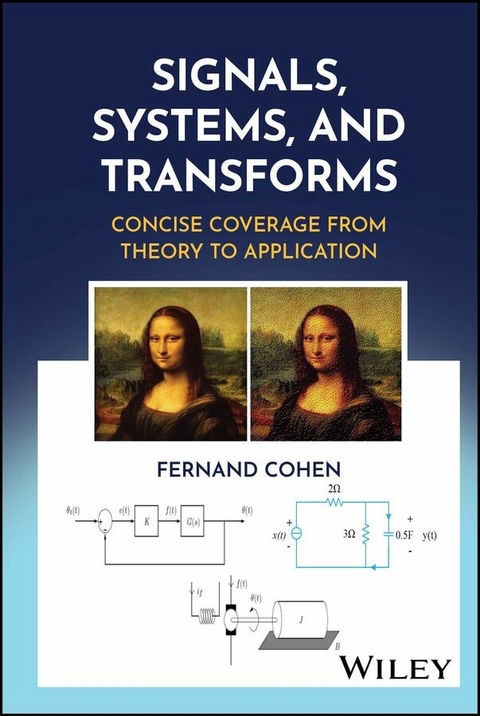
Signals, Systems, and Transforms (eBook)
343 Seiten
Wiley (Verlag)
978-1-394-30085-3 (ISBN)
Concise, linear textbook exploring the fundamentals of signals and systems analysis using Fourier tools and generalized Fourier tools
Signals, Systems, and Transforms covers the fundamentals of analyzing analog and discrete signals and systems in various domains using Fourier and generalized Fourier tools. The book shows how these tool elements are interconnected and weaves them into a sequential coherent story, with each element leading to the next, helping readers more easily grasp newer material due to previously developed concepts. Practically, the book examines how the theory applies to various fields ranging from biomedical imaging to filter designs for audio and video signals.
The book includes interesting examples of the theories presented in the textbook for hands-on learning, as well as a lab section in MATLAB, where the reader is shown simulated examples and asked to perform certain tasks using simple MATLAB codes and functions. This book condenses material usually expressed in 800-1200 pages into approximately one-fourth of that length by capitalizing on how the various Fourier transforms relate and by unifying the treatment of the analog and discrete transforms.
Signals, Systems, and Transforms includes information on:
- Laplace transform (LT) and Z-transform (ZT) as generalized Fourier transform. It then uses the concepts of transforms in the analysis of linear systems with rational Laplace and Z-transform
- The discrete Fourier transform (DFT) and its fast computation using fast Fourier transform (FFT) as a sampler in the Fourier domain
- Sampling of double-sided lowpass and bandpass signals (double- and single-sided) using concepts of modulation and Hilbert transform (HT)
- Quantization of signals, covering optimal quantizers, uniform quantizers, and compandors
- It introduces Singular Value Decomposition (SVD) as a subcase of optimal quantizers
- Unitary (energy-preserving) transforms such as the suboptimal cosine transforms
Signals, Systems, and Transforms provides all of the necessary knowledge for electrical and computer engineering students to master fundamental tools related to the subject and be able to branch into the fascinating fields of signal processing and modeling, signal and system control, and power.
Fernand Cohen is a Professor in the Electrical and Computer Engineering Department at Drexel University. He joined Drexel University in 1987. Prior, he was an Assistant Professor in the Electrical Engineering Department at the University of Rhode Island. He received his PhD and MSc in Electrical Engineering from Brown University in 1980 and 1983, respectively.
Preface
The material in this textbook covers the fundamentals of transform methods, linear system analysis, and signal processing (SP). It is based on my experience teaching linear system and signal processing courses at the undergraduate and graduate levels over the past 40 years. The textbook is suitable for 20‐week course at the undergraduate level and a 15‐week (one semester) course at the graduate level. The textbook combines and treats concepts of modeling analog and discrete signals and systems in the Fourier domain (frequency representation). It covers the celebrated discrete Fourier transform (DFT) and its fast computation using fast FT (FFT) as a sampler in the Fourier domain. It introduces the Laplace transform (LT) and Z‐transform (ZT) as generalized Fourier transform. It then uses the concepts of transforms in the analysis of linear systems with rational Laplace and Z‐transform. It also deals with the digitization of signals and systems in both the time and the Fourier domains by introducing sampling of double‐sided lowpass and bandpass signals (double and single sided) using concepts of modulation and Hilbert transform (HT). It also introduces the concept of quantization of signals and covers optimal quantizer, uniform quantizers, intuitive quantizers, and compandors. It situates the FT within the general class of unitary (energy preserving) transforms, which includes, among others, the suboptimal cosine transforms. Finally, it illustrates a few applications of the covered theory in circuit analysis, signal and systems analysis, medical imaging, and signal restoration and compression.
The coverage of this textbook is unique as it takes the reader’s prior and current knowledge and builds on it to develop new concepts. For instance, the coverage starts with complex spaces developed in a sophomore course on linear algebra and generalizes that to function spaces, where the concept of completeness and spanning the space in terms of a set of basis vectors is generalized to functions, along with the concept of geometric projection and dot products. It is within that frame that the development of Fourier series is presented. Fourier transform is then developed from Fourier series by treating aperiodic signals as periodic but with infinite periods. This allows an intuitive and simple generalization of Fourier series to Fourier transform, and the computation of the spectrum associated with a periodic function in terms of the Fourier transform of the time‐limited signal that coincides the periodic signal over one period and is zero everywhere else. A parallel treatment of discrete signals is pursued where Fourier series of periodic sequences are developed, and the generalized spectrum as the discrete‐time Fourier transform (DTFT), whose samples are the infamous DFT and its FFT fast computation version. This generalization treatment is also used when introducing Laplace transform as generalized Fourier transforms. Similarly, Z‐transform, which parallels LT, is a generalized DTFT. Another uniqueness is situating FT within the larger class of unitary transforms (UT), useful in compression of signals, FT is a subclass, which might not be the optimal one. It also shows how the suboptimal cosine transform uses FFT. It presents a complete treatment of signals and system digitization ranging from sampling to quantization. Finally, it presents how concepts of transforms are used in the analysis of linear systems, with applications in renography, filter design, and signal restoration and compression. As much as possible, examples in each chapter are included to illustrate material covered and the subtlety involved in the applicability and computational aspects of the theory presented. This is illustrated through figures and pictures to solidify the concepts. After each chapter, a summary of what has been covered is given, followed by chapter problems that could be attempted on paper or using software such as MATLAB. At the end of almost every chapter in the problems subsection, there is a lab section in MATLAB, where the reader is shown simulated examples as well as asked to perform certain tasks. This strongly cements the concepts covered and gives the reader hands‐on experience with the material covered in this chapter.
While most similar books are upward of 1000 pages, this book is able to cover all the requisite material in less than 250 pages. The book does so in a concise nature by utilizing how the various Fourier transforms relate and by unifying the treatment of the analog and discrete, and making use of the fact that FS problems can be addressed and solved using FT theory, the book can achieve conciseness and clarity for the students without compromising any in‐depth understanding.
Linear system analysis and signal processing at both the graduate and undergraduate levels are fundamental courses in all ECE departments across the United States and overseas. No ECE student can graduate without having the content of this textbook in one form or another. While there are textbooks dealing with the various topics covered or subsets of them, there is no single textbook that combines all these topics in one manuscript, nor does it cover the topics in this sequential concise manner, where students are naturally led to a new topic from a previously covered one. The efficiency in covering the material is made possible by focusing on the important building blocks and the sequential nature of the material presented without compromising its in‐depth understanding. This constitutes a very attractive pedagogical tool for learning. In addition, while concentrating on the theory of the necessary and important prerequisite material of an ECE undergraduate and graduate student, the textbook systematically develops the topics in a cohesive and concise manner while providing examples and real‐life applications to cement these concepts.
At the author’s institution (Drexel university), there are at least four courses offered both at the graduate and undergraduate levels that collectively cover the material in this book. The courses here at Drexel are ECE S301 (linear systems I); ECE S303 (linear systems II); ECE S431 (introduction to fundamentals of SP), and ECE S631 (fundamentals of deterministic SP). Two of these courses are required and fundamental courses for EE, CE, and BE students. Students at Drexel and elsewhere are in dire need of a book that addresses all the concepts and ideas covered in this book.
In summary, there are five key features that make this book attractive to students. These are as follows:
- No textbook exists today that encapsulates the entirety of the subject matter covered by this textbook. In course assessment surveys and exit interviews, students express a dire need to have one textbook that combines all the topics they learn in their linear system analysis and SP courses. The textbook compiles those various topics into a single text that easily feeds into many courses in signal and system analysis, as well as SP. It can also act as a reference textbook for students to go back while working in the industry or pursuing graduate studies.
- The sequential nature of what is presented builds on what the students know to develop new concepts. It is a natural development of the material in structure and content that is quite appealing to grasp and learn from.
- It clearly demonstrates how all the various components are interconnected and how they relate to one another. It emphasizes the connections between continuous and discrete times and addresses the issues of sampling and quantization and their impact on system design.
- It includes interesting examples and applications to the theories presented in the textbook for hands‐on learning, as well as a lab section in MATLAB, where the reader is shown simulated examples and asked to perform certain tasks using simple MATLAB codes and functions.
- It condenses material usually expressed in 800–1200 pages into approximately one fourth of that by focusing on the important building blocks and the sequential nature of the material presentation. This is made possible by capitalizing on how the various Fourier transforms relate and by unifying the treatment of the analog and discrete transforms. This is a very attractive feature to students, who rely on the textbook to enhance learning of the material. In course assessments and exit interviews, students consistently complain that their texts are often too long or bloated. This book aims to provide a remedy for that issue by covering the material in a concise and efficient manner.
The book consists of 10 chapters. Follow is a brief description of each chapter.
Chapter 1 covers concepts of signals and systems. This includes concept of periodic functions, singularity functions, causality, anticausality, and noncausality of signals for continuous and discrete signals. The concept of system linearity, time invariance, and causality is also introduced, leading to linear time invariant systems (LTI), with the signature of the system being its impulse response. The convolution operation is introduced allowing the output of the LTI system to be computed given an input and the impulse response of the system. We also show the impulse response for rational systems. Finally, the concept of deconvolution is also introduced for scenarios where we can measure the input and output of a system and we need to determine the impulse response of the system.
Chapter 2 deals with the theory and construction of Fourier representation of periodic functions and sequences, through a Fourier series (FS) expansion, with the coefficients in...
| Erscheint lt. Verlag | 8.10.2025 |
|---|---|
| Sprache | englisch |
| Themenwelt | Technik ► Elektrotechnik / Energietechnik |
| Schlagworte | Compandor • discrete Fourier transform • Discrete time fourier transform • Fast Fourier transform • Fourier series • Fourier transform • Laplace transform • Nyquist rate • Sampling of double and single bandpass signals • Z-Transform |
| ISBN-10 | 1-394-30085-9 / 1394300859 |
| ISBN-13 | 978-1-394-30085-3 / 9781394300853 |
| Informationen gemäß Produktsicherheitsverordnung (GPSR) | |
| Haben Sie eine Frage zum Produkt? |
 EPUB (Adobe DRM)
Kopierschutz: Adobe-DRM
Adobe-DRM ist ein Kopierschutz, der das eBook vor Mißbrauch schützen soll. Dabei wird das eBook bereits beim Download auf Ihre persönliche Adobe-ID autorisiert. Lesen können Sie das eBook dann nur auf den Geräten, welche ebenfalls auf Ihre Adobe-ID registriert sind.
Details zum Adobe-DRM
Dateiformat: EPUB (Electronic Publication)
EPUB ist ein offener Standard für eBooks und eignet sich besonders zur Darstellung von Belletristik und Sachbüchern. Der Fließtext wird dynamisch an die Display- und Schriftgröße angepasst. Auch für mobile Lesegeräte ist EPUB daher gut geeignet.
Systemvoraussetzungen:
PC/Mac: Mit einem PC oder Mac können Sie dieses eBook lesen. Sie benötigen eine
eReader: Dieses eBook kann mit (fast) allen eBook-Readern gelesen werden. Mit dem amazon-Kindle ist es aber nicht kompatibel.
Smartphone/Tablet: Egal ob Apple oder Android, dieses eBook können Sie lesen. Sie benötigen eine
Geräteliste und zusätzliche Hinweise
Buying eBooks from abroad
For tax law reasons we can sell eBooks just within Germany and Switzerland. Regrettably we cannot fulfill eBook-orders from other countries.
aus dem Bereich