


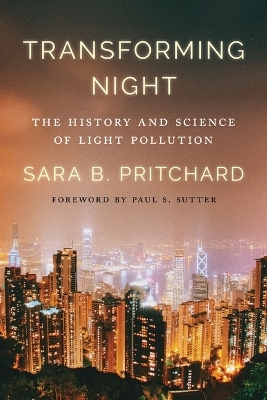
Transforming Night
The History and Science of Light Pollution
Seiten
2026
University of Washington Press (Verlag)
978-0-295-75520-5 (ISBN)
University of Washington Press (Verlag)
978-0-295-75520-5 (ISBN)
- Noch nicht erschienen (ca. Juli 2026)
- Versandkostenfrei
- Auch auf Rechnung
- Artikel merken
Who owns the night—and what is lost as we flood it with light, worldwide?
Darkness has become legible—and contested. Blending archival narrative with on-the-ground ethnography, Sara B. Pritchard traces how four fields—astronomy, remote sensing, conservation science, and ecology—have investigated artificial light at night, turning a ubiquitous convenience into a category of harm. From observatories chasing ever-receding darkness to the satellite images that first rendered a nocturnal planet from space and recent “Black Marble” maps, Pritchard shows how methods, instruments, and field sites shape what scientists can know about night and light—and what remains unseen.
Across these encounters, night emerges not as a backdrop but as an environment in its own right—one transformed by rapidly expanding, brightening illumination in the Anthropocene. The book chronicles the ascent of “light pollution,” as well as the new challenge of space-based brightness from satellite constellations, even as dark-sky advocates fight to preserve the starry firmament. Attentive to politics as much as photons, Pritchard brings environmental justice to the fore—highlighting tensions among light poverty, forced illumination, and surveillance and calls for “beneficial darkness.” She takes seriously Indigenous astronomers’ critiques of dispossession and “astro-colonialism,” asking what it means to site world-class telescopes on sacred land.
Sweeping from local parks to planetary vistas, Transforming Night reframes a familiar story of modern light as a history of changing nights—past, present, and possible. It will engage readers in environmental history and humanities, science and technology studies, and the sciences themselves, along with dark-sky activists and anyone drawn to the beauty and politics of the world after nightfall.
Darkness has become legible—and contested. Blending archival narrative with on-the-ground ethnography, Sara B. Pritchard traces how four fields—astronomy, remote sensing, conservation science, and ecology—have investigated artificial light at night, turning a ubiquitous convenience into a category of harm. From observatories chasing ever-receding darkness to the satellite images that first rendered a nocturnal planet from space and recent “Black Marble” maps, Pritchard shows how methods, instruments, and field sites shape what scientists can know about night and light—and what remains unseen.
Across these encounters, night emerges not as a backdrop but as an environment in its own right—one transformed by rapidly expanding, brightening illumination in the Anthropocene. The book chronicles the ascent of “light pollution,” as well as the new challenge of space-based brightness from satellite constellations, even as dark-sky advocates fight to preserve the starry firmament. Attentive to politics as much as photons, Pritchard brings environmental justice to the fore—highlighting tensions among light poverty, forced illumination, and surveillance and calls for “beneficial darkness.” She takes seriously Indigenous astronomers’ critiques of dispossession and “astro-colonialism,” asking what it means to site world-class telescopes on sacred land.
Sweeping from local parks to planetary vistas, Transforming Night reframes a familiar story of modern light as a history of changing nights—past, present, and possible. It will engage readers in environmental history and humanities, science and technology studies, and the sciences themselves, along with dark-sky activists and anyone drawn to the beauty and politics of the world after nightfall.
Sara B. Pritchard is professor of science and technology studies at Cornell University. She is author of Confluence: The Nature of Technology and the Remaking of the Rhône and coauthor of Technology and the Environment in History.
| Erscheint lt. Verlag | 21.7.2026 |
|---|---|
| Reihe/Serie | Weyerhaeuser Environmental Books |
| Mitarbeit |
Herausgeber (Serie): Paul S. Sutter |
| Vorwort | Paul S. Sutter |
| Zusatzinfo | 18 Illustrations, black and white; 18 Illustrations, black and white; 18 Illustrations, black and white; 18 Illustrations, black and white; 18 Illustrations, black and white; 18 Illustrations, black and white; 18 Illustrations, black and white; 18 Illustrations, black and white; 18 Illustrations, black and white |
| Verlagsort | Seattle |
| Sprache | englisch |
| Maße | 152 x 229 mm |
| Gewicht | 481 g |
| Themenwelt | Naturwissenschaften ► Biologie ► Ökologie / Naturschutz |
| Technik ► Umwelttechnik / Biotechnologie | |
| ISBN-10 | 0-295-75520-2 / 0295755202 |
| ISBN-13 | 978-0-295-75520-5 / 9780295755205 |
| Zustand | Neuware |
| Informationen gemäß Produktsicherheitsverordnung (GPSR) | |
| Haben Sie eine Frage zum Produkt? |
Mehr entdecken
aus dem Bereich



aus dem Bereich
Methoden – Lösungen – Anwendungen
Buch | Hardcover (2025)
Hanser (Verlag)
CHF 69,95


