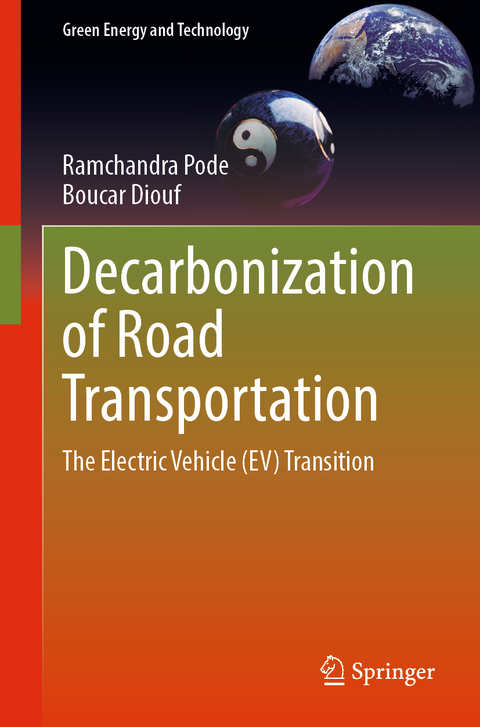
Decarbonization of Road Transportation
Springer International Publishing (Verlag)
978-3-032-11387-0 (ISBN)
- Noch nicht erschienen - erscheint am 07.02.2026
- Versandkostenfrei
- Auch auf Rechnung
- Artikel merken
This book describes the transition from gasoline-powered vehicles to electric vehicles (EVs), which is the most effective strategy for decarbonizing land transportation. This shift can significantly reduce greenhouse gas emissions and dependence on fossil fuels, paving the way for a sustainable transport system.
Increased EV adoption has the potential to lower greenhouse gas (GHG) emissions substantially, with projections suggesting that emissions from fuel production lead to net zero by 2040 through energy-sector decarbonization. This book explores recent advancements in EV adoption across various regions, which are largely driven by government policies such as subsidies and regulations that make EV ownership more accessible compared to traditional internal combustion engine (ICE) vehicles. Despite these favorable policies, the rate of EV adoption has not met expectations, highlighting a gap between policy intent and environmental impact. This book examines critical issues such as rapid depreciation and technological evolution. It emphasizes the interplay between advancements in EV technology particularly lithium-ion batteries and artificial intelligence and their implications for sustainable development. The text stresses importance of achieving zero-carbon emissions and fostering sustainable practices across scientific, technological, and economic dimensions. Ultimately, this book serves as a vital resource for understanding how effective transportation technologies can contribute to a cleaner environment and sustainable future.
This comprehensive book is tailored for undergraduate and postgraduate engineering students, as well as professionals and researchers in environmental science, electrical engineering, transportation, and renewable energy sectors.
Ramchandra Pode is an emeritus professor at Kyung Hee University in Seoul, South Korea, known for his work in the fields of organic light-emitting diode (OLED) technologies and renewable energy. He has made significant contributions to several influential books on organic electronics and renewable energy, frequently as a co-author or chapter contributor. In 2011, he co-authored a book titled Solar Lighting, part of the Green Energy and Technology series.
Professor Pode s research has focused on enhancing the efficiency and structure of OLED devices, such as phosphorescent OLEDs and transparent conducting electrodes. Further, his research contributions encompass the potential of lithium-ion batteries within renewable energy systems and the beneficial uses of rice husk ash waste generated by biomass power plants.
Professor Boucar Diouf is a scholar and researcher specializing in sustainable technologies and energy systems, currently holding a position as a professor at Kyung Hee University in Seoul, South Korea. He obtained his Ph.D. in physics from INSA Toulouse in France, where he established a robust foundation in applied physics and subsequently in energy systems. Over the last 15 years, his research has been primarily concentrated on renewable energy integration, electric vehicle technologies, and the development of innovative strategies for energy efficiency.
Professor Diouf has made significant contributions to the academic discourse in renewable energy technologies. Among his notable achievements are the reduction of electronic waste and the enhancement of access to clean energy and electric mobility. His research has explored the second life of mobile phone batteries, focusing on repurposing old batteries for use in affordable solar home systems. This initiative not only minimizes the accumulation of used batteries in landfills by facilitating their testing, refurbishment, and reuse but also fosters energy access by creating economical lighting solutions for rural households lacking electricity.
Electric vehicles in the history of road transportation.- Decarbonizing road transportation.- The electric vehicle transition.- Electric vehicle transition policies and strategies.- Transition to zero-emission vehicles: Case studies of Norway and China.- Technology and subsidies in the depreciation of electric vehicles.- Modelling the used vehicle market share in the electric vehicle transition.- The second-hand market in the electric vehicle transition.- Is the grid ready for the electric vehicle transition?- Way forward: A full transition to electric vehicles.
| Erscheinungsdatum | 29.11.2025 |
|---|---|
| Reihe/Serie | Green Energy and Technology |
| Zusatzinfo | XIII, 299 p. 101 illus., 98 illus. in color. |
| Verlagsort | Cham |
| Sprache | englisch |
| Maße | 155 x 235 mm |
| Themenwelt | Technik ► Fahrzeugbau / Schiffbau |
| Technik ► Maschinenbau | |
| Schlagworte | Decarbonization of Road Transportation • EV Adoption Strategies and Consumers' Perceptions • EV Adoption Strategies and Consumers’ Perceptions • EV Economics • EV Infrastructure and Technology Developments • EV Price Depreciation and Used EV Market • EV technology • Green Energy and Technology • Incorporation of AI and Information Technologies in EVs • Sustainable Battery Manufacturing • Sustainable Sevelopment |
| ISBN-10 | 3-032-11387-3 / 3032113873 |
| ISBN-13 | 978-3-032-11387-0 / 9783032113870 |
| Zustand | Neuware |
| Informationen gemäß Produktsicherheitsverordnung (GPSR) | |
| Haben Sie eine Frage zum Produkt? |
aus dem Bereich