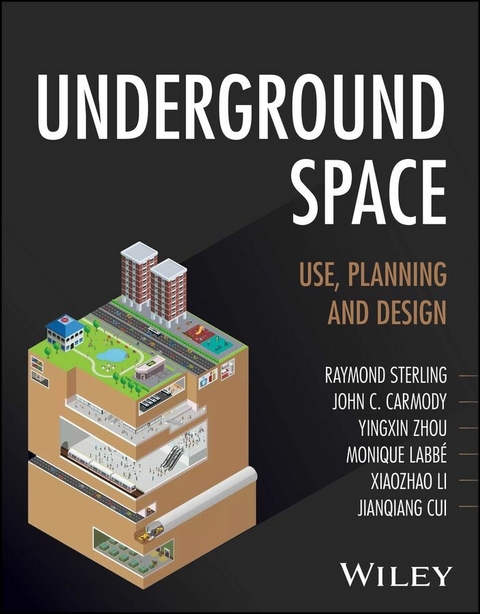
Underground Space (eBook)
480 Seiten
Wiley (Verlag)
978-1-394-20963-7 (ISBN)
Unlocking the Hidden Potential of Cities from the Ground Down
With cities worldwide facing pressures from rapid urbanization, climate change, and land scarcity, underground space has become a vital resource for sustainable and resilient urban development. Underground Space: Use, Planning and Design provides a comprehensive framework for planners, engineers, architects, and policymakers to understand and apply underground solutions and updates a landmark reference work on the topic. Combining many decades of research, practice, and global examples, this book offers authoritative guidance on how underground space can contribute to the creation of livable, future-ready cities.
Written by a team of experts from around the globe, Underground Space offers:
- An understanding of the many reasons why underground space is used and when to choose to build underground.
- Broad coverage of underground uses, from transport and urban utilities to underground architectural applications.
- Recent advances made in three-dimensional urban underground planning.
- Updated design approaches and human-centered considerations for the exterior and interior design, layout, lighting, and safety of underground spaces.
- In-depth exploration of sustainability, resilience, and adaptability issues.
- Insights from several decades of hands-on experience with modern underground designs.
Underground Space: Use, Planning and Design is an essential, up-to-date reference on the subject for architects, planners, and engineers in public agencies, private sectors, and research institutions. It is also valuable for use in courses on architectural design, urban planning, underground infrastructure, and infrastructure provision.
Raymond Sterling is a Professor Emeritus (Civil Engineering) at Louisiana Tech University where he directed the Trenchless Technology Center from 1995-2009. From 1977-1995, he was on the faculty of the University of Minnesota where he was the founding Director of the Underground Space Center.
John C. Carmody (1947-2019) was an architect and the Associate Director of the Underground Space Center at the University of Minnesota. His major research interests included the planning, design, and construction of underground facilities, energy-efficient building design, building technology, and life safety in buildings.
Yingxin Zhou is Technical Director with Knights Synergy (S) Pte Ltd and Academy of Engineering Singapore and served as Head Engineering (Underground Facilities) with the Defence Science and Technology Agency, Singapore.
Monique Labbé is the recipient of the Pioneering Woman Architect ARVHA Prize in 2023 and runs Les Ateliers Monique LABBÉ. She created and chaired the AFTES Underground Space Committee. She initiated in 2009 and directs the Ville 10D-Ville d'Idées National Research Project on the urban use of the underground.
Xiaozhao Li is Director, Professor of the State Key Laboratory for Geo-Mechanics and Deep Underground Engineering, China University of Mining & Technology. He is also Founding Director of Yunlong Lake Laboratory for Deep Underground Science and Engineering.
Jianqiang Cui is a Senior Lecturer in Urban Planning at Griffith University, Brisbane, Australia. Her research interests lie in the fields of urban planning and design, transport planning and policy, environment and behaviour, and urban underground space.
Unlocking the Hidden Potential of Cities from the Ground Down With cities worldwide facing pressures from rapid urbanization, climate change, and land scarcity, underground space has become a vital resource for sustainable and resilient urban development. Underground Space: Use, Planning and Design provides a comprehensive framework for planners, engineers, architects, and policymakers to understand and apply underground solutions and updates a landmark reference work on the topic. Combining many decades of research, practice, and global examples, this book offers authoritative guidance on how underground space can contribute to the creation of livable, future-ready cities. Written by a team of experts from around the globe, Underground Space offers: An understanding of the many reasons why underground space is used and when to choose to build underground.Broad coverage of underground uses, from transport and urban utilities to underground architectural applications.Recent advances made in three-dimensional urban underground planning.Updated design approaches and human-centered considerations for the exterior and interior design, layout, lighting, and safety of underground spaces.In-depth exploration of sustainability, resilience, and adaptability issues.Insights from several decades of hands-on experience with modern underground designs. Underground Space: Use, Planning and Design is an essential, up-to-date reference on the subject for architects, planners, and engineers in public agencies, private sectors, and research institutions. It is also valuable for use in courses on architectural design, urban planning, underground infrastructure, and infrastructure provision.
| Erscheint lt. Verlag | 6.10.2025 |
|---|---|
| Sprache | englisch |
| Themenwelt | Technik ► Architektur |
| Schlagworte | Underground construction • underground space design • underground space planning • underground space psychology • underground space resiliency • underground space sustainability • underground space use • utility infrastructure |
| ISBN-10 | 1-394-20963-0 / 1394209630 |
| ISBN-13 | 978-1-394-20963-7 / 9781394209637 |
| Informationen gemäß Produktsicherheitsverordnung (GPSR) | |
| Haben Sie eine Frage zum Produkt? |
 PDF (Adobe DRM)
Kopierschutz: Adobe-DRM
Adobe-DRM ist ein Kopierschutz, der das eBook vor Mißbrauch schützen soll. Dabei wird das eBook bereits beim Download auf Ihre persönliche Adobe-ID autorisiert. Lesen können Sie das eBook dann nur auf den Geräten, welche ebenfalls auf Ihre Adobe-ID registriert sind.
Details zum Adobe-DRM
Dateiformat: PDF (Portable Document Format)
Mit einem festen Seitenlayout eignet sich die PDF besonders für Fachbücher mit Spalten, Tabellen und Abbildungen. Eine PDF kann auf fast allen Geräten angezeigt werden, ist aber für kleine Displays (Smartphone, eReader) nur eingeschränkt geeignet.
Systemvoraussetzungen:
PC/Mac: Mit einem PC oder Mac können Sie dieses eBook lesen. Sie benötigen eine
eReader: Dieses eBook kann mit (fast) allen eBook-Readern gelesen werden. Mit dem amazon-Kindle ist es aber nicht kompatibel.
Smartphone/Tablet: Egal ob Apple oder Android, dieses eBook können Sie lesen. Sie benötigen eine
Geräteliste und zusätzliche Hinweise
Buying eBooks from abroad
For tax law reasons we can sell eBooks just within Germany and Switzerland. Regrettably we cannot fulfill eBook-orders from other countries.
aus dem Bereich