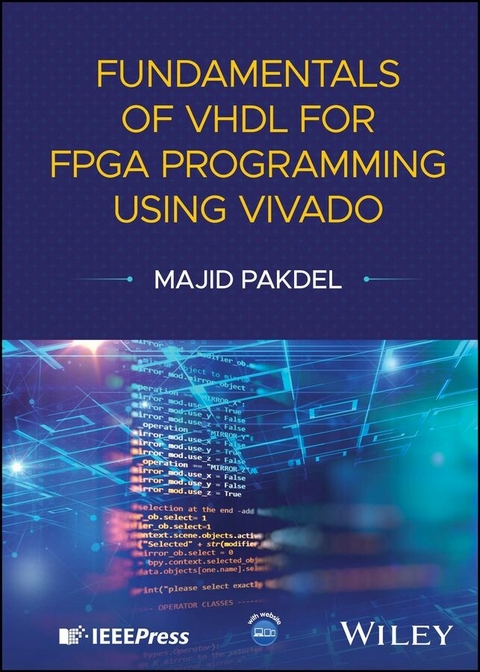
Fundamentals of VHDL for FPGA Programming Using Vivado (eBook)
793 Seiten
Wiley-IEEE Press (Verlag)
978-1-394-34310-2 (ISBN)
Enables readers to understand VHDL in the context of FPGA programming with a focus on the Vivado Design Suite
Fundamentals of VHDL for FPGA Programming Using Vivado is a comprehensive guide designed to introduce readers to VHSIC Hardware Description Language (VHDL) and its application in Field Programmable Gate Array (FPGA) programming, particularly using the Vivado Design Suite by Xilinx. The inclusion of hands-on protocol-based projects for FPGA and MicroBlaze allows readers to apply what they have learned in practical scenarios, helping to reinforce understanding and develop problem-solving skills.
This book includes information on:
- What FPGAs are, how they work, and why they are widely used in digital systems due to various advantages
- Basic concepts of VHDL necessary for understanding digital design, including syntax, data types, and structures
- Best practices in VHDL coding and FPGA design to enhance the quality of designs and reduce debugging time
- The Vivado toolchain and its use in designing, simulating, and implementing VHDL code on FPGA devices
Accessible yet comprehensive, Fundamentals of VHDL for FPGA Programming Using Vivado is an essential learning resource for students aiming to start their careers in FPGA or VLSI system design and new professionals in the FPGA field seeking to build foundational skills and knowledge.
Majid Pakdel received his Master's degree in Electrical Power Engineering from Isfahan University of Technology, Iran, in 2007, his PhD in Electrical Power Engineering from University of Zanjan in 2018, and his second Masters degree in Computer Engineering-Artificial Intelligence and Robotics from Malek Ashlar University of Technology, Tehran, in 2023. He has published over 20 papers and books in the fields of electrical engineering and computer science.
Enables readers to understand VHDL in the context of FPGA programming with a focus on the Vivado Design Suite Fundamentals of VHDL for FPGA Programming Using Vivado is a comprehensive guide designed to introduce readers to VHSIC Hardware Description Language (VHDL) and its application in Field Programmable Gate Array (FPGA) programming, particularly using the Vivado Design Suite by Xilinx. The inclusion of hands-on protocol-based projects for FPGA and MicroBlaze allows readers to apply what they have learned in practical scenarios, helping to reinforce understanding and develop problem-solving skills. This book includes information on: What FPGAs are, how they work, and why they are widely used in digital systems due to various advantagesBasic concepts of VHDL necessary for understanding digital design, including syntax, data types, and structuresBest practices in VHDL coding and FPGA design to enhance the quality of designs and reduce debugging timeThe Vivado toolchain and its use in designing, simulating, and implementing VHDL code on FPGA devices Accessible yet comprehensive, Fundamentals of VHDL for FPGA Programming Using Vivado is an essential learning resource for students aiming to start their careers in FPGA or VLSI system design and new professionals in the FPGA field seeking to build foundational skills and knowledge.
Chapter 1
Overview
1.1 Introduction
In this book, we are going to use the Vivado tool from Xilinx, which is their newest tool that we will be using to develop our projects on the A7 development board. What is this book about? Well, this book focuses on two main topics: VHDL and FPGA development. There is a lot to the VHDL language, so what we’re going to do is go through and explain specific parts of the VHDL language, specifically how it relates to FPGA development. You can use VHDL for a variety of things, but in this book, we’re going to focus on the part of the shell that’s used to implement a design on an FPGA. This includes different types of digital logic or anything else you can think of that can be done digitally – we’re going to put it on the FPGA. We’re going to show you how to do just that. Thus, in this book, we’re going to explain how to use Vivado, the software development kit for Xilinx, and how to develop on the A7 development board, which is a Xilinx development board. Now, the layout of this book is such that we are going to cover the basics of Vivado, and then work on a project. This means you will get some theory and an understanding of how different parts of the Vivado work. After that, we’ll go ahead and do a project and then we’ll cover more theory in another project. So, the idea is that once you come to a project, at that point, you should have learned everything you need to know to complete it successfully. As we go through the different theories and explain them, we will walk through and show how they relate specifically to the next project in the book as they step down. So, all of the different projects that we’re working with include the following: we have a buttons and LEDs project, where we are going to press a button on our FPGA board, which will light up an LED. The whole idea behind this is to show you how to do the basics – how to take inputs and generate outputs. You’re going to have to use the buttons as input and display the output on LEDs. Then we have a blinking LED project, where we’re going to show you how to create a timer, specifically a counter, which control how LED blinks on and off at a specified interval. Then we have the brightness project, where we are going to vary the brightness of the LEDs. If you have the Arty A7 board, you will have both standard LEDs and an RGB (red–green–blue) LED. In this project, we are going to vary the brightness using pulse width modulation. We’re going to explain how pulse width modulation works, how to implement it in VHDL, and then deploy it on the development board to vary the brightness of the LEDs on the board.
We then want to show you the UART demonstration project, which is a very basic introduction to using UART on your development board. Both boards have a UART port, and this is going to show you how we can take information from the actual developer board and display it on a computer. Well, you can use UART to take that information displayed on the computer. So, we’re going to show you how to do that. Then, we have the other UART IO project, where we will take information just like we did in UART demonstration project. But take it a step further, where we are going to take inputs in, so we’ll type in commands on our computer to have certain actions occur on the development board, such as checking the input to tell us which buttons are pushed or which switches are high, and also sending a command to tell it to light up certain LEDs. We have an ADC processing project, where we are going to interface the board with a temperature sensor to demonstrate the analog-to-digital conversion. We’re going to vary the temperature of the sensor to show how it responds – when the sensor gets colder, you’ll see the temperature decrease, and when it gets hotter, the temperature will increase. We’re going to take that temperature, convert it into both Celsius and Fahrenheit, and then display the values on the computer screen so that you can see the actual ambient temperature or the temperature that a sensor is indicating. We have an SPI interface project. This project is going to be working only with the Arty A7 development board, and what we’ll do is we are going to take and store information on the onboard SPI flash. This is because these are volatile memories, which means that when you program the package and then power it off, the configurations are lost when it is powered back on. So, we’re going to show you how to take information and store it on the external flash so that when you power it back on and reprogram it, you can pull that information from the external flash. So, we’re going to work on it and show you how to do the interface between an FPGA and external flash using the SPI interface. Who’s this course for? This is for anyone who has no previous FPGA or VHDL design experience and wants to understand how it’s used as well as a design from scratch on FPGA. So, whether you’re an engineer, student, or hobbyist, this course is specifically designed for you to show you how to do this type of project and use FPGA. Now that you know what to expect from this book, let’s get started.
1.2 Introduction to VHDL
In this section, we’re going to introduce and briefly explain what VHDL is. Well, it’s a hardware descriptive language, and it’s similar to Verilog. If you have ever heard of Verilog, they are not one and the same. They’re two different languages, but they’re doing the same thing. We’re describing hardware. It’s a hardware descriptive language, hence the name VHDL, and what that means is we’re using the VHDL to describe a hardware circuit. We’re not actually writing software, so you kind of have to wrap your mind around the idea. When you’re working with the VHDL, you’re not writing software. It’s not like C, Java, or MATLAB, where everything you write happens sequentially. It’s not that at all. What we’re doing is describing how we want a digital hardware circuit to operate, so we can think of it as architecting a digital schematic. So, you’ll say, OK, we want the specific AND gate or we want a comparator and we want to drive some sort of digital; whatever type of digital thing you’re wanting to do, you implement it and describe it in detail, and that’s the whole idea behind it. The big advantage of using VHDL is that it’s very portable. So, if we have VHDL that we are running on Xilinx or Altera device, we can take that same VHDL out, as long as we’re not using specific components on the actual device, such as memory, which means we have to change a little bit to use memory on the other device. We can take this one feature design and move it around a different logic device on FPGA, a couple or any other type of logic device you might be using. So, that’s one of the big advantages of using the VHDL – you can build up a library so that if you’re creating a project with an Altera device, you can use those same designs. When you create a project on a Xilinx device, you can use almost all of those same designs when designing a device. That’s the whole idea – it’s very portable. The whole reason that VHDL was developed is that designing digital hardware used to take a long time. If you wanted to design something digital, you had to place new chips on a board, which requires a new board layout, a new schematic, and long turnaround times. If you can just place one chip in the middle that’s implementing all of this functionality and you want to change it, such as your algorithm changes or you find a small bug with an FPGA and VDL, you can then modify your VHDL circuitry and reload it on the FPGA and now your design change has taken place without an actual board layout change. So, that’s one of the major advantages of using VHDL, or as you call it, configurable hardware, and the important thing we understand is it’s not software. You’re not writing software.
Some of the constructs, syntax, and structures are very similar, and they operate in the same manner. But you must understand that you’re describing hardware and that’s the overall concept. What you’re doing when you’re working with the VHDL is you’re not actually writing a software program; you’re describing a hardware circuit. Where is VHDL actually used? So, it’s used in several different ways, and probably the most common is that it’s used to configure – or we’ll call it program, but you’re not necessarily programming – you’re configuring the circuit. CPLDs and FPGAs are types of configurable hardware devices, and CPLDs and FPGAs are similar in a lot of aspects. But typically, your FPGAs are larger devices, and they have SRAM-like base, whereas your CPLDs might be like EPROM or flash-based. So, the FPGA doesn’t contain its configuration. When you power it off, you’ll typically have to store that configuration on a memory chip offboard the FPGA. So, any power on it that sucks in that configuration or as in this book here, we’re going to just program the JTAG. So, once your FPGA is powered up, you program and/or configure it. Then you’ll notice that when you remove the power and power it back on, it loses its configuration. That’s because we just loaded it directly onto the FPGA, which is just RAM memory. So, as soon as your power is down, it loses all the configurations. Another reason you can use VHDL is to simulate digital circuits. So, if you had a board, sort of a board layout you’re...
| Erscheint lt. Verlag | 7.10.2025 |
|---|---|
| Sprache | englisch |
| Themenwelt | Mathematik / Informatik ► Informatik |
| Technik ► Elektrotechnik / Energietechnik | |
| Schlagworte | Digital Design • electronic system structure • field programmable gate array • fpga debug • fpga device • fpga projects • vhdl coding • vhdl debug • vhdl projects • VHSIC Hardware Description Language • Vivado Design Suite • Xilinx |
| ISBN-10 | 1-394-34310-8 / 1394343108 |
| ISBN-13 | 978-1-394-34310-2 / 9781394343102 |
| Informationen gemäß Produktsicherheitsverordnung (GPSR) | |
| Haben Sie eine Frage zum Produkt? |
 EPUB (Adobe DRM)
Kopierschutz: Adobe-DRM
Adobe-DRM ist ein Kopierschutz, der das eBook vor Mißbrauch schützen soll. Dabei wird das eBook bereits beim Download auf Ihre persönliche Adobe-ID autorisiert. Lesen können Sie das eBook dann nur auf den Geräten, welche ebenfalls auf Ihre Adobe-ID registriert sind.
Details zum Adobe-DRM
Dateiformat: EPUB (Electronic Publication)
EPUB ist ein offener Standard für eBooks und eignet sich besonders zur Darstellung von Belletristik und Sachbüchern. Der Fließtext wird dynamisch an die Display- und Schriftgröße angepasst. Auch für mobile Lesegeräte ist EPUB daher gut geeignet.
Systemvoraussetzungen:
PC/Mac: Mit einem PC oder Mac können Sie dieses eBook lesen. Sie benötigen eine
eReader: Dieses eBook kann mit (fast) allen eBook-Readern gelesen werden. Mit dem amazon-Kindle ist es aber nicht kompatibel.
Smartphone/Tablet: Egal ob Apple oder Android, dieses eBook können Sie lesen. Sie benötigen eine
Geräteliste und zusätzliche Hinweise
Buying eBooks from abroad
For tax law reasons we can sell eBooks just within Germany and Switzerland. Regrettably we cannot fulfill eBook-orders from other countries.
aus dem Bereich