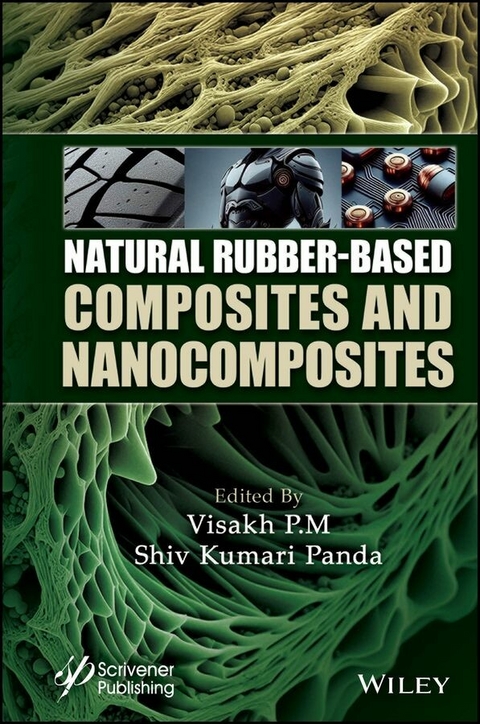
Natural Rubber-Based Composites and Nanocomposites (eBook)
466 Seiten
Wiley-Scrivener (Verlag)
978-1-394-21380-1 (ISBN)
Discover the latest research in the field of natural rubber composites in this comprehensive guide to the fundamentals and applications of this innovative field.
This book summarizes recent research accomplishments in the area of natural rubber nanocomposites, serving as a comprehensive reference for academics and professionals working to research and develop this growing field. Its application-oriented approach explores solutions to both fundamental and applied problems, covering a wide range of topics, including the state-of-the-art in natural rubber composites and nanocomposites, emerging challenges and opportunities, and detailed descriptions of various natural rubber-based composites and nanocomposites. Through expert insights and real-world case studies, the chapters will provide an up-to-date look at recent major innovations in this field.
Readers will find the volume:
- Serves as a one-stop reference for natural rubber-based composites, blends, and nanocomposites;
- Encompasses a large scope, including natural rubber-bamboo composites, natural rubber-bio-nanocomposites, biodegradation of natural rubber and its composites, and nanocomposites;
- Includes chapters on natural rubber recycling; the use of green additives in eco-friendly compounds based on natural rubber; and radiative protective qualities of natural rubber based polymer composites;
- Explores the applications helping researchers find solutions to both fundamental and applied problems in the area of natural rubber-based nanocomposites.
Audience
Rubber scientists, rubber technologists, polymer scientists, academics, and industry professionals interested in the many applications of natural rubber.
Visakh P.M., PhD works in the Natural Bioactive Materials Laboratory, Department of Bioengineering, Ege University, Bornova/Izmir, Turkey. He has published 45 books, 22 research articles, four reviews, and more than 50 book chapters. His areas of research include polymer sciences, polymer nanocomposites, material sciences, bionanocomposites, and rubber-based nanocomposites.
Shiv Kumari Panda, PhD is an assistant professor at the Udayanath Autonomous College of Science and Technology, Cuttack, Odisha, India. She has edited ten books and written several research articles for international journals. Her research focuses on material characterization, polymerization, and nanomaterials.
Discover the latest research in the field of natural rubber composites in this comprehensive guide to the fundamentals and applications of this innovative field. This book summarizes recent research accomplishments in the area of natural rubber nanocomposites, serving as a comprehensive reference for academics and professionals working to research and develop this growing field. Its application-oriented approach explores solutions to both fundamental and applied problems, covering a wide range of topics, including the state-of-the-art in natural rubber composites and nanocomposites, emerging challenges and opportunities, and detailed descriptions of various natural rubber-based composites and nanocomposites. Through expert insights and real-world case studies, the chapters will provide an up-to-date look at recent major innovations in this field. Readers will find the volume: Serves as a one-stop reference for natural rubber-based composites, blends, and nanocomposites; Encompasses a large scope, including natural rubber-bamboo composites, natural rubber-bio-nanocomposites, biodegradation of natural rubber and its composites, and nanocomposites; Includes chapters on natural rubber recycling; the use of green additives in eco-friendly compounds based on natural rubber; and radiative protective qualities of natural rubber based polymer composites; Explores the applications helping researchers find solutions to both fundamental and applied problems in the area of natural rubber-based nanocomposites. Audience Rubber scientists, rubber technologists, polymer scientists, academics, and industry professionals interested in the many applications of natural rubber.
1
Natural Rubber Composites and Nanocomposites: State-of-the-Art, New Challenges, and Opportunities
Visakh. P.M.1* and Shiv Kumari Panda2
1Natural Bioactive Materials Laboratory, Department of Bioengineering Ege University, Bornova/Izmir, Turkey
2Udayanath Autonomous College of Science & Technology Adaspur, Cuttack, Odisha, India
Abstract
In this chapter, the we are providing a short versions of all the chapters related to different topics such as natural rubber-bamboo composites for noise control applications, natural rubber-based bio-composites and bio-nanocomposites, mechanical, dynamical/mechanical, electrical, and thermal properties of natural rubber-carbon nanotube nanocomposites and their applications, biodegradation of natural rubber and their composites and nanocomposites, radiative protective qualities of natural rubber-based polymer composites, the use of green additives in eco-friendly compounds based on natural rubber, natural rubber recycling: advances, limitations and applications, elastocaloric effect of natural rubber, and natural-rubber based composites and nanocomposites.
Keywords: Natural-rubber, composites, nanocomposites, elastocaloric, rubberbamboo, eco-friendly compounds
1.1 Natural Rubber–Bamboo Composites for Noise Control Applications
Rubber can be produced in two ways: naturally from the latex of the Hevea brasiliensis tree, which is mostly grown in the Far East, or artificially by utilizing several processes on petroleum. The H. brasiliensis tree is cultivated in tropical parts of Southeast Asia, mostly in Malaysia and Indonesia. It produces latex, which is used to make natural rubber (NR), which is economically marketed [1]. The lengthy entwined coils that make up the natural rubber’s polymer chains are always in motion at room temperature. Carbon black has been the most popular reinforcing filler in the rubber industry, particularly tires, for many years. Crude oil is the source of carbon black, which is a non-renewable resource that can eventually run out. As a result, a natural alternative source is required for carbon black in the rubber industry as a reinforcing agent without significantly altering the final products’ mechanical and physical qualities. For damping applications, Praveen et al. [2] created a styrene butadiene rubber (SBR) compound that is loaded with carbon black (CB) and organo-modified nanoclay.
They discovered that when the filler was loaded, the mechanical characteristics and storage modulus increased significantly, leading to a low damping ratio. Yurkin et al. [3] investigated the vibration damping of three viscoelastic composites. The findings indicate that butyl rubber, EPDM, and EVA had damping ratios of 1.38, 0.6, and 0.42, respectively, suggesting that they could be used as viable options for damping applications. A filler is required to improve the mechanical, chemical, and physical qualities of elastomers when they are used in vibration damping for vehicles, railroads, and aircraft. Fillers have a significant impact on how rubber composites behave in a viscoelastic manner. NR completely satisfies the requirements for cut resistance, flex-fatigue resistance, and tensile qualities of final goods [4]. Except for rubber, all materials are specified as part per hundred rubber (PHR) or the quantity needed for 100 rubbers. A tire rubber compound should offer the best possible performance. For the best grip, the largest coefficient of friction must exist between the wheel and pavement. Simultaneously, the rolling resistance can be decreased to enhance fuel efficiency [5]. Materials with extremely small particle sizes are added to the RB mixture in powdered form as fillers or reinforcement additives [6]. Fillers are used to strengthen rubber, make it easier to process, and lower the cost and color of the material. Fillers can be either organic or inorganic and can be dry powders. Fillers are typically utilized to provide elastomers with the desired characteristics in commercial applications. The primary motivation for this is to lower costs and enhance compositional qualities. Fillers can be divided into two categories based on their color and impact. They can be separated and categorized into three types of fillers: semi-active, inactive, and active (reinforcing). Carbon blacks are known as black fillers, including silica, talc, calcium carbonate, talc, and zinc oxide, are known as white fillers [7].
In 2014, 32 million tons of wood and textile waste and 68 million tons of paper waste were produced in the United States, accounting for approximately 39% of the country’s annual municipal solid waste burden [8]. The Central Pollution Control Board (CPCB) in New Delhi conducted research that indicated that the proportion of trash generated in India comprises components of several materials ranging between 3%–5% and 1%–5%. Overall, the unfavorable noise resulting from improvements in mechanical tools has proven to be a more complicated issue. Following this principle, waste products from the processing of fabrics and corn can be mixed with waste products from the processing of paper to produce a substance that absorbs sound and reduces noise pollution [9]. With time and living progress, noise contamination and mechanical oscillations have become inevitable problems in human existence. The need for a better living environment is growing, and people can no longer be exposed to mechanical vibrations and the noise they produce. Furthermore, mechanical vibration shortens machine life and reduces precision [10]. Global bamboo production is estimated to be 20 million tons (MTs) per year, with 10 MTs originating from China, Japan, and India [11]. Bamboo finds its use in a wide range of industries, including apparel, food, furniture, flooring, and interior design. Over the past few decades, there has been increased interest among researchers in the thermochemical conversion of waste bamboo into products rich in carbon and biochar. Researchers have developed a spectrum of damping materials using various methods. The two most common modification strategies are the addition of functional reinforcing fillers to the IIR matrix or their mixing with other fillers to generate composite damping materials. Nanofillers have a large specific surface area that allows them to penetrate deeply into the rubber matrix. Carbon nanotubes, talc, and carbon black are joint-strengthening fillers. To improve the mix of filler and rubber from an environmental perspective, Tang et al. [12] substituted waste recycled red brick powder with the conventional filler carbon black and silica in styrene-butadiene rubber (SBR). The production costs were reduced, while the tensile characteristics were improved.
Lignin is a possible reinforcing material for polymeric materials because of its high stiffness, which is attributed to its aromatic portion and intramolecular solid/intermolecular contacts [13]. The butyl rubber’s qualities can be enhanced by curing IIR with phenolic resin modified by lignin. Butyl rubber is a hydrophilic substance that absorbs moisture during use because it contains polar functional groups. Owing to their low thermal stability, classic damping materials typically have a limited-service life. Therefore, the development of damping materials with good moisture resistance and thermal stability is crucial. Rubber is a common material found in various products. Several common rubber products that we encounter daily are rubber bands, shoes, and gloves. Because rubber products may return to their original shapes after being stretched or twisted, they are classified as elastomers. Rubber is an elastic substance that can be produced both naturally and artificially. Given that NR is an organic material, its characteristics are dictated by the biochemical mechanism by which the plant produces resin. Unlike synthetic rubber, NR polymerization cannot be changed. Natural rubber cannot be altered after it is removed from the plant. The modified forms of natural rubber that are considered significant are epoxidized natural rubber, poly (methyl methacrylate)-grafted natural rubber, hydro-halogenated natural rubber, cyclized natural rubber, depolymerized liquid natural rubber, resin-modified natural rubber, and poly (methyl methacrylate)-grafted natural rubber.
Mechanical oscillations and noise pollution have become unavoidable issues in human life as time and life have evolved. People are increasingly in need of improved living conditions, and they are unable to tolerate the noise and vibrations caused by machinery. Moreover, mechanical vibrations decrease the precision and shorten the life of the equipment. Soundabsorbing materials exhibit excellent dampening properties and a wide range of possible applications. Rubber-like materials offer excellent viscoelasticity, friction, and damping capabilities. These rubbers usually have a high relative molecular mass and strong molecular chain interactions, including polar, hydrogen, and ionic interactions. These RBs are used as dampers in various industries, including trains, aircraft, and cars. This study analyzed and highlighted natural bamboo rubber composite materials for successful noise and vibration control.
1.2 Natural Rubber-Based Bio-Composites and Bio-Nanocomposites
Sustainable materials, alternatively known as “green” or eco-friendly materials, are currently receiving a lot of attention and are characterized as inexpensive renewable resource materials that are locally produced without causing any kind of...
| Erscheint lt. Verlag | 3.10.2025 |
|---|---|
| Reihe/Serie | Thermoplastic Bionanocomposites Series |
| Sprache | englisch |
| Themenwelt | Naturwissenschaften ► Chemie |
| Technik ► Maschinenbau | |
| ISBN-10 | 1-394-21380-8 / 1394213808 |
| ISBN-13 | 978-1-394-21380-1 / 9781394213801 |
| Informationen gemäß Produktsicherheitsverordnung (GPSR) | |
| Haben Sie eine Frage zum Produkt? |
 EPUB (Adobe DRM)
Kopierschutz: Adobe-DRM
Adobe-DRM ist ein Kopierschutz, der das eBook vor Mißbrauch schützen soll. Dabei wird das eBook bereits beim Download auf Ihre persönliche Adobe-ID autorisiert. Lesen können Sie das eBook dann nur auf den Geräten, welche ebenfalls auf Ihre Adobe-ID registriert sind.
Details zum Adobe-DRM
Dateiformat: EPUB (Electronic Publication)
EPUB ist ein offener Standard für eBooks und eignet sich besonders zur Darstellung von Belletristik und Sachbüchern. Der Fließtext wird dynamisch an die Display- und Schriftgröße angepasst. Auch für mobile Lesegeräte ist EPUB daher gut geeignet.
Systemvoraussetzungen:
PC/Mac: Mit einem PC oder Mac können Sie dieses eBook lesen. Sie benötigen eine
eReader: Dieses eBook kann mit (fast) allen eBook-Readern gelesen werden. Mit dem amazon-Kindle ist es aber nicht kompatibel.
Smartphone/Tablet: Egal ob Apple oder Android, dieses eBook können Sie lesen. Sie benötigen eine
Geräteliste und zusätzliche Hinweise
Buying eBooks from abroad
For tax law reasons we can sell eBooks just within Germany and Switzerland. Regrettably we cannot fulfill eBook-orders from other countries.
aus dem Bereich