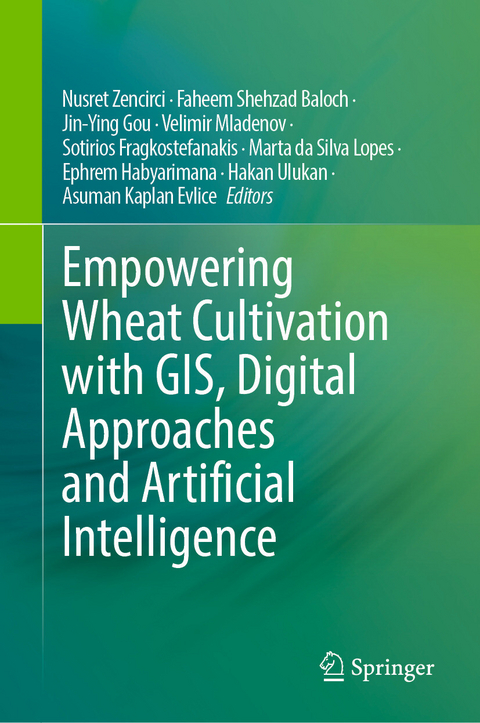
Empowering Wheat Cultivation with GIS, Digital Approaches and Artificial Intelligence (eBook)
297 Seiten
Springer (Verlag)
978-3-031-99954-3 (ISBN)
The global population is projected to exceed 9 billion by 2050, leading to imminent food shortages not only for the current but also future generations. Anticipated increases in appetite coming 50 years will pose significant challenges to food production. This demand will exert additional pressure on agriculture for the escalating need for food. On one hand, research indicates a 60% increase in food production is necessary to accommodate the projected 9 billion people, on the other hand, a substantial portion of the population is grappling with various micronutrient deficiencies, such as iron, zinc, iodine, vitamin A, and folic acid, a condition referred to as "hidden hunger." Hence, it is imperative to exert substantial efforts towards developing improved cultivars under enhanced technological conditions.
Concerns about climate change are anticipated to profoundly affect soil water availability, carbon storage, and crop yields. Droughts in the Mediterranean and Africa are expected to worsen during certain seasons. Each year, climate change leads to substantial losses in agricultural production, with a worsening scenario in the future.
Wheat breeding has witnessed significant advancements with the wheat genomics, whole-genome sequencing, high-throughput phenotyping, genome-editing technologies, and marker-assisted breeding. These enable genome-based breeding to produce higher enough yielding by 2050. Speed breeding has a crucial role in the incorporation of new genes into breeding pipelines, facilitating the creation of innovative homozygous advanced lines, and accelerating the identification and functional characterization of new genes.
Climate change and recent technological advancements necessitate efficient utilization of remote sensing, digital tools, and artificial intelligence approaches, have gained prominence in wheat agriculture. This book aims to encompass both past and upcoming research activities in this domain. It serves as a valuable resource for wheat breeders interested in leveraging modern data technologies in their research endeavours.
| Erscheint lt. Verlag | 1.11.2025 |
|---|---|
| Zusatzinfo | XIV, 297 p. 62 illus., 55 illus. in color. |
| Sprache | englisch |
| Themenwelt | Naturwissenschaften ► Biologie |
| Technik ► Elektrotechnik / Energietechnik | |
| Weitere Fachgebiete ► Land- / Forstwirtschaft / Fischerei | |
| Schlagworte | agriculture technologies • Artificial Intelligence • digital Evolution • food production • Remote Sensing • YIELD AND QUALITY |
| ISBN-10 | 3-031-99954-1 / 3031999541 |
| ISBN-13 | 978-3-031-99954-3 / 9783031999543 |
| Informationen gemäß Produktsicherheitsverordnung (GPSR) | |
| Haben Sie eine Frage zum Produkt? |
 PDF (Wasserzeichen)
DRM: Digitales Wasserzeichen
Dieses eBook enthält ein digitales Wasserzeichen und ist damit für Sie personalisiert. Bei einer missbräuchlichen Weitergabe des eBooks an Dritte ist eine Rückverfolgung an die Quelle möglich.
Dateiformat: PDF (Portable Document Format)
Mit einem festen Seitenlayout eignet sich die PDF besonders für Fachbücher mit Spalten, Tabellen und Abbildungen. Eine PDF kann auf fast allen Geräten angezeigt werden, ist aber für kleine Displays (Smartphone, eReader) nur eingeschränkt geeignet.
Systemvoraussetzungen:
PC/Mac: Mit einem PC oder Mac können Sie dieses eBook lesen. Sie benötigen dafür einen PDF-Viewer - z.B. den Adobe Reader oder Adobe Digital Editions.
eReader: Dieses eBook kann mit (fast) allen eBook-Readern gelesen werden. Mit dem amazon-Kindle ist es aber nicht kompatibel.
Smartphone/Tablet: Egal ob Apple oder Android, dieses eBook können Sie lesen. Sie benötigen dafür einen PDF-Viewer - z.B. die kostenlose Adobe Digital Editions-App.
Buying eBooks from abroad
For tax law reasons we can sell eBooks just within Germany and Switzerland. Regrettably we cannot fulfill eBook-orders from other countries.
aus dem Bereich