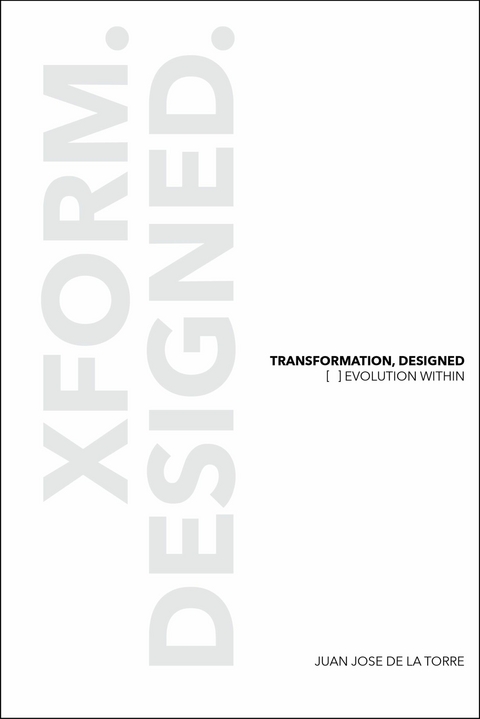
Transformation, Designed (eBook)
182 Seiten
Ballast Books (Verlag)
978-1-966786-69-6 (ISBN)
A world leader in digital businesses, disruption, and digital transformation, Juan Jose (J.J.) de la Torre is an expert in the areas of strategy, innovation, and all things digital. He has been recognized as one of the world's top eighteen digital transformation leaders and a top five digital marketing influencer. J.J. holds an MBA from INSEAD, a master's degree from La Salle, and an industrial engineering degree from Adolfo Ibanez. J.J. is a senior executive with decades of experience across the globe. Following his return to his home country, Chile, after twenty years of a successful international career, J.J. joined Virtus Partners as a senior partner. At Virtus, J.J. led the organization's digital endeavors, which turned into Raven, a unique consulting boutique solely focused on business disruption and acceleration. As Raven's CEO, J.J. pools strategy, design, technology, and analytics to help clients across industries embrace digital enablers and technologies. He has founded and successfully traded three start-ups and is also an angel investor for fourteen start-ups, a mentor for more than 150 companies, and the founder of the first information and communications technology incubator in Saudi Arabia as well as the first 360 accelerator in the Middle East. He has even advised the United Nations and has delivered more than two hundred keynotes on entrepreneurship, gaining recognition from Forbes, the Bill & Melinda Gates Foundation, and more. A father of three and a loving husband to his wife, Maria, J.J. is a former professional DJ and now music composer, a PADI diving instructor, and a mountain bike and golf aficionado. In his free time, he enjoys traveling and adventure sports.
In today's fast-paced business world, remaining relevant and competitive is critical for any enterprise. But with every company jostling to create the next best product or service, that's much easier said than done. So, how can you disrupt the traditional way of doing things and create unique value propositions that launch you far beyond what big corporations can do? One word: design. In his debut book, Transformation, Designed, J.J. de la Torre insightfully explores the role of design in business transformation, particularly in the digital age. Pulling from J.J.'s expertise and experiences as a thought leader at the forefront of innovation, strategy, and design, this incredible resource details how to leverage design to change companies and disrupt entire industries from within. Through case studies and insights from digital disruptors and trailblazing corporations, Transformation, Designed provides a toolkit for organizations looking to jumpstart their own evolution processes. In its pages, it highlights the role design has played throughout history, relates the explosion of opportunities provided by the advent of digital technology, and describes how the future will require continuous reinvention. Ultimately, readers should recognize that embracing design is key for companies seeking to create experiences that reshape their value propositions and forge lasting partnerships with loyal customers and even other disruptors. Transformation, Designed is an essential guide for not only leaders but individuals interested in the intersection of design and business. Offering a clear path to accelerating your organization for long-term success, this book is a must-read for anyone eager to execute digital transformation powered by design.
DESIGN MATTERS—HISTORY AND EVOLUTION
“Design must reflect the practical and aesthetic in business, but above all, good design must primarily serve people.”
—Thomas J. Watson
Every day, we interact with objects, products, services, and people. These interactions not only allow us to live our daily lives but also to connect with people, places, and goods.
These interactions are always the result of someone trying to generate an action, or an intention, and they are designed! Even the simplest thing, like holding a cup of tea, is the result of design. The cup holder is there to generate interaction—in this case, helping you avoid getting your hands burnt when the tea is hot. This was designed to generate that effect.
Definition of Design
From Wikipedia:
A design is a plan or specification for the construction of an object or system or for the implementation of an activity or process, or the result of that plan or specification in the form of a prototype, product or process. The verb to design expresses the process of developing a design. In some cases, the direct construction of an object without an explicit prior plan (such as in craftwork, some engineering, coding and graphic design) may also be considered to be a design activity. The design usually has to satisfy certain goals and constraints, may take into account aesthetic, functional, economic or socio-political considerations and is expected to interact with a certain environment. Major examples of designs include architectural blueprints, engineering drawings, business processes, circuit diagrams and sewing patterns.4
My definition:
Design is the relationship that governs the interaction between entities.
For years, executives and corporations have associated design with the cosmetic and aesthetic element of “how things look.” Design has been regarded as an art—sometimes too crazy and abstract to be understood. Corporations then have opted to see design as a way to “enrich” their value propositions, to make them more saleable and more attractive.
However, design is much more than how things look. It is not just a cosmetic element that comes at the end of the creation process. It is not just “art.” Design is a driving element of behavior, which can be used to shape business visions into experiences that can really transform organizations and industries.
Anyone can create a beautiful design. But the important thing is that we create a design that drives behavior—that helps you, as an organization, achieve the goals and objectives that you have for your business. Design must fulfill a need and must be compelling in the way that it can be consumed. We also need to think about the usage and the end user of that design. On the one hand, we can be extremely focused on the brand; on the other hand, we can concentrate on the customer.
Think how the design of a ketchup bottle has changed. Instead of having to flip the bottle upside down, tap it on the bottom, and hope some ketchup emerges, now you simply squeeze the bottle, and out comes the ketchup. This is an example of design focused on the end user rather than the brand. We can say that design is a creative activity that must deliver objects that are useful and aesthetic.
Now that we’ve established that, let’s go back in time together to examine the history of design. As we continue through this chapter, we will consider the evolving impact of design from the Industrial Revolution through to the start-ups revolution. By comprehensively understanding design, we can unlock a crucial tool to create new value propositions and discover why it is critical to the success of your business.
Design and the Industrial Revolution
Prior to the Industrial Revolution, manual laborers learned their trade by going through an apprenticeship under a master craftsman, often taking years to progress from novice to master. Most production depended on water, wind, or human energy, and the businesses that existed were known as cottage industries. This term reflected the fact that most goods were produced in limited quantities by workers in their own homes.
By the mid-1700s, new methods of production were being developed, leading to the factory system. These new factories became centralized in industrial towns and cities. By the late eighteenth and early nineteenth centuries, automation by machines was introduced, driven by the improvement in the steam engine and its integration into manufacturing. Steam had the ability to power large machines capable of producing goods in large quantities at low prices.
The manufacture of textiles is an example of this shift from a cottage industry to factory-based production. Before steam, the manufacture of textiles was performed on a limited scale by workers in their own homes or workshops. Spinning and weaving were still done in households for domestic consumption, and any surplus was sold to clothiers passing through the village or town and sold on.
The mechanization of the textile industry through the introduction of new steam-driven machines replaced the craftsmen, resulting in faster and cheaper production but often sacrificing the quality of the product. In fact, The Great Exhibition of the Works of Industry of All Nations in London in 1851 drew criticism for the shoddy and poorly designed products created by these industrialized methods.
This revolution in industry meant that machines were now crafting the goods while the worker’s role had become much less specialized. It was more concerned with feeding machines the raw materials they needed to deliver the final product than producing the product themselves. At this time, we can say that design:
- Provided solutions to manufacturing problems.
- Focused on the mass production of goods.
- Used automated factories.
We can also say that this was often to the detriment of the product.
There was no thought given to using design to provide solutions for people’s lives. Industrial products were no longer being crafted but designed using a template and then mass produced. The designer was no longer a craftsman but someone who created the templates and planned the production process while the machine and factory workers implemented the design. In essence, products were planned by designers and engineers and then manufactured by machines and unskilled workers. This separation became referred to as industrial design.
The arts and crafts movement of the early 1900s, while opposing the tradeoff between fast, efficient production and quality craftsmanship, did recognize that industrially manufactured goods also had the potential to create durable and aesthetic products for the general population.
This became particularly evident in the second stage of the industrial revolution when steam was replaced with electricity and a new type of product entered people’s households: the electric appliance. This provided a unique challenge for designers and required a different approach: product design.
The first iterations of these electric-powered products presented new technology in old, familiar designs. A new electric kettle looked very similar to the old, familiar stove kettle. This made it easier for the user to understand, accept, and buy into the product. “It’s like your old one but better” was the main design message.
Probably the best (and most recognizable) example of large-scale manufacturing epitomized by the Industrial Revolution that still continues today is that of car manufacturing. Henry Ford combined car building with assembly line manufacturing and changed the automobile industry forever. The establishment of the Ford Motor Company in June 1903 was the beginning of a technological revolution in both automotive design and manufacturing techniques.
At the start, Ford built cars the same way as everybody else—one at a time. The vehicle was assembled from the chassis up in one spot on the factory floor with workers sourcing parts from stores in other parts of the factory before returning to fit them. To speed up the process, the component parts were assembled on benches, and the chassis was moved from one team of workers to the next for fitting. However, this was still time consuming, requiring skilled teams of mechanics. Essentially, the car was being hand built.
For Ford to achieve his goal of mass consumption through mass production, the next step was automation. Ford and his engineers invented machines to make large quantities of the parts needed for the vehicle and devised methods of assembling parts as fast as they were made. Workers were placed at appointed stations, and the chassis was hauled along between them, stopping at each station for parts to be fitted before being passed on to the next station and so on until the car was complete.
The creation of a moving assembly line system vastly improved production efficiency. Instead of the factory workers moving around to the parts, they stayed in one place, and the vehicle was brought to them via the assembly line. The company had multiple rails set up inside the factory, and the cars, starting with the chassis and axle, were moved along the track to the next set of workers trained in their particular part of the operation. Once that station had completed their tasks, the car would move on, and the workers would wait for the next vehicle to come along.
In this way, the Ford Motor Company was able to produce more cars more quickly, and the price became more affordable. Owning a car...
| Erscheint lt. Verlag | 30.9.2025 |
|---|---|
| Sprache | englisch |
| Themenwelt | Technik |
| ISBN-10 | 1-966786-69-7 / 1966786697 |
| ISBN-13 | 978-1-966786-69-6 / 9781966786696 |
| Informationen gemäß Produktsicherheitsverordnung (GPSR) | |
| Haben Sie eine Frage zum Produkt? |
 EPUB (Ohne DRM)
Größe: 5,8 MB
Digital Rights Management: ohne DRM
Dieses eBook enthält kein DRM oder Kopierschutz. Eine Weitergabe an Dritte ist jedoch rechtlich nicht zulässig, weil Sie beim Kauf nur die Rechte an der persönlichen Nutzung erwerben.
Dateiformat: EPUB (Electronic Publication)
EPUB ist ein offener Standard für eBooks und eignet sich besonders zur Darstellung von Belletristik und Sachbüchern. Der Fließtext wird dynamisch an die Display- und Schriftgröße angepasst. Auch für mobile Lesegeräte ist EPUB daher gut geeignet.
Systemvoraussetzungen:
PC/Mac: Mit einem PC oder Mac können Sie dieses eBook lesen. Sie benötigen dafür die kostenlose Software Adobe Digital Editions.
eReader: Dieses eBook kann mit (fast) allen eBook-Readern gelesen werden. Mit dem amazon-Kindle ist es aber nicht kompatibel.
Smartphone/Tablet: Egal ob Apple oder Android, dieses eBook können Sie lesen. Sie benötigen dafür eine kostenlose App.
Geräteliste und zusätzliche Hinweise
Buying eBooks from abroad
For tax law reasons we can sell eBooks just within Germany and Switzerland. Regrettably we cannot fulfill eBook-orders from other countries.
aus dem Bereich