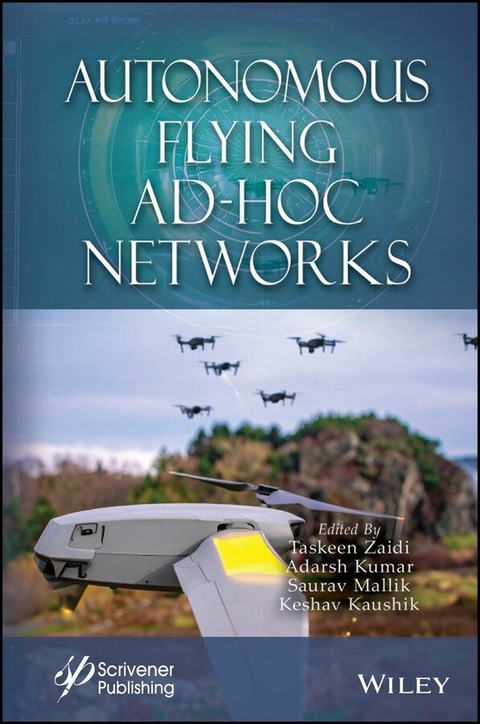
Autonomous Flying Ad-Hoc Networks (eBook)
276 Seiten
Wiley-Scrivener (Verlag)
978-1-394-23107-2 (ISBN)
Learn to leverage the power of Autonomous Flying Ad-Hoc Networks (FANETs) for everything from urban surveillance to disaster relief, and stay ahead in the rapidly evolving world of drone technology and AI.
Flying ad-hoc networks (FANETS) are emerging as an innovative technology in the Unmanned Aerial Vehicles (UAV) space, which has proven its usefulness in urban surveillance, disaster management, and rescue operations. In FANETs, a swarm of UAVs are locally connected together through a base station and the nearby environment to gather the information. FANETs are able to cover larger distances than its predecessors, MANETs (Mobile Ad-hoc Networks) and VANETs (Vehicle Ad-Hoc Networks), making them an ideal solution for gathering vital data. As artificial intelligence is implemented across a number of industries, this technology has the capability to train large datasets. Researchers are exploring ways to improve AI algorithms and quantum computing using this technology. Autonomous Flying Ad-Hoc Networks offers comprehensive coverage of the fundamentals of FANET technology by comparing the differences between FANETs, MANETs, and VANETs, including their characteristics, features, and design models, and discussing the applications and challenges of FANET adoption.
Taskeen Zaidi, PhD works in the School of Computer Science and Information Technology at Jain University with over 12 years of research and teaching experience. She has published over 40 research papers in international journals, conferences, and workshops. Her areas of interest include cloud computing, ad-hoc networks, distributed computing, and mobile application development.
Adarsh Kumar, PhD is an associate professor in the School of Computer Science at the University of Petroleum and Energy Studies. He has published over 120 research papers in reputed journals, conferences, and workshops. His primary research interests include cybersecurity, cryptography, network security, and ad-hoc networks.
Saurav Mallik, PhD is a research scientist in the Department of Pharmacology and Toxicology at the University of Arizona. He has edited one book and coauthored over 82 research papers in peer-reviewed international journals, conferences, and book chapters. His research areas include data mining, computational biology, bioinformatics, biostatistics, and machine learning.
Keshav Kaushik, PhD is an assistant professor in the Systemic Cluster under the School of Computer Science at the University of Petroleum and Energy Studies with over eight years of teaching experience. He has edited over ten books and published over 65 research papers in international journals and conferences. His research focuses on cybersecurity, digital forensics, and the Internet of Things.
Learn to leverage the power of Autonomous Flying Ad-Hoc Networks (FANETs) for everything from urban surveillance to disaster relief, and stay ahead in the rapidly evolving world of drone technology and AI. Flying ad-hoc networks (FANETS) are emerging as an innovative technology in the Unmanned Aerial Vehicles (UAV) space, which has proven its usefulness in urban surveillance, disaster management, and rescue operations. In FANETs, a swarm of UAVs are locally connected together through a base station and the nearby environment to gather the information. FANETs are able to cover larger distances than its predecessors, MANETs (Mobile Ad-hoc Networks) and VANETs (Vehicle Ad-Hoc Networks), making them an ideal solution for gathering vital data. As artificial intelligence is implemented across a number of industries, this technology has the capability to train large datasets. Researchers are exploring ways to improve AI algorithms and quantum computing using this technology. Autonomous Flying Ad-Hoc Networks offers comprehensive coverage of the fundamentals of FANET technology by comparing the differences between FANETs, MANETs, and VANETs, including their characteristics, features, and design models, and discussing the applications and challenges of FANET adoption.
| Erscheint lt. Verlag | 25.9.2025 |
|---|---|
| Sprache | englisch |
| Themenwelt | Technik ► Maschinenbau |
| Schlagworte | ad hoc networks • FANET • Joint Optimization • malicious nodes • Manet • mobility models • Multi-Criteria QoS • Multi-UAVs • network topology • Neural networks • ns-3 • Reconnaissance • routing protocol • Sybil attack • Unmanned Aerial Vehicles |
| ISBN-10 | 1-394-23107-5 / 1394231075 |
| ISBN-13 | 978-1-394-23107-2 / 9781394231072 |
| Informationen gemäß Produktsicherheitsverordnung (GPSR) | |
| Haben Sie eine Frage zum Produkt? |
 PDF (Adobe DRM)
Kopierschutz: Adobe-DRM
Adobe-DRM ist ein Kopierschutz, der das eBook vor Mißbrauch schützen soll. Dabei wird das eBook bereits beim Download auf Ihre persönliche Adobe-ID autorisiert. Lesen können Sie das eBook dann nur auf den Geräten, welche ebenfalls auf Ihre Adobe-ID registriert sind.
Details zum Adobe-DRM
Dateiformat: PDF (Portable Document Format)
Mit einem festen Seitenlayout eignet sich die PDF besonders für Fachbücher mit Spalten, Tabellen und Abbildungen. Eine PDF kann auf fast allen Geräten angezeigt werden, ist aber für kleine Displays (Smartphone, eReader) nur eingeschränkt geeignet.
Systemvoraussetzungen:
PC/Mac: Mit einem PC oder Mac können Sie dieses eBook lesen. Sie benötigen eine
eReader: Dieses eBook kann mit (fast) allen eBook-Readern gelesen werden. Mit dem amazon-Kindle ist es aber nicht kompatibel.
Smartphone/Tablet: Egal ob Apple oder Android, dieses eBook können Sie lesen. Sie benötigen eine
Geräteliste und zusätzliche Hinweise
Buying eBooks from abroad
For tax law reasons we can sell eBooks just within Germany and Switzerland. Regrettably we cannot fulfill eBook-orders from other countries.
aus dem Bereich