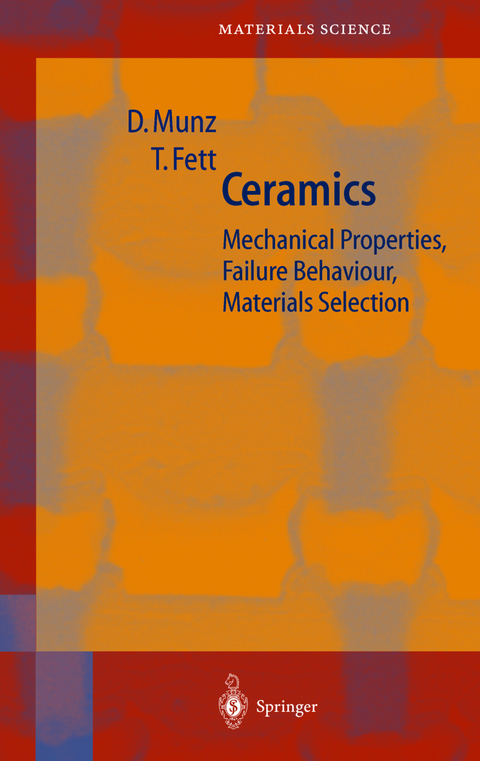
Ceramics
Springer Berlin (Verlag)
978-3-540-65376-9 (ISBN)
1 Overview and Basic Properties.- 1.1 General Behaviour.- 1.2 Overview of Ceramic Materials.- 1.3 Fields of Application.- 2 Physical Properties.- 2.1 Thermal Expansion Coefficient.- 2.2 Thermal Conductivity.- 2.3 Electrical Conductivity.- 2.4 Specific Heat.- 2.5 Density.- 2.6 Elastic Constants.- 3 Fracture Mechanics.- 3.1 Fundamentals.- 3.2 Experimental Methods for the Determination of the Mode-I Fracture Toughness KIc.- 3.3 Experimental Methods for the Determination of Mode-II and Mixed-Mode Fracture Toughness.- 3.4 Mixed-Mode Criteria and Experimental Results.- 4 R-Curve Behaviour.- 4.1 Experimental Observation.- 4.2 Determination of R-Curves.- 4.3 Reasons for R-Curve Behaviour.- 4.4 Influence of R-Curves on Strength.- 4.5 Computation of R-Curves.- 4.6 Determination of Bridging Stresses from Crack Profiles.- 5 Subcritical Crack Growth.- 5.1 Basic Relations.- 5.2 Computation of Lifetimes.- 5.3 Methods of Determining Subcritical Crack Growth.- 5.4 Influence of R-Curve Behaviour on Subcritical Crack Growth.- 5.5 Some Theoretical Considerations on Subcritical Crack Growth.- 6 Cyclic Fatigue.- 6.1 Representation of Cyclic Fatigue Results.- 6.2 Proof of a Cyclic Effect.- 6.3 Methods for the Determination of da/dN-?K Curves.- 6.4 Effect of R-Ratio.- 6.5 Theoretical Considerations.- 6.6 Differences Between Micro- and Macrocracks.- 7 Determination of Strength.- 7.1 Measurement of Tensile Strength.- 7.2 Measurement of Compressive Strength.- 8 Scatter of Mechanical Properties.- 8.1 Principal Behaviour.- 8.2 Determination of Weibull Parameters.- 8.3 The Size Effect.- 8.4 Scatter of Lifetimes.- 8.5 Some Specific Problems.- 9 Proof Test Procedure.- 9.1 Proof Test Without Subcritical Crack Growth.- 9.2 Proof Test Including Subcritical Crack Growth.- 9.3 Problems in Proof Tests.- 10Multiaxial Failure Criteria.- 10.1 Representation in Multiaxiality Diagrams.- 10.2 Global Multiaxiality Criteria.- 10.3 Defect Models.- 10.4 Experimental Methods.- 10.5 Experimental Results.- 11 Thermal Shock Behaviour.- 11.1 Thermal Stresses.- 11.2 Measurement of Thermal Shock Sensitivity.- 11.3 Fracture Mechanical Treatment of Thermal Shock.- 11.4 Thermal Shock Parameters.- 11.5 Size Effect in Thermal Shock.- 11.6 Thermal Fatigue.- 12 High-Temperature Behaviour.- 12.1 Creep Deformation.- 12.2 Failure in the Creep Range.- 12.3 Creep Crack Growth.- 13 Plasticity.- 13.1 Plasticity During Contact Loading.- 13.2 Plasticity During Surface Grinding.- 13.3 Plasticity by Phase Transformation in Zirconia.- 13.4 Plasticity by Domain Switching in Piezoelectric Ceramics.- 13.5 Measurement of Plastic Deformations in Bending Tests.- 13.6 Time-Dependent Plasticity Effects.- A.1 Rectangular Bar.- A.2 Comact-Tension (CT) Specimen.- A.3 Round Compact Tension (RCT) Specimen.- A.4 Double-Cantilever-Beam Specimen (DCB).- A.5 Weight Function for Chevron-Notched Bending Bars.- A.6 Specimens for Mixed-Mode Tests.
| Erscheint lt. Verlag | 11.3.1999 |
|---|---|
| Reihe/Serie | Springer Series in Materials Science |
| Zusatzinfo | X, 299 p. |
| Verlagsort | Berlin |
| Sprache | englisch |
| Maße | 155 x 235 mm |
| Gewicht | 570 g |
| Themenwelt | Technik ► Maschinenbau |
| Schlagworte | Ceramics • Deformation • fatigue • Fracture • fracture mechanics • Keramikwerkstoffe • Mechanics • plastic deformation • Plasticity • Stress |
| ISBN-10 | 3-540-65376-7 / 3540653767 |
| ISBN-13 | 978-3-540-65376-9 / 9783540653769 |
| Zustand | Neuware |
| Informationen gemäß Produktsicherheitsverordnung (GPSR) | |
| Haben Sie eine Frage zum Produkt? |
aus dem Bereich