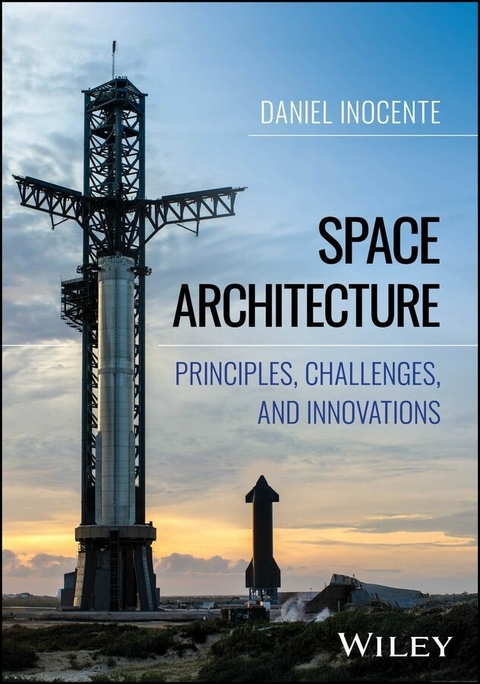
Space Architecture (eBook)
989 Seiten
Wiley (Verlag)
978-1-394-31811-7 (ISBN)
An exciting and authoritative discussion of the latest advances in the technology required for space travel and space exploration
In Space Architecture: Principles, Challenges, and Innovations, experienced architect and designer Daniel Inocente delivers a comprehensive exploration of the design and development of habitats and infrastructure required to support human life in space. The book offers readers a thorough description of the principles, challenges, and solutions currently animating discussions in this emerging field.
Beginning with an introduction that establishes the central importance of space architecture, Inocente explains the interdisciplinary nature of the field and demonstrates how integrated knowledge from engineering, architecture, environmental science, and psychology are coming together to build a spacefaring future for humanity.
Readers will also find:
- A thorough introduction to space habitat design, including discussions of pre-integrated, prefabricated, and in-situ derived habitats
- Comprehensive explorations of the environmental challenges posed by space and space travel, including microgravity, extreme temperatures, vacuum, and ionizing radiation
- Practical discussions of space destinations, like low-earth orbit, deep space, moons, and planets
- Complete treatments of mobility architecture, including surface mobility systems and lunar terrain vehicles
Perfect for both architecture and aerospace professionals, Space Architecture: Principles, Challenges, and Innovations will also benefit researchers with an interest in space architecture, students of architecture, aerospace engineering, or space studies, and laypeople enthusiastic about space travel and space exploration.
Daniel Inocente is a licensed architect and founder of Daniel Inocente Architecture (DIA), based in New York. He also serves as Professor of Practice in Architecture and Space Architecture at Arizona State University, where he leads design studios and technical seminars. Daniel brings a multidisciplinary approach to architecture, combining design innovation with technical expertise across a wide range of building types and scales.
Daniel's work reflects a modern, forward-thinking approach shaped by global experience across multiple sectors, including high-rise, cultural, residential, and transportation projects. Prior to founding DIA, he held senior roles on major international commissions, contributing to large-scale developments in North America, Europe, the Middle East, and Asia.
His professional career includes building partnerships with ESA, MIT, and universities, as well as working for NASA and as a Senior Space Architect at Blue Origin, where he brought architectural thinking to the design of next-generation habitats, mobility systems, and off-world infrastructure. Across all endeavors, Daniel approaches architecture as a synthesis of engineering, design, and human experience, seeking to create environments that are at once visionary and deeply responsive to context.
An exciting and authoritative discussion of the latest advances in the technology required for space travel and space exploration In Space Architecture: Principles, Challenges, and Innovations, experienced architect and designer Daniel Inocente delivers a comprehensive exploration of the design and development of habitats and infrastructure required to support human life in space. The book offers readers a thorough description of the principles, challenges, and solutions currently animating discussions in this emerging field. Beginning with an introduction that establishes the central importance of space architecture, Inocente explains the interdisciplinary nature of the field and demonstrates how integrated knowledge from engineering, architecture, environmental science, and psychology are coming together to build a spacefaring future for humanity. Readers will also find: A thorough introduction to space habitat design, including discussions of pre-integrated, prefabricated, and in-situ derived habitats Comprehensive explorations of the environmental challenges posed by space and space travel, including microgravity, extreme temperatures, vacuum, and ionizing radiation Practical discussions of space destinations, like low-earth orbit, deep space, moons, and planets Complete treatments of mobility architecture, including surface mobility systems and lunar terrain vehicles Perfect for both architecture and aerospace professionals, Space Architecture: Principles, Challenges, and Innovations will also benefit researchers with an interest in space architecture, students of architecture, aerospace engineering, or space studies, and laypeople enthusiastic about space travel and space exploration.
Space Architecture
Architecture, one of the oldest and most influential human disciplines, stands as a testament to our society’s ingenuity and adaptability.. From the grandeur of the pyramids in ancient Egypt to the soaring skyscrapers of modern cities, architecture has not only shaped our physical environment but also influenced the way we live, work, and interact. It is a field that merges art, engineering, and science, requiring a deep understanding of human needs, culture, aesthetics, functionality, and technological advancements. Now, as humanity sets its sights beyond Earth, the discipline of architecture is evolving to encompass an unprecedented frontier: Space Architecture.
Space architecture is a dynamic field situated at the intersection of design, engineering, and science. It focuses on creating habitable environments beyond Earth, playing a critical role in humanity's extraterrestrial endeavors. This discipline encompasses the design and construction of habitats on other planets, in orbit, and on the Moon, as well as the necessary infrastructure and vehicles to transport humans and cargo. It is not just about building structures in space but also about ensuring the safety, comfort, and psychological well‐being of those who will inhabit these new environments.
The significance of space architecture has grown exponentially as space agencies and private enterprises ramp up efforts to explore, utilize space resources, and establish permanent human settlements on the Moon and Mars. The need for sustainable space habitats is crucial as humanity looks to extend its presence beyond Earth. Space architecture addresses the unique challenges posed by the harsh conditions of outer space, including extreme temperatures, radiation, microgravity, and isolation. This requires a holistic approach that integrates advanced technologies and materials while prioritizing human needs.
NASA defines "Architecture" in the context of space exploration as a comprehensive plan detailing the systems, standards, and collaborations necessary for sustainable, human‐led missions to the Moon and Mars. This encompasses not only the technology and infrastructure but also the human resources, training, and logistical support required to achieve long‐term exploration goals.
At the core of space architecture are propulsion systems that transport humans and cargo across vast distances, life support systems that ensure a continuous supply of breathable air and clean water, and habitat modules that protect inhabitants from the vacuum of space and cosmic radiation. Equally critical are communication networks that maintain contact with Earth, robotic systems that assist in construction and maintenance, and sustainable power solutions such as advanced solar arrays and compact nuclear reactors. Together, these elements form an ecosystem that not only sustains life but also expands our ability to explore new frontiers.
Human factors are central to space architecture. The design of habitats must prioritize the health, safety, and comfort of astronauts, who face physical and psychological challenges during extended missions. Training programs prepare astronauts not only for the technical challenges of space but also for the psychological effects of isolation and confinement. These programs foster resilience, adaptability, and teamwork—essential qualities for thriving in the extreme conditions of space.
Logistics and supply chains play a vital role in supporting space missions, ensuring the continuous flow of materials, equipment, and provisions. The development of reusable launch systems and in situ resource utilization (ISRU) technologies are paving the way for more efficient and sustainable missions. ISRU, for example, involves extracting and using resources available on the Moon or Mars, such as water ice for drinking water, oxygen, and rocket fuel.
The success of space architecture depends on collaboration between international space agencies, private companies, academic institutions, and research organizations. By pooling knowledge, resources, and expertise, these partnerships foster innovation and accelerate the development of new technologies needed for lunar and Martian colonization. The International Space Station (ISS) (Figure 1) is a prime example of international cooperation, serving as a hub for advancing space habitat technologies and demonstrating the potential of modular construction and recycling systems.
As humanity progresses toward becoming a multi‐planetary species, the demand for sustainable and livable space structures grows. Space architects are tasked with designing environments that can sustain life in the harsh conditions of space, employing innovative methods to ensure the safety, comfort, and well‐being of astronauts. These efforts will ultimately facilitate extended missions and the establishment of permanent bases on the Moon and Mars.
The field of space architecture propels innovation by challenging the limits of what is technically and materially feasible. The ISS, with its modular construction and advanced recycling systems, exemplifies the complexity and interdisciplinary collaboration required in space architecture. Lessons learned from the ISS have led to advancements in energy efficiency, waste recycling, and life support systems that have applications on Earth.
Figure 1 International Space Station, NASA.
Space architecture is not just about creating functional structures but also focuses on the psychological and social well‐being of astronauts. Habitats are designed with comfort features such as sleeping quarters, exercise facilities, and windows for Earth observation to boost morale and reduce the psychological impact of isolation. The discipline blends architecture, engineering, medicine, psychology, and other fields, pushing the boundaries of design and technology.
As humanity extends its reach deeper into space, the role of space architecture will continue to grow. This field not only enhances our capacity to explore but also enriches our understanding of how to build sustainable environments in the most extreme conditions. Space architecture is more than just a technical challenge; it is a vital endeavor that could shape the future of human civilization beyond Earth.
IMPORTANCE OF SPACE ARCHITECTURE
Space Architecture is essential for advancing human presence beyond Earth and has significant implications for life on our planet. This discipline goes beyond designing functional structures in space—it fosters innovation, inspires global collaboration, and contributes to solving challenges both in space and on Earth. Below are key drivers highlighting the importance of space architecture:
Advancing Space Exploration:
Space architecture is foundational to humanity's efforts to explore and inhabit the cosmos. It enables long‐duration missions, supports visions of permanent settlements on other planets, and provides the infrastructure needed for scientific research, resource extraction, and interplanetary travel. By addressing challenges such as radiation protection, microgravity adaptation, and life support systems, space architecture directly contributes to making these ambitions achievable.
Innovation and Technology Transfer:
Technological advancements and material innovations developed through space architecture often find applications on Earth. For instance, recycling technologies used in life support systems aboard the International Space Station (ISS) have informed water purification methods for remote and arid regions on Earth. Similarly, sustainable building materials and energy‐efficient systems designed for space inspire green architecture and renewable energy solutions. These innovations help address pressing global challenges, from water scarcity to climate change.
Interdisciplinary Collaboration:
Space architecture exemplifies interdisciplinary collaboration, uniting architects, engineers, scientists, psychologists, and other experts to solve complex problems. This synergy fosters innovation, allowing insights from different fields to converge into groundbreaking solutions. The collaborative model of space architecture serves as a blueprint for tackling global challenges, such as sustainable urban development and climate adaptation, through integrated approaches.
Education and Inspiration:
The challenge of designing habitable environments in the extreme conditions of space captures the imagination of people worldwide. Space architecture inspires the next generation of architects, engineers, and scientists, motivating them to pursue careers in STEM (Science, Technology, Engineering, and Mathematics). It fosters creative thinking and problem‐solving, encouraging students to push boundaries and envision new possibilities for humanity's future.
Global Cooperation:
Space architecture relies on international partnerships, as exemplified by the International Space Station, where agencies from multiple nations collaborate to achieve shared goals. These partnerships demonstrate the potential for global unity and cooperation in addressing challenges beyond Earth. The collaborative efforts required for space exploration set a precedent for tackling complex issues like climate change and global health crises through shared knowledge, resources, and ambitions.
Human Resilience and Adaptability:
Space architecture challenges us to adapt to environments vastly different from Earth. Designing for extreme conditions—such as microgravity, radiation, and resource scarcity—requires...
| Erscheint lt. Verlag | 22.9.2025 |
|---|---|
| Sprache | englisch |
| Themenwelt | Technik ► Maschinenbau |
| Schlagworte | space architecture book • space architecture solutions • space exploration • space exploration technology • Space Habitat Design • space habitation • Space Habitats • Space transportation • Space travel challenges • Space travel technology |
| ISBN-10 | 1-394-31811-1 / 1394318111 |
| ISBN-13 | 978-1-394-31811-7 / 9781394318117 |
| Informationen gemäß Produktsicherheitsverordnung (GPSR) | |
| Haben Sie eine Frage zum Produkt? |
 EPUB (Adobe DRM)
Kopierschutz: Adobe-DRM
Adobe-DRM ist ein Kopierschutz, der das eBook vor Mißbrauch schützen soll. Dabei wird das eBook bereits beim Download auf Ihre persönliche Adobe-ID autorisiert. Lesen können Sie das eBook dann nur auf den Geräten, welche ebenfalls auf Ihre Adobe-ID registriert sind.
Details zum Adobe-DRM
Dateiformat: EPUB (Electronic Publication)
EPUB ist ein offener Standard für eBooks und eignet sich besonders zur Darstellung von Belletristik und Sachbüchern. Der Fließtext wird dynamisch an die Display- und Schriftgröße angepasst. Auch für mobile Lesegeräte ist EPUB daher gut geeignet.
Systemvoraussetzungen:
PC/Mac: Mit einem PC oder Mac können Sie dieses eBook lesen. Sie benötigen eine
eReader: Dieses eBook kann mit (fast) allen eBook-Readern gelesen werden. Mit dem amazon-Kindle ist es aber nicht kompatibel.
Smartphone/Tablet: Egal ob Apple oder Android, dieses eBook können Sie lesen. Sie benötigen eine
Geräteliste und zusätzliche Hinweise
Buying eBooks from abroad
For tax law reasons we can sell eBooks just within Germany and Switzerland. Regrettably we cannot fulfill eBook-orders from other countries.
aus dem Bereich