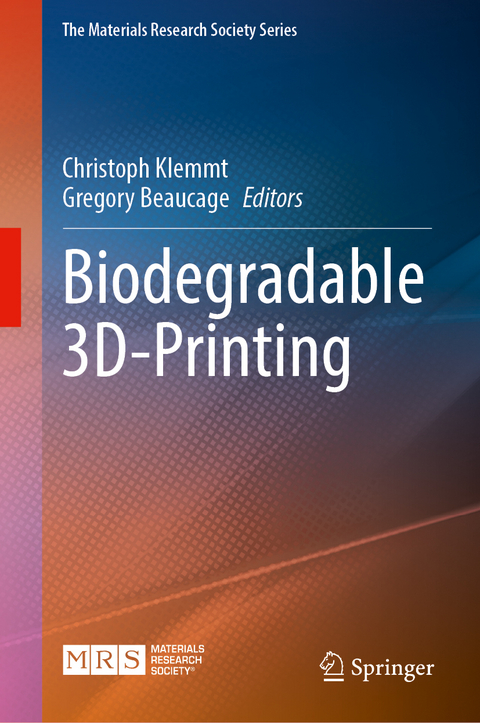
Biodegradable 3D-Printing
Springer Verlag, Singapore
978-981-95-4024-2 (ISBN)
- Titel nicht im Sortiment
- Artikel merken
This book is a compilation of original research chapters authored by leading scholars in the field, framed by an introduction and conclusion provided by the editors. The introduction primarily comprises two chapters: one compiles lifecycle information of prevalent 3D printing methods and materials, while the other reviews existing research in biodegradable 3D printing. The invited chapters are divided into two sections: the first section addresses methodologies and the technical means for achieving 3D printing with biodegradable materials, featuring research on various fibers, binders, and technologies, with a focus on materials science and chemical engineering. The second section emphasizes applications across different fields and explores the potential offered by biodegradable materials, including applications in medical implants, product design, molds for casting, and architectural-scale applications.
This book offers an overview of various methods, materials, and applications, making it suitable for readers from academia in materials science, chemical engineering, and biomedical engineering, as well as industry professionals in product design, architecture, and the fine arts that are interested in exploring techniques or alternatives applicable to their practice. It is also relevant for the hacker and maker communities that wish to improve the sustainability of their methods. Additionally, the book's appendix provides step-by-step instructions for novices, such as students or members of the maker community, to quickly initiate their own projects and research efforts.
Dr. Christoph Klemmt is Associate Professor at the Department of Design, Art, Architecture and Planning at the University of Cincinnati. He set up and runs the Architectural Robotics Lab that investigates novel and sustainable technologies in architectural computation and fabrication. Christoph Klemmt graduated from the Architectural Association in London and received his doctoral degree from the University of Applied Arts Vienna. He has worked among others for Zaha Hadid Architects, where his responsibilities focused on the company’s projects Soho Galaxy, Wangjing Soho and Leeza Soho in China. Christoph Klemmt co-founded Orproject, an architect’s office specializing in advanced geometries with an ecologic agenda. Orproject has exhibited at the Palais De Tokyo in Paris, the China National Museum in Beijing and the Biennale in Venice. The work of Orproject has been featured world-wide in magazines and books, and the practice has won several international awards. Dr. Gregory Beaucage is Professor of Chemical and Materials Engineering at the University of Cincinnati. He has published extensively in polymers and materials science with 189 publications and 6,900 citations. He has collaborated with Christoph Klemmt on the development of new materials for 3D printing of wood for the past four years. Beaucage holds a Ph.D. from the University of Massachusetts at Amherst in Polymer Science and Engineering and was a post doc at Sandia National Laboratories before joining the faculty at the University of Cincinnati. He was a Fulbright Global Scholar at Sheffield University in the UK and at several Universities in Ethiopia, South Africa, and Lesotho. He has been Visiting Professor at University of the Witwatersrand, Johannesburg, University of Sheffield, University of Cape Town, ETHZ in Zürich.
Part 1:Introduction.- 1.1. Intention of the Book.- 1.2. Sustainability in Additive Manufacturing.- 1.3. Review of Biodegradable Methods in Additive Manufacturing.- Part 2: Materials and Methods.- 2.1. FLAM - 3D Printing with Chitin - Cellulose Composites.- 2.2. 3D Bioprinting with Cellulose-derived Bioink and Precursors.- 2.3. Living Composites: Mycelium Biofabrication and the Evolution of De-sign.- 2.4. Three-dimensional Printing of Lignin and Wood.- Part 3: Applications.- 3.1. Three-Dimensional Printing of Biodegradable Materials in the Biomedi-cal Sector.- 3.2. Wet Mold Concrete Casting with Biodegradable Materials.- 3.3. Large-Scale 3D-Printing of Wood for Architectural Applications.- 3.4. 3D Printing with Living Matter.- Conclusion: 4.1. Conclusion.- Appendix.- 5.1. Detailed material compositions and recipes of some of the papers from this book.
| Erscheinungsdatum | 29.11.2025 |
|---|---|
| Reihe/Serie | The Materials Research Society Series |
| Zusatzinfo | 80 Illustrations, color; 9 Illustrations, black and white |
| Verlagsort | Singapore |
| Sprache | englisch |
| Maße | 155 x 235 mm |
| Themenwelt | Technik ► Maschinenbau |
| Technik ► Umwelttechnik / Biotechnologie | |
| Schlagworte | 3D-Printing • Additive Manufacturing • Biodegradable Materials • Cellulose • compostable • plant fiber • sustainability • Wood |
| ISBN-10 | 981-95-4024-0 / 9819540240 |
| ISBN-13 | 978-981-95-4024-2 / 9789819540242 |
| Zustand | Neuware |
| Informationen gemäß Produktsicherheitsverordnung (GPSR) | |
| Haben Sie eine Frage zum Produkt? |
aus dem Bereich