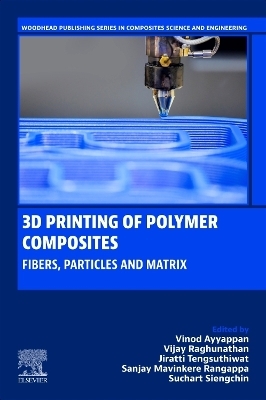
3D Printing of Polymer Composites
Woodhead Publishing (Verlag)
978-0-443-40340-8 (ISBN)
- Noch nicht erschienen (ca. Mai 2026)
- Versandkostenfrei
- Auch auf Rechnung
- Artikel merken
Vinod Ayyappan is a research fellow at Department of Materials and Production Engineering (MPE), The Sirindhorn International Thai – German Graduate School of Engineering (TGGS), King Mongkut's University of Technology North Bangkok. He has published more than 20 articles in various articles in SCI and Scopus indexed Journals including Elsevier, Taylor & Francis, Springer, Sage etc. His current research areas include Additive manufacturing, Advanced material technology, Natural Fiber composites, and Polymer Composites. Dr. Vijay Raghunathan is from the Department of Production Engineering, National Institute of Technology, Tiruchirappalli, Tamil Nadu, India. He did his Post Doctorate in the field of natural fiber and its composites from TGGS, King Mongkut’s University of Technology North Bangkok, Thailand. He received his Bachelor of Engineering in Mechanical Engineering and Master of Engineering in Computer Integrated Manufacturing from Anna University, Chennai, India, in 2012 and 2014, respectively, with university rank. He completed his Doctor of Philosophy in Production Engineering from National Institute of Technology Tiruchirappalli, India, in 2020. His research focused on developing and characterizing automobile brake friction composites in collaboration with academia and industries across the globe. He was awarded the Budding Researcher Award of the Production Engineering Department in 2020 by National Institute of Technology Tiruchirappalli, India. He has published over 75 articles in various SCI and Scopus-indexed journals. He has published seven book chapters, holds 2 Indian patents, and 5 design registrations. He is editing several books for reputed international publishers Dr. Jiratti Tengsuthiwat is an Assistant Professor and Researcher of King Mongkut's University of Technology North Bangkok (KMUTNB), Thailand. He received B.E. (Tool and Die Engineering) from King Mongkut's University of Technology North Bangkok (KMUTNB), Thailand, in the year 2010, M.Sc. (Materials and Production Engineering), from the Sirindhorn International Thai – German Graduate School of Engineering (TGGS), King Mongkut's University of Technology North Bangkok (KMUTNB), Thailand, in the year 2014, Ph.D. (Materials and Production Engineering), from the Sirindhorn International Thai – German Graduate School of Engineering (TGGS), King Mongkut's University of Technology North Bangkok (KMUTNB), Thailand, in the year 2018. His current research areas include Natural fiber composites, Polymer Composites, Biodegradable polymer and Advanced Material Technology Sanjay Mavinkere Rangappa serves as a Principal Research Scientist and Advisor for International Development at King Mongkut's University of Technology North Bangkok, Thailand. He holds a BEng in Mechanical Engineering (2010), an MTech in Computational Analysis (2013), and a PhD in Mechanical Engineering Science (2018) from Visvesvaraya Technological University, India, followed by a Post-Doctorate from KMUTNB (2019). A prolific researcher in materials science and composites, his research focuses on natural fiber composites, polymer composites, and advanced material technology. He has received multiple accolades, including Outstanding Researcher Award 2021 from KMUTNB and recognition in Stanford University's Top 2% Most-Cited Scientists list. He also serves as an Associate Editor for Elsevier’s Heliyon and Frontier Materials, while holding seven patents across UK, Thailand, and India. Prof. Dr.-Ing. habil. Suchart Siengchin serves as the President of King Mongkut's University of Technology North Bangkok (KMUTNB). His academic journey spans German institutions, earning degrees in Mechanical Engineering, Polymer Technology, and Material Science, culminating in a PhD from the University of Kaiserslautern and habilitation from Chemnitz University. A distinguished researcher in polymer processing and composite materials, he serves as the Editor-in-Chief of KMUTNB’s International Journal of Applied Science and Technology. His excellence in research has been recognized with multiple KMUTNB Outstanding Researcher Awards (2010, 2012, 2013) and the National Excellence Researcher Award (2021) from the National Research Council of Thailand. He is ranked among Stanford University's top 2% scientists globally, reflecting his substantial impact in materials science and engineering.
Section 1: Introduction and Advances in 3D Printing of Polymer Composites
1. 3D-Printing: The state of the art- Introduction
2. Advances in additive manufacturing of polymer composites: Material and binder jetting, Sheet lamination, and SLS innovations
3. Advancements in the reinforcement strategies of SLA and DLP printing of polymer composites
4. The role of artificial intelligence, machine learning, and finite element modelling in additive manufacturing of polymer composites
5. Optimization of process parameters for the 3D printing of composites: Materials a key deciding factor
Section 2: Fiber Reinforcement Strategies in 3D Printing
6. Natural and Synthetic Fibers: Pathway to eco-friendly and high-performance 3D printing of lightweight composites
7. The role of synthetic fibers in 3D printing: Continuous and Discontinuous Fibers Effect
8. Effect of surface treatment on fiber wettability and Static-Dynamic, Thermal, and Water absorption characteristics of natural/synthetic fibers-based 3D printed composites
9. Effect of fiber size and reinforcement percentage over the 3D printability of polymer composites
10. Thermoplastics-Matrix for 3D printing: Types, Filament/Component Manufacturing, Characterization
11. Role of thermosets in 3D printing: Latest advancements & Challenges
Section 3: Fillers, Nanomaterials, and Performance in 3D Printing
12. Influence of organic/inorganic fillers on the performance behavior of 3D printing of composites: pros and cons
13. Tribological behavior of filler reinforced 3D printed composites: influence of inorganic/organic and solid lubricants
14. Effect of size, shape, and loading contents of the fillers in polymer composites for additive manufacturing.
15. Nanomaterials on 3D printing: Types, Development, and Characterization
16. Numerical Simulation of Particle reinforced 3D printed composites.
Section 4: Applications and Environmental Impact of 3D Printing
17. Hybrid Metal-Plastic Structures: Next Generation of 3D-Printing- Manufacturing Techniques and Applications
18. Recycled materials in polymer additive manufacturing: A cost-effective approach
19. Role of composites 3D printing in automobile and construction components
20.Influence of particles and fibers with matrix on the 3D printing of composites for medical applications
21. Effect of particles and fibers on the 3D printing of components for Energy storage and electronics applications
22. Impact of fibers, particles, and matrix in the waste reduction of 3D printed composites: Carbon footprint approaches
23. Life Cycle Assessment (LCA) of 3D Printed Composites: A Perspective Review
| Erscheint lt. Verlag | 1.5.2026 |
|---|---|
| Reihe/Serie | Woodhead Publishing Series in Composites Science and Engineering |
| Sprache | englisch |
| Maße | 152 x 229 mm |
| Themenwelt | Technik ► Maschinenbau |
| ISBN-10 | 0-443-40340-6 / 0443403406 |
| ISBN-13 | 978-0-443-40340-8 / 9780443403408 |
| Zustand | Neuware |
| Informationen gemäß Produktsicherheitsverordnung (GPSR) | |
| Haben Sie eine Frage zum Produkt? |
aus dem Bereich